
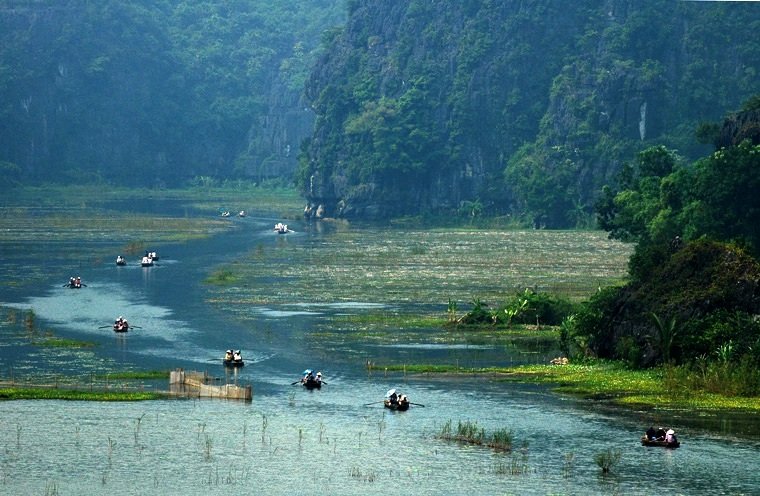
A UNESCO Mixed World Heritage Site where limestone karst towers rise from flooded valley floors in northern Vietnam — a landscape holding 30,000 years of human history, the ruins of Vietnam’s first independent capital, and sacred Buddhist cave shrines navigated by rowing boat.
At a glance
The Trang An Landscape Complex in Ninh Binh Province is one of the most geologically and historically layered sites in Southeast Asia. Towering karst limestone pinnacles — some over 200 metres high — rise abruptly from valley floors permanently flooded by river systems, creating a maze of water corridors that can only be navigated by flat-bottomed rowing boat. The site covers roughly 6,172 hectares and was inscribed by UNESCO in 2014 as a Mixed Heritage Site, recognising both its exceptional natural beauty and its deep cultural and archaeological significance. It is one of very few places in the world to hold a Mixed inscription.
Within the karst landscape lie sacred grottoes, river-level cave shrines, and ancient temples built directly into cliff faces — among them the three-tier Bich Dong Pagoda, constructed in the 15th century CE into the layers of a mountain cliff. The valleys also encompass the site of Hoa Lu, the ancient capital of Vietnam’s first independent state after a thousand years of Chinese domination, founded in 968 CE by Emperor Dinh Bo Linh.
Key facts
- UNESCO status: Mixed World Heritage Site (natural + cultural), inscribed 2014
- Location: Ninh Binh Province, northern Vietnam, approximately 90 km south of Hanoi
- Area: 6,172 hectares (core zone), with a 6,026 ha buffer zone
- Geology: Late Permian to Early Triassic limestone karst, approximately 250 million years old
- Archaeological span: c. 30,000 BCE to 1009 CE (Palaeolithic through medieval Vietnamese capital)
- Capital period: Hoa Lu served as capital of Dai Co Viet (968-1009 CE) and early Ly Dynasty (1009-1010 CE)
- Navigation: Flat-bottomed rowing boats through water corridors between the karst peaks
- Film connection: Kong: Skull Island (2017) was filmed here — the karst towers formed the geological spine of Skull Island
History
Archaeological investigation of the Trang An karst caves has revealed continuous human occupation spanning roughly 30,000 years. Early Palaeolithic and Mesolithic inhabitants used the caves as shelters, leaving behind stone tools and faunal remains that document both the subsistence strategies of prehistoric hunter-gatherers and the dramatic environmental changes — including periods when the valleys were dry, then periodically flooded — that shaped the landscape over millennia.
By the late first millennium CE, the valleys had become politically significant. In 968 CE, the warlord Dinh Bo Linh unified the fragmented Vietnamese feudal states and established Hoa Lu as the capital of Dai Co Viet — the first independent Vietnamese polity after nearly a thousand years of Chinese domination under the Han, Tang, and other dynasties. The karst geography was both a defensive asset and a symbolic anchor: the surrounding limestone peaks made the capital nearly impregnable. The Dinh and early Le dynasties ruled from here until 1009-1010 CE, when the capital was relocated north to Thang Long (present-day Hanoi) by Emperor Ly Thai To.
The sacred character of the caves deepened over subsequent centuries. Buddhist and Taoist monks established shrines and pagodas within the grottoes. The Bich Dong Pagoda complex — built in three ascending tiers into a cliff face in the 15th century CE — remains one of Vietnam’s most celebrated cave temples. Dozens of smaller cave shrines, accessible only by boat, are still active places of worship today.
What you see
The visual experience of Trang An is structured around water and stone. The karst pinnacles — draped in tropical vegetation and pocked with cave mouths — rise directly from the flooded valley floor, creating enclosed water corridors sometimes only a few metres wide. Boat journeys pass through low cave tunnels into open valley basins, emerging into sudden expanses of sky and cliff. The sequence of enclosure and openness is the defining spatial rhythm of the site.
The Bich Dong Pagoda is the most architecturally elaborate structure within the complex. Its three tiers — Ha (Lower), Trung (Middle), and Thuong (Upper) — are built progressively higher into the cliff, each tier offering a wider panorama of the valley below. Stone steps cut directly into the rock connect the levels. The pagodas contain altars, lacquered wooden sculptures, and incense burners maintained by resident monks.
At the site of the ancient capital Hoa Lu, two memorial temples survive: the Dinh Tien Hoang Temple (dedicated to Emperor Dinh Bo Linh) and the Le Dai Hanh Temple. Both date from the 17th century CE but stand on the foundations of the original 10th-century palace complex. Stone carvings, dragons on balustrades, and heavy timber roofing characterise their architecture.
Why this place matters
The Mixed UNESCO inscription of 2014 recognised something genuinely rare: a landscape where natural and cultural heritage are not merely adjacent but deeply interpenetrating. The karst geography shaped the archaeology (caves as shelters, then as shrines), the political history (the impregnable capital), and the spiritual landscape (grottoes as sacred space) simultaneously. There are fewer than 40 Mixed World Heritage Sites globally.
The 30,000-year archaeological sequence makes Trang An one of the longest continuously significant cultural landscapes in Southeast Asia. The site also functions as a living landscape: the cave pagodas are still used for worship, the villages within the buffer zone still farm the terraced valley floors, and the rowing-boat navigation is still operated by local families — not as theatre, but as the only practical means of reaching the inner sanctuaries.
Practical information
- Open: Daily, approximately 07:00-17:00 (last boat departure)
- Entry fee: Boat circuit tickets approximately 250,000 VND (c. USD 10) per person; separate fees for Hoa Lu temples (approximately 20,000 VND)
- Boat circuits: Three marked routes of varying lengths (1-3 hours); Circuit 3 covers the most remote inner valleys
- Best months: October-April (dry season, calmer water, clearer skies); summer months can bring flooding that closes inner corridors
- Crowds: Weekends and Vietnamese public holidays see heavy boat traffic; weekday mornings are significantly quieter
- Photography: Bring a waterproof bag or dry pouch; spray and low clearances in cave tunnels are routine
Getting there
Ninh Binh is approximately 90 km south of Hanoi, reached in roughly 2 hours by train (regular service from Hanoi Railway Station) or 2-2.5 hours by bus from Giap Bat or My Dinh bus stations. The Trang An boat pier is 7 km from Ninh Binh town centre; motorbike taxis (xe om) and hired bicycles are common local options. The ancient capital site at Hoa Lu is 3 km from Trang An and is easily combined in a single day.
Nearby
- Tam Coc — Similar rowing-boat karst experience in the adjacent valley; less curated, different spatial atmosphere (within the same UNESCO zone)
- Bai Dinh Temple Complex — Vietnam’s largest Buddhist complex (completed 2019), 12 km northwest; not UNESCO but architecturally monumental in scale
- Cuc Phuong National Park — Vietnam’s oldest national park, 45 km west; biodiversity reserve and endangered primate rescue centre
- Phat Diem Cathedral — 19th-century syncretic cathedral combining Vietnamese and Gothic architectural elements, 28 km southeast
Sources
- UNESCO World Heritage Centre. Trang An Landscape Complex. whc.unesco.org/en/list/1438
- Wikipedia contributors. Trang An. en.wikipedia.org/wiki/Trang_An
- Wikipedia contributors. Hoa Lu. en.wikipedia.org/wiki/Hoa_Lu
- Wikipedia contributors. Bich Dong Pagoda. en.wikipedia.org/wiki/Bich_Dong_Pagoda
Find it on the map
See this place and what’s around it →Historical events at this place (1)
📷 Become a Cultural Heritage Online photographer
Share your photos of places: they stay published under your name as the author. The more they're seen, the more you get noticed — and soon a contest will reward the most appreciated photos.
Log in or sign up free to add a photo