
A UNESCO World Heritage Site in western Japan where the world’s most productive silver mine once supplied one-third of the globe’s silver — an industry-scale pre-industrial operation embedded in a still-forested mountain landscape of over 600 shafts, drainage tunnels, a preserved merchant town, and ancient transport routes to the sea.
At a glance
Iwami Ginzan — literally Silver Mountain of Iwami Province — lies in Oda City in Shimane Prefecture on the San’in coast of western Honshu. Inscribed as a UNESCO World Heritage Site in 2007, the property encompasses not just the mine itself but the full cultural landscape that sustained and connected it: the forested mountain riddled with shafts and tunnels, the historic mining town of Omori, the network of transport routes (ginzan-kaido) that carried silver to the Sea of Japan, and the coastal port infrastructure at Tomogashima.
At its height in the late 16th to early 17th centuries, Iwami Ginzan produced an estimated one-third of the world’s total silver supply, making it a direct driver of the global silver trade that connected Japan to China, Europe, and the Americas via the Manila Galleon route. The mine was worked entirely by pre-industrial hand methods — iron picks (tsuruhashi), manual ventilation bellows, and shoulder-carried ore baskets — yet achieved an output that altered global monetary systems.
Key facts
- UNESCO status: World Heritage Site (cultural), inscribed 2007
- Location: Oda City, Shimane Prefecture, San’in coast of western Honshu, Japan
- Active period: c. 1526–1923 CE (approximately 400 years of operation)
- Peak production: Late 16th–early 17th century CE; estimated one-third of world silver supply at peak
- Infrastructure: Over 600 mine shafts (mabu), drainage tunnels, and smelting galleries excavated into the mountain
- Controlling powers: Ouchi and Amago clans (early 16th c.) → Mori clan → Tokugawa shogunate (from 1600 CE)
- Transport routes: Ginzan-kaido network linking the mine to the port of Tomogashima on the Sea of Japan
- Town component: Historic merchant town of Omori, still inhabited, with preserved machiya townhouses
History
The silver deposits at Iwami were reportedly first identified and worked in the late 15th century CE, though organised large-scale mining began in earnest around 1526 CE under the patronage of the powerful Ouchi clan, who controlled the region from their base at Yamaguchi. Control of the mine quickly became a strategic priority: the Amago clan contested ownership, and the two powers fought recurrently for dominance over the silver revenue. The Mori clan — who ultimately prevailed — recognised Iwami Ginzan as the economic foundation of their regional power.
The critical transformation came after the Battle of Sekigahara in 1600 CE, when Tokugawa Ieyasu emerged as Japan’s paramount military ruler. He immediately secured Iwami Ginzan under direct shogunal administration, recognising that its silver output was essential to funding the emerging Tokugawa state. The shogunate managed the mine for over two centuries, using the silver to pay for domestic construction projects and to conduct overseas trade — primarily with China via the Dutch East India Company at Nagasaki.
Iwami silver’s global impact was disproportionate to the mine’s remote location. The silver was exported to China in exchange for silk and ceramics, and this flow contributed directly to the global silver glut of the 17th century — a monetary phenomenon that destabilised prices across Europe as silver from both Japan and the Americas flooded markets simultaneously. Spanish and Portuguese merchants carried awareness of Iwami Ginzan’s productivity back to Europe, and the mine appears in 16th-century European geographical texts.
Production declined through the 18th and 19th centuries as the richest veins were exhausted. The Meiji-era reopening of Japan brought new investment and some resumption of activity, but the mine finally closed in 1923, leaving behind a landscape that had never been industrialised in the modern sense — the mountain forest had regrown over the shafts and ruins, preserving them in a state of gradual natural reclamation.
What you see
The mine zone is now a largely forested mountain landscape. Over 600 shaft entrances (mabu) are scattered across the slopes, many partially collapsed or sealed; a small number are accessible for guided entry. The shafts are surprisingly narrow — miners worked in near-darkness in passages sometimes less than a metre wide, with only small clay lamps for light. The drainage tunnels (sodezukuri) that were dug to prevent flooding are visible as low horizontal openings in the hillside.
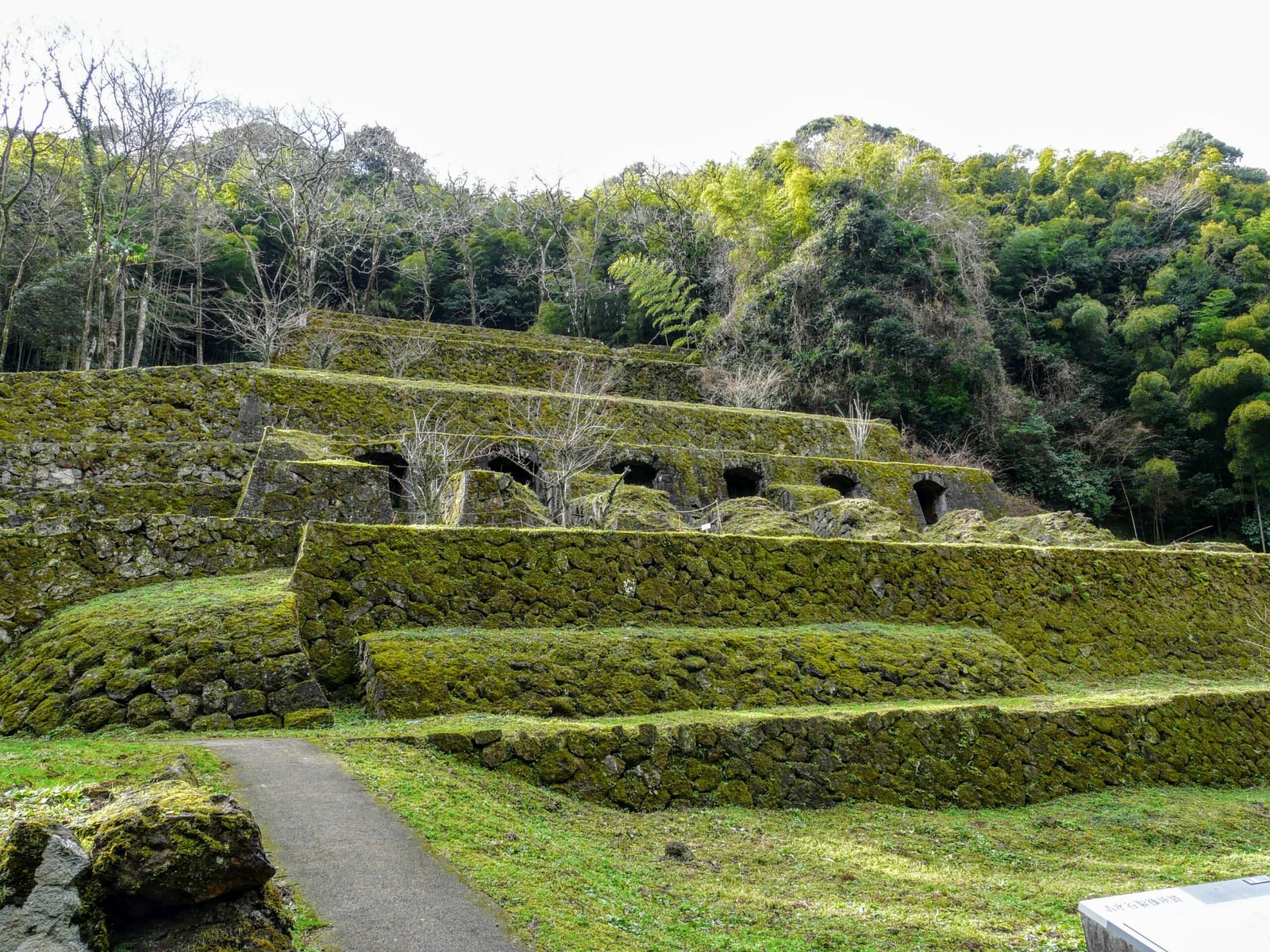
The Shimizudani Refinery ruins are among the most evocative surface remains: stone foundations and terrace walls in the forest where silver ore was processed, with vegetation slowly reclaiming the stonework. The Ryugenji Mabu shaft — the best-preserved accessible mine shaft — allows visitors to enter a short section with electric lighting to experience the claustrophobic scale of the underground workings.
The historic town of Omori, 2 km from the mine entrance, is the cultural heart of the UNESCO zone. Its single main street is lined with machiya merchant townhouses — heavy timber-framed buildings with plastered earthen walls — that preserve the spatial character of a Edo-period (1603–1868) mining community. Several buildings operate as museums, craft shops, and restaurants; the street feels inhabited rather than museified. The Kanayama Shrine, dedicated to the mine’s patron deity, anchors the upper end of the town.
Why this place matters
The UNESCO inscription recognised Iwami Ginzan as evidence of pre-industrial resource extraction at industrial scale — a demonstration that large-scale organised production was not invented in 18th-century Britain but existed in earlier forms across the world. The mine also documents the social organisation required to sustain such production: the temple records of Omori contain the names and burial records of thousands of miners, providing one of the most complete surviving human accounts of pre-modern industrial labour anywhere in Asia.
The conservation of the landscape rather than the structures is equally significant. The decision not to reconstruct the mine buildings and to allow the forest to grow back over the workings means the site preserves an authentic record of decay and natural reclamation — a different kind of heritage authenticity than the preserved-and-restored model common in European sites.
Practical information
- Visitor centre: Iwami Ginzan World Heritage Center, open Tuesday–Sunday, 09:00–17:00 (closed Mondays and late December–early January)
- Entry fee: Museum admission approximately 500 JPY; Ryugenji Mabu shaft entry approximately 500 JPY; most outdoor paths are free
- Walking distance: The mine area and Omori town are 2–3 km apart; comfortable walking shoes essential; cycling is popular and bikes can be rented in Omori
- Best season: Spring (cherry blossom, April–May) and autumn (foliage, October–November) are most scenic; summer is humid but the forest provides shade
- Time needed: Allow a full day for mine zone + Omori town; Ryugenji Mabu shaft tour is 30–40 minutes with a guide
Getting there
The nearest train station is Nima on the JR Sanin Main Line, approximately 13 km from Omori (taxi or local bus required for the final stretch). A more direct approach is by bus from Oda City Station (also on the Sanin Main Line), with services to Omori running several times daily. Oda City is approximately 2.5 hours by limited-express train from Matsue or 3.5 hours from Osaka. There is no direct Shinkansen access; the closest Shinkansen station is Hiroshima (1.5–2 hours onward by limited express and local connections).
Nearby
- Izumo Taisha Grand Shrine — One of Japan’s most ancient and important Shinto shrines, approximately 60 km east in Izumo City; dedicated to the god of relationships and good fortune
- Matsue Castle — One of Japan’s few surviving original feudal castle towers (not a modern reconstruction), approximately 80 km east; surrounded by a still-water moat navigable by small boat
- Adachi Museum of Art — Internationally acclaimed garden and modern Japanese painting collection, approximately 70 km east; the garden is regularly ranked among Japan’s finest
- Yuushien Garden — Traditional Japanese garden on Daikonshima island in Lake Nakaumi, 80 km east; famous for peony collection
Sources
- UNESCO World Heritage Centre. Iwami Ginzan Silver Mine and its Cultural Landscape. whc.unesco.org/en/list/1246
- Wikipedia contributors. Iwami Ginzan Silver Mine. en.wikipedia.org/wiki/Iwami_Ginzan_Silver_Mine
- Agency for Cultural Affairs, Japan. World Cultural Heritage: Iwami Ginzan Silver Mine. bunka.go.jp
Find it on the map
See this place and what’s around it →📷 Become a Cultural Heritage Online photographer
Share your photos of places: they stay published under your name as the author. The more they're seen, the more you get noticed — and soon a contest will reward the most appreciated photos.
Log in or sign up free to add a photo