
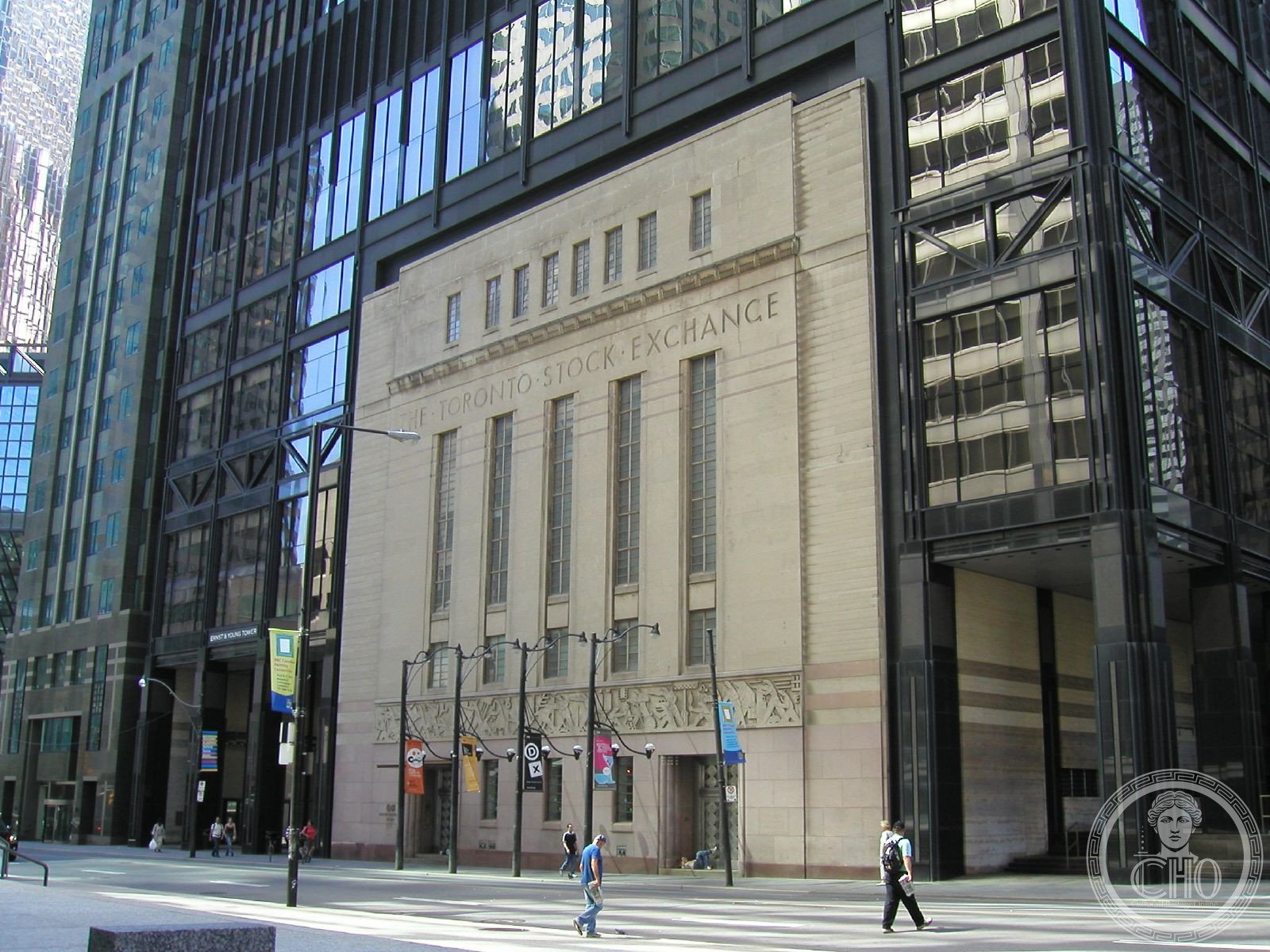
The Toronto Stock Exchange Building at 234 Bay Street is a landmark of Canadian Art Déco architecture, completed in 1937 to house one of North America’s most important financial exchanges. Designed by the firm of George and Moorhouse with Samuel H. Maw, the building features decorative relief work by the celebrated Canadian artist Charles Comfort, whose friezes along the facade are among the most accomplished examples of sculptural Art Déco work in the country. The exchange operated from this building until 1983, after which the structure was designated a heritage property and eventually transformed into the Design Exchange, a cultural venue dedicated to design. Today it functions as a prestigious event and exhibition space at the heart of Toronto’s Financial District, its Art Déco fabric meticulously preserved within the surrounding Toronto-Dominion Centre complex.
At a glance
- Type
- Financial exchange building, heritage event venue
- Period
- 1937
- Style
- Art Déco
- Location
- 234 Bay Street, Toronto, Ontario, Canada
- Coordinates
- 43.6477° N, 79.3801° W
- Architect(s)
- George and Moorhouse with Samuel H. Maw; relief sculpture by Charles Comfort
Overview
The Toronto Stock Exchange Building is one of Canada’s most significant Art Déco structures, designed to embody both financial authority and cultural aspiration. Completed in 1937 at 234 Bay Street in Toronto’s Financial District, the building served as the home of the Toronto Stock Exchange for over four decades. Its facade is distinguished by the relief sculptures of Charles Comfort, a prominent Canadian artist, whose depictions of industry, labour, and commerce gave the building an identity that transcended its commercial function. The building encompasses over 3,700 square metres of interior space and, following renovation and repurposing in the 1990s and 2020s, now operates as one of Toronto’s premier event venues under the name Design Exchange, while retaining its status as a designated heritage property.
History
Opened in 1937 to replace the Toronto Stock Exchange’s previous premises, the building served as Canada’s primary equities trading floor for over four decades. The TSX relocated to Exchange Tower in 1983, and the original building was subsequently acquired by real estate company Olympia and York. Heritage designation came in 1978, protecting the structure’s architectural character. A citizens’ group formed in 1986 to advocate for a design museum in Toronto, leading to the building being acquired and rebranded as the Design Exchange in 1988. The Design Exchange operated as Canada’s only design museum until 2019, when its collection was deaccessioned. After significant renovation, the venue reopened in April 2023 as a cultural event space hosting exhibitions, conferences, and the biennial EDIT festival.
Architecture & Design
George and Moorhouse, working with Samuel H. Maw, created a building that exemplifies the restrained institutional variant of Art Déco that characterised major financial buildings of the 1930s. The structure balances the style’s characteristic geometric boldness with an air of civic seriousness appropriate to a national financial exchange. The facade reliefs executed by Charles Comfort — one of Canada’s leading painters and muralists of the twentieth century — are the building’s most celebrated feature, depicting themes of industry and commerce with sculptural skill and symbolic depth. The interior, encompassing over 3,700 square metres, was incorporated into the Toronto-Dominion Centre complex in 1991 while retaining its distinct heritage character. The building’s Art Déco volumes and ornamental programme remain largely intact.
Cultural significance
As the home of Canada’s principal stock exchange for nearly half a century, the Toronto Stock Exchange Building was a nerve centre of national economic life during some of the most turbulent decades of the twentieth century. Its designation as a heritage property in 1978 — while still in active use as a financial institution — reflected an early recognition of its architectural importance. As the Design Exchange, the building hosted Canada’s only dedicated design museum, the National Design Awards, and major international design exhibitions that brought global creative culture to Toronto. The biennial EDIT festival, which continues to be held here, has established the venue as a significant platform for design, innovation, and technology on the international stage.
Visiting today
The Toronto Stock Exchange Building now operates as the Design Exchange (DX), a premium event and cultural venue. It is available for private events, exhibitions, and public programming including the EDIT festival. Access for general visitors depends on scheduled events and exhibitions; the building’s exterior Art Déco facades and relief sculptures by Charles Comfort can be appreciated at any time. The venue offers over 3,700 square metres of event space across multiple floors. For event schedules and public programming, see designexchangetoronto.com.
Getting there
The building is located at 234 Bay Street in Toronto’s Financial District, directly accessible via the underground PATH pedestrian network, which connects to Union Station and multiple subway lines. King Station and St. Andrew Station on the TTC subway are both within a short walk. Several TTC streetcar and bus routes serve Bay Street and King Street West. The building is also accessible by taxi and ride-share services; Union Station serves GO Transit commuter rail and VIA Rail trains from across the region.
Sources & resources
Find it on the map
See this place and what’s around it →Record researched and written by Luigi De Marchi for Cultural Heritage Online, 2026.
📷 Become a Cultural Heritage Online photographer
Share your photos of places: they stay published under your name as the author. The more they're seen, the more you get noticed — and soon a contest will reward the most appreciated photos.
Log in or sign up free to add a photoIs this page about you?
This page is read by travellers and heritage enthusiasts who find it on Google. Tell us how you are connected to this place and we will take it from there.