

The oldest known battlefield in northern Europe: a Bronze Age river valley where the skeletal remains of approximately 140 warriors — killed in a large-scale organised battle around 1250 BC — have been preserved in the waterlogged riverbed, rewriting our understanding of prehistoric warfare.
At a glance
In the valley of the Tollense River in Mecklenburg-Vorpommern, northeastern Germany, approximately 120 km north of Berlin near the town of Neubrandenburg, one of the most important and unsettling archaeological discoveries of the 21st century has been unfolding since 1996. The site preserves the remains of a large-scale Bronze Age battle fought approximately 1250 BC — contemporary with the fall of the Mycenaean civilisation and the traditional date of the siege of Troy — in a state of extraordinary physical detail that has transformed the understanding of organised violence in prehistoric northern Europe. Before Tollense, armies of thousands in Bronze Age Europe were unknown. After Tollense, they are an established archaeological fact.
Key facts
- Date of battle: c. 1250 BC (Nordic Bronze Age, contemporary with late Mycenaean Greece)
- Remains recovered (to 2020): approximately 140 individuals — almost exclusively young adult males, 15–35 years old, in good physical health
- Animals: 5 horses (rare luxury animals in Bronze Age Europe, suggesting high-status warriors)
- Weapons found: bronze and flint arrowheads, spearheads, a bronze knife, wooden clubs; personal ornaments including a gold spiral arm-ring
- Non-local warriors confirmed: isotopic analysis shows many dead grew up far from northern Germany; their childhood diet differed from the local population
- Estimated total combatants: demographic modelling suggests 4,000 or more — an army of unprecedented scale for Bronze Age Europe
- Excavation coverage: approximately 3% of the estimated total deposit; recovery ongoing since 1996
History
The site was identified in 1996 when a walker found a human arm bone protruding from the riverbank of the Tollense with a flint arrowhead still embedded in it. Subsequent investigation by archaeologists from the State Office for Culture and Monument Preservation in Mecklenburg-Vorpommern, and later by a major interdisciplinary project from the University of Greifswald, revealed that the waterlogged riverbed and adjacent peat bog contained the skeletal remains of a large number of individuals who had died violently in a single event — a battle on or near the river crossing, probably at a wooden bridge or ford, around 1250 BC. The waterlogged, anaerobic conditions of the riverbed preserved bone, wood, and even organic materials (leather, rope fibres) that would have decayed entirely in dry burial conditions.
The composition of the dead is what made Tollense truly revolutionary. The individuals were almost exclusively young adult males in good physical health and good nutritional condition — not the starved, disease-weakened population of subsistence farmers one might expect in a prehistoric conflict, but people who had been well-fed and physically fit. Many showed healed injuries from previous violence, indicating professional or semi-professional warriors rather than hastily conscripted farmers. The gold arm-ring and bronze ornaments found among the dead are of types foreign to the local Mecklenburg tradition, pointing to warriors from distant regions — isotopic analysis subsequently confirmed that many of the dead had grown up 500 or more kilometres away, possibly in the Danube area of central Europe.
The demographic implications are staggering. Based on the density of remains in the excavated 3% of the deposit, researchers have estimated that the total number of combatants at Tollense may have been 4,000 or more. In 1250 BC, assembling, feeding, and deploying an army of this size required a level of social organisation, political authority, logistical capacity, and surplus agricultural production that European prehistorians had not previously attributed to pre-state Bronze Age societies. Tollense did not just discover a battle; it discovered that Bronze Age Europe was capable of something that many scholars had assumed it was not.
What you see
The Tollense Valley battlefield is not a conventional archaeological site with visible structures or monuments. The battle remains are located in the riverbed and peat bog of the Tollense valley — below the surface of the water and earth — and are only accessible to archaeologists during controlled excavations, typically in summer when river levels allow. There is no permanent site museum at the location itself; the excavated material is housed and displayed at the State Museum of Prehistory and Early History (Landesmuseum fur Vorgeschichte) in Schwerin, approximately 90 km to the west.
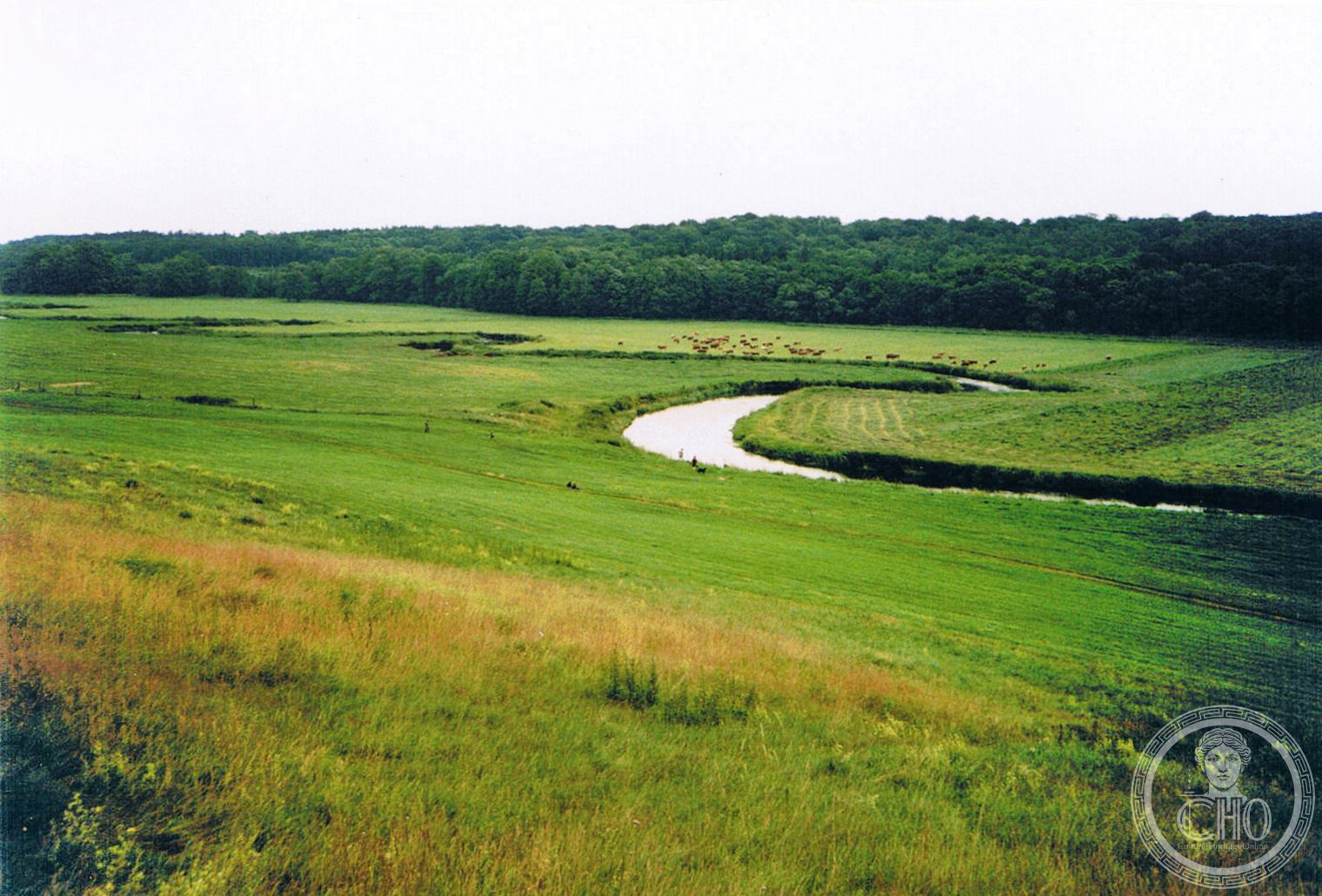
What a visitor to the Tollense valley does encounter is the landscape itself: a quiet, pastoral river valley in the Mecklenburg lake district, with the river winding through meadows and willow trees, giving no outward indication of the catastrophic event preserved in its bed. This landscape is the context that makes Tollense intelligible: a river crossing in a flat, easily traversable valley, at a point where a Bronze Age route northward through the forests of Mecklenburg would have had to cross the Tollense — a natural chokepoint. The violence happened here because the geography made it happen here.
Practical information
- Location: Tollense valley near Weltzin, Amt Neverin, Mecklenburg-Vorpommern; approximately 6 km north of Neubrandenburg
- Site access: the valley is accessible as open countryside; there is no fee and no formal archaeological zone enclosure
- On-site interpretation: minimal; information panels may be present at the discovery point near Weltzin
- Primary museum: Landesmuseum fur Vorgeschichte (State Museum of Prehistory), Schwerin — Tollense material on permanent display; approximately 90 km west
- Photography: permitted throughout the open landscape
- Time required: 30–60 minutes for the landscape visit; half-day if combining with Schwerin museum
Getting there
The Tollense valley is located near the village of Weltzin, approximately 6 km north of Neubrandenburg in Mecklenburg-Vorpommern. By car from Berlin: take the A20 motorway northwest toward Rostock, exit at Neubrandenburg-Nord, then drive north on rural roads toward Weltzin (approximately 2.5 hours from Berlin). Public transport to Neubrandenburg is available by train from Berlin Hbf (approximately 1.5 hours), with onward connections by rural bus or taxi to Weltzin. Note that the site has no visitor infrastructure; this is a landscape visit for the archaeologically motivated traveller.
Nearby
- Neubrandenburg medieval town walls: 6 km south; one of the best-preserved medieval brick fortification circuits in northern Germany, with four medieval gates intact
- Mecklenburg lake district (Mecklenburgische Seenplatte): the Tollense valley is at the edge of one of Europe’s largest lake landscapes; excellent for cycling and kayaking
- Schwerin State Museum of Prehistory: 90 km west; the primary repository for Tollense battlefield finds and broader Mecklenburg prehistory collections
- Gross Raden Slavic open-air museum: approximately 80 km west near Sternberg; reconstructed early medieval Slavic settlement on a lake island
Sources
- Jantzen, Detlef, et al. “A Bronze Age battlefield? Weapons and trauma in the Tollense Valley, north-eastern Germany.” Antiquity, vol. 85, 2011 — first major publication of the battlefield discovery and significance
- Terberger, Thomas, et al. “The Bronze Age battlefield in the Tollense valley — conflict, warlike violence and social change around 1200 BCE.” Quaternary International, vol. 544, 2020 — synthesis of isotopic, osteological, and demographic findings
- Price, T. Douglas, et al. “Multi-isotope proveniencing of human remains from a Bronze Age battlefield in the Tollense Valley in northeast Germany.” Archaeological and Anthropological Sciences, vol. 9, 2017 — isotopic confirmation of non-local warriors
- Curry, Andrew. “The Slaughter at the Bridge.” Science, vol. 351, 2016 — accessible narrative account of the discovery and its implications
- Wikipedia contributors. “Tollense Valley.” Wikipedia, The Free Encyclopedia. Accessed 2026-06-11.
Find it on the map
See this place and what’s around it →📷 Become a Cultural Heritage Online photographer
Share your photos of places: they stay published under your name as the author. The more they're seen, the more you get noticed — and soon a contest will reward the most appreciated photos.
Log in or sign up free to add a photo