
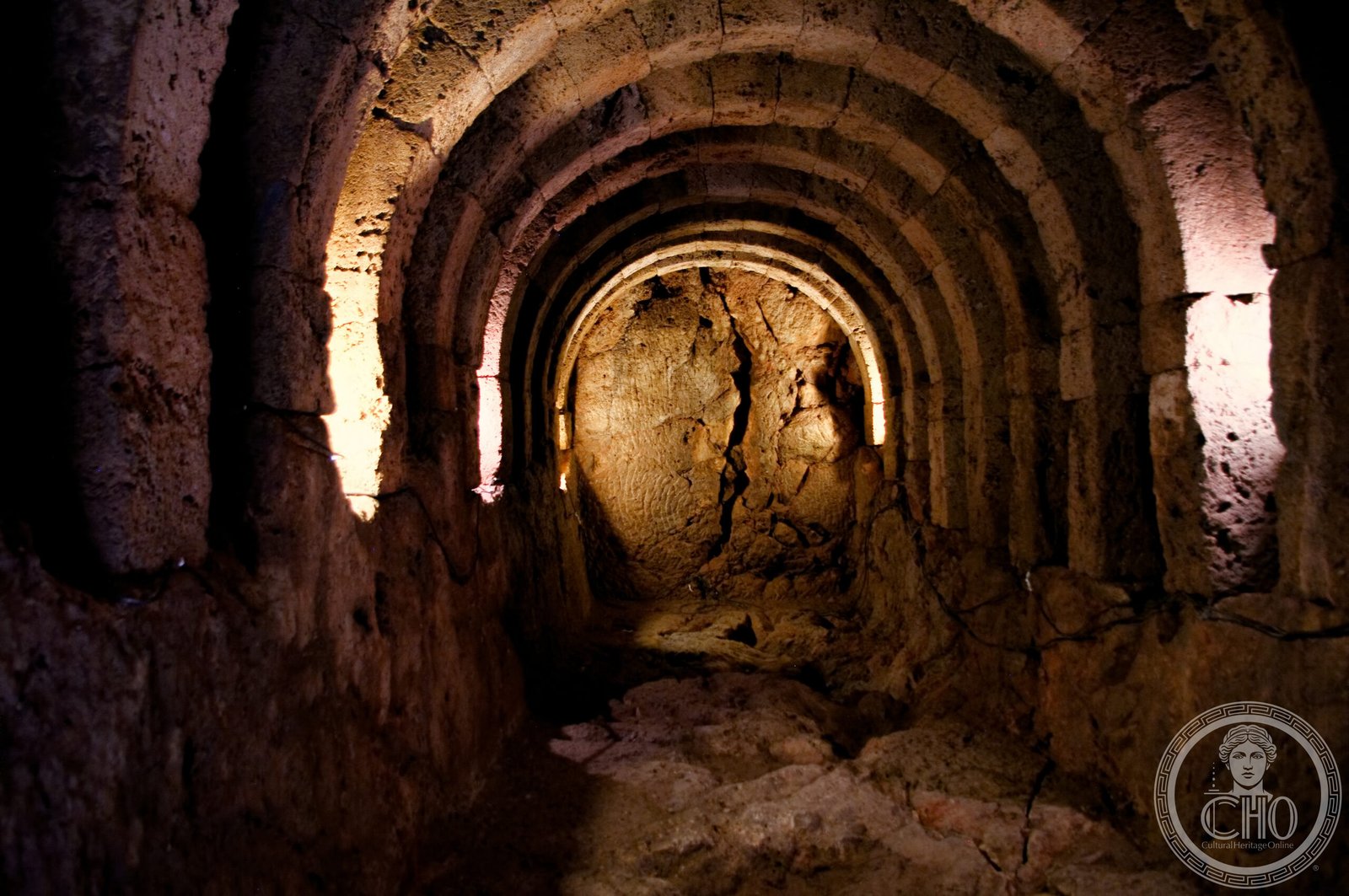
The ancient Oracle of the Dead on the Acheron River, where pilgrims performed ritual descents to consult the shades of the dead — and where Homer placed Odysseus’s descent to the underworld in Book 11 of the Odyssey.
At a glance
In the Epirus region of northwestern Greece, at the confluence of three rivers the ancient Greeks associated with the underworld — the Acheron, the Kokytos, and the Pyriphlegethon — the Necromanteion of Ephyra was an oracular sanctuary dedicated to Hades and Persephone. Pilgrims came from across the Greek world to consult the spirits of the dead, undergoing days of ritual preparation before descending into a vaulted underground chamber. The Hellenistic complex excavated here between 1958 and 1977 is the only archaeological site positively identified with the ancient practice of necromancy, and the only place in the Greek world where the tradition that Homer preserves — Odysseus consulting the dead — was enacted as a living religious rite.
Key facts
- Location: Near Mesopotamos village, Preveza, Epirus, northwestern Greece
- Period: Hellenistic, c. 3rd century BC; possibly earlier sacred use; destroyed by Romans 167 BC
- Dedicated to: Hades and Persephone, rulers of the Greek underworld
- Excavator: Sotirios Dakaris, University of Ioannina, 1958–1977
- Key find: Bronze wheels and iron chains interpreted as a theatrical hoisting mechanism for spirit apparitions
- Literary connection: Identified as the site of Odysseus’s katabasis in Homer’s Odyssey, Book 11
- Rivers: Acheron, Kokytos, and Pyriphlegethon — the three rivers of Hades in Greek mythology
History
The sanctuary at Ephyra occupies a hilltop above the confluence of rivers the ancient Greeks identified as the entrance to the realm of the dead. The Acheron — ‘river of woe’ — flows through a deep gorge here before entering the Ionian Sea; the Kokytos and Pyriphlegethon join it nearby. For the ancient Greeks, this landscape was not merely metaphorical: Thucydides and Strabo both identify this confluence as the literal mouth of Hades, and it was here that the Necromanteion — the ‘oracle of the dead’ — operated as a functioning religious institution.
The ritual procedure involved extended preparation: pilgrims spent days in the sanctuary’s outer precinct, fasting, undergoing purification, and consuming special ritual foods. When the oracle was ready, the petitioner was led through a labyrinthine series of corridors through the thick stone walls of the main building — a disorienting passage designed to replicate the journey through the underworld — before arriving in the subterranean chamber where the consultation took place. The Roman general Aemilius Paullus destroyed the sanctuary in 167 BC after conquering Epirus; a thick destruction layer of burnt material covers the Hellenistic complex.
Systematic excavation by Sotirios Dakaris between 1958 and 1977 revealed a remarkable find: the remains of a hoisting mechanism in the underground chamber, including bronze wheels, iron chains, and iron fittings, interpreted as the apparatus used to lower a costumed figure representing a shade before the consulting petitioner — theatrical machinery for producing the apparition of the dead.
What you see
The surviving ruins form a rectangular complex on the hilltop, with walls up to 3.3 metres thick in the main building — unusually massive construction explained by the need to create the labyrinthine internal corridors that formed the ritual approach to the oracle. The underground chamber (approximately 9 × 3 metres) is vaulted and partially carved from the bedrock, creating a genuinely subterranean atmosphere. The approach corridors zigzag through the thickness of the walls in a pattern that would have completely disorientated a visitor approaching in near-darkness.
The modern site is covered by a Byzantine-era church (Agios Ioannis Prodromos) built directly on the ancient ruins — a common pattern of Christian appropriation of pagan sacred sites. The underground chamber is accessible to visitors. The nearby Acheron gorge, with its striking limestone karst landscape and dark waters, communicates more vividly than any exhibit why the ancient Greeks chose this place as their portal to the underworld.
Practical information
- Address: Near Mesopotamos village, Preveza regional unit, Epirus, Greece
- Opening hours: Typically 08:00–20:00 summer; 08:30–15:30 winter — verify locally
- Admission: Modest fee; free on certain national holidays
- Combined visit: Acheron River gorge (Glyki, c. 15 km) — canyon hiking plus the oracle
- Best time: Spring or autumn; summer afternoons are hot
Getting there
Approximately 65 km south of Ioannina and 25 km southeast of Preveza. By car from Ioannina: take the E90 motorway south toward Preveza, exit for Mesopotamos/Kanalaki, follow signs to Mesopotamos village; the site is on the hill above the village. No reliable public transport; a car or organised tour from Ioannina or Preveza is necessary. Nearest airport: Preveza/Aktion Airport (PVK), with seasonal charter flights and year-round connections from Athens.
Nearby
- Acheron River gorge (Glyki, ~15 km) — spectacular limestone canyon with shallow river wading; the mythological river itself
- Ancient Nikopolis (~30 km north) — Roman city founded by Augustus after the Battle of Actium (31 BC)
- Kassope (~25 km north) — well-preserved Hellenistic city on a hillside
- Preveza old town (~25 km northwest) — Venetian-era port on the Ambracian Gulf
Sources
- Dakaris, S. (1993). Cassopaia and the Elean Colonies. Athens: Ministry of Culture
- Ogden, D. (2001). Greek and Roman Necromancy. Princeton University Press
- Strabo, Geography VII.7.5
- Homer, Odyssey XI (the Nekuia)
- Wikipedia contributors. “Necromanteion.” Wikipedia. Accessed June 2026
Find it on the map
See this place and what’s around it →📷 Become a Cultural Heritage Online photographer
Share your photos of places: they stay published under your name as the author. The more they're seen, the more you get noticed — and soon a contest will reward the most appreciated photos.
Log in or sign up free to add a photoIs this page about you?
This page is read by travellers and heritage enthusiasts who find it on Google. Tell us how you are connected to this place and we will take it from there.