
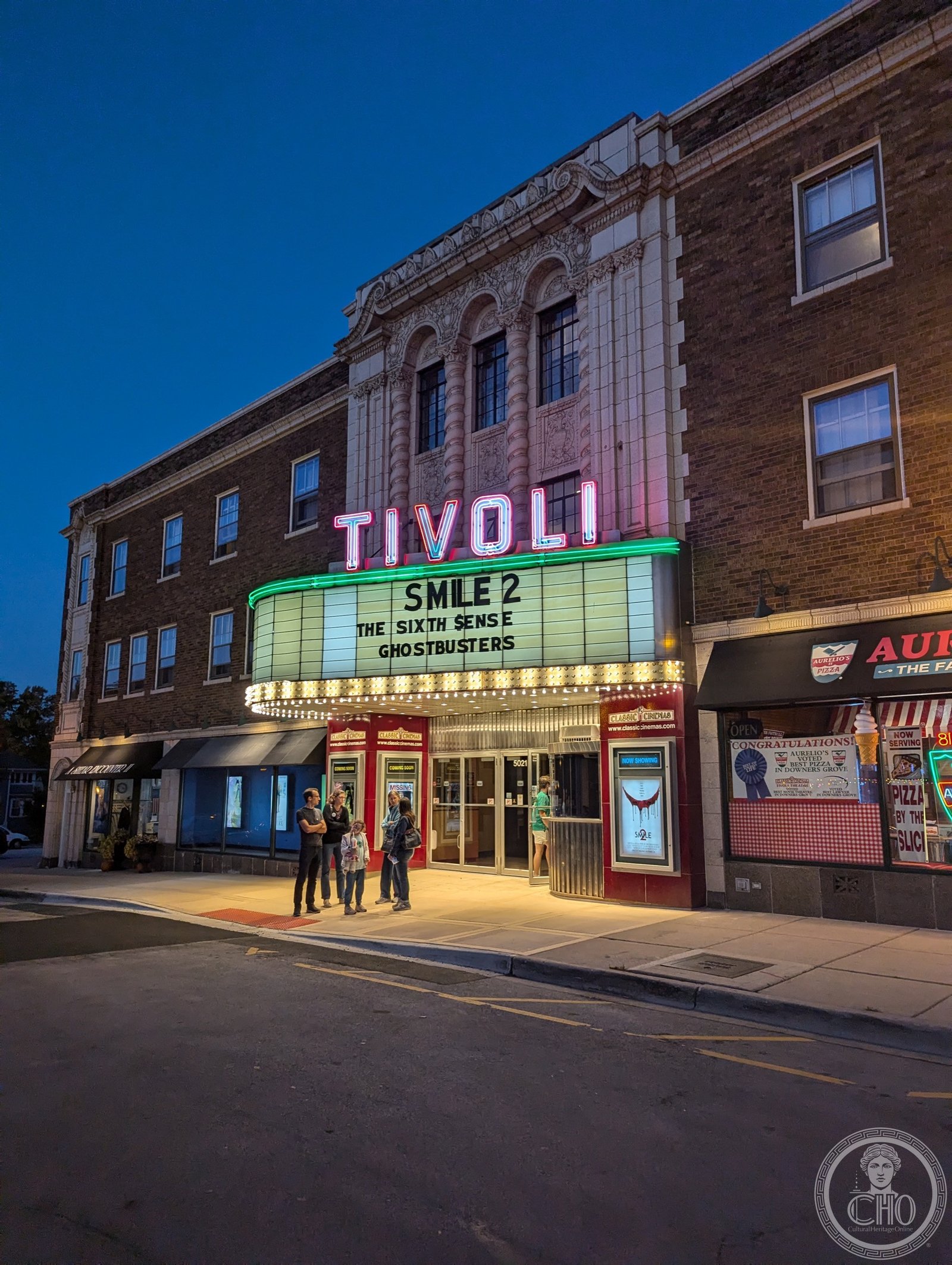
The Tivoli Theatre on Main Street in Downers Grove is one of the finest surviving examples of a suburban Art Deco movie theater in the Chicago metropolitan area—a 1928 single-screen picture palace that still operates as a working cinema, connecting the suburban residential communities of DuPage County to the architectural heritage of the golden age of American movie exhibition.
At a glance
The Tivoli Theatre at 5021 Main Street in Downers Grove, Illinois opened in 1928 as a neighborhood movie theater serving the residential community that had developed along the Burlington Northern commuter rail corridor west of Chicago. Unlike the grand picture palaces of downtown Chicago—the Oriental, the Chicago, the Uptown—the Tivoli was designed for a suburban audience of commuters and their families, delivering a genuine Art Deco theatrical experience at the community scale. The theater has been operating continuously for nearly a century, making it one of the longest-running single-screen cinemas in the Chicago metropolitan area. Recent restoration efforts have preserved the building’s original Art Deco facade, marquee, and auditorium character while upgrading the projection and sound systems to current digital standards.
Key facts
- Address: 5021 Main Street, Downers Grove, IL 60515
- GPS: 41.7953° N, 88.0134° W
- Built: 1928
- Style: Art Deco
- Capacity: approximately 600 seats (single screen)
- Status: Active cinema, preserved and restored
- NRHP: Listed on National Register of Historic Places
History
Downers Grove developed as a commuter suburb along the Galena and Chicago Union Railroad (later the Chicago, Burlington and Quincy, now Metra’s BNSF line) from the mid-19th century, attracting middle-class Chicago families who wanted access to the city’s commercial economy while living at a remove from its density and industrial conditions. By the 1920s, Downers Grove was a well-established residential community of approximately 7,000 people whose Main Street commercial strip included the retail, service, and entertainment businesses that served a prosperous suburban economy.
The Tivoli Theatre opened in 1928 as part of the expansion of cinema exhibition into the suburban markets that were increasingly important to the movie business in the late silent and early sound era. Unlike the massive downtown palaces that could seat 3,000 or more, the Tivoli was designed for the scale of a suburban Main Street: a building with an ornate Art Deco facade that signaled quality and ambition without the financial investment that the downtown first-run palaces required. The name “Tivoli” was popular among theater operators in the 1920s, evoking the Tivoli Gardens pleasure grounds of Copenhagen and suggesting European sophistication. The exterior facade’s vertical neon sign and the decorative tile and terra cotta ornament of the entrance delivered the Art Deco experience to Downers Grove’s commuter audiences.
The Tivoli has operated as a cinema through the sound era, the television era, the multiplex era, and the streaming era—a remarkable continuity for a single-screen neighborhood theater. While most of its contemporaries were demolished, subdivided, or converted to other uses, the Tivoli maintained its function and its character through successive waves of technological change and competitive pressure. The theater underwent significant restoration work in recent decades that preserved the original facade, the Art Deco lobby, and the character of the auditorium while installing digital projection and sound systems that allow it to program current releases alongside classic films.
What you see
The Main Street facade is an excellent example of Art Deco applied to a suburban commercial building at the neighborhood scale: the vertical sign rising above the marquee, the geometric ornament in the terra cotta and tile of the entrance surround, and the setback upper story with its Art Deco relief work deliver the theatrical vocabulary of the era in a composition sized for a Main Street storefront rather than a downtown boulevard. The neon marquee—updated but consistent with the original 1928 design in character—still animates the building at night in the way that made the movie theater a beacon in the suburban streetscape.
Inside, the lobby and auditorium retain the character of the original 1928 design in their proportions and decorative vocabulary, even where surfaces have been refreshed or restored. The single-screen configuration—one large auditorium rather than the subdivided multiplex model—preserves the relationship between audience and screen that the original architects designed into the building: a shared experience at a scale that the multiplex deliberately reduced. The restoration has maintained the ceiling height, the sight lines, and the decorative elements that give the Tivoli its identity as a distinct place.
Practical information
- The Tivoli Theatre operates as an active cinema programming current releases and classic films; check landmarktheatres.com or the theater’s local listings for showtimes.
- Located on Main Street in downtown Downers Grove, adjacent to the Metra BNSF line station (Downers Grove Main Street stop).
- Free parking on Main Street and in the municipal parking lots adjacent to downtown Downers Grove.
- The theater’s preserved Art Deco character makes it a destination for architecture enthusiasts as well as cinema-goers; the facade is best appreciated at dusk when the neon is illuminated.
Getting there
The Tivoli Theatre is at 5021 Main Street in downtown Downers Grove, Illinois, approximately 25 miles west of downtown Chicago. The Metra BNSF Railway line (Burlington Northern) serves the Downers Grove Main Street station adjacent to the theater; trains run frequently on weekdays and weekends from Chicago Union Station, with journey times of approximately 35-45 minutes. By car from Chicago, take I-290 west to I-355 south to Ogden Avenue west, then south on Main Street. O’Hare International Airport (ORD) is approximately 20 miles north via I-294 and I-290; drive time is 30-40 minutes depending on traffic.
Nearby
- Downers Grove Metra Station (adjacent): the Burlington Northern Station serves as the community’s connection to downtown Chicago; the station building dates from the commuter rail expansion of the early 20th century and is part of the historic downtown character.
- Morton Arboretum (3 miles north): the 1,700-acre arboretum at 4100 Illinois Route 53 in Lisle is one of the largest arboreta in the country, with a Midwest native plant collection, children’s garden, and year-round programming; the Joy Morton family funded the arboretum and their Morton Salt Company was one of the defining Chicago-area businesses.
- Cantigny Park (10 miles northwest): the estate of Colonel Robert R. McCormick, publisher of the Chicago Tribune, includes the Cantigny Golf Course, First Division Museum, and the 500-acre park grounds open to the public at 1S151 Winfield Road in Wheaton.
- Uptown Theatre Chicago (20 miles northeast): the 1925 Walter Ahlschlager atmospheric theater at 4816 N Broadway — the largest atmospheric theater built in America — provides the full-scale metropolitan counterpoint to the Tivoli’s suburban picture palace; the Uptown remains closed awaiting restoration.
Sources
- Tivoli Theatre Downers Grove — Landmark Theatres website and local preservation documentation
- National Register of Historic Places, Downers Grove Main Street Historic District
- Downers Grove Museum / Heritage Library records
- Cinema Treasures, “Tivoli Theatre, Downers Grove” database entry
Find it on the map
See this place and what’s around it →Record researched and written by Luigi De Marchi for Cultural Heritage Online, 2026.
📷 Become a Cultural Heritage Online photographer
Share your photos of places: they stay published under your name as the author. The more they're seen, the more you get noticed — and soon a contest will reward the most appreciated photos.
Log in or sign up free to add a photoIs this page about you?
This page is read by travellers and heritage enthusiasts who find it on Google. Tell us how you are connected to this place and we will take it from there.