
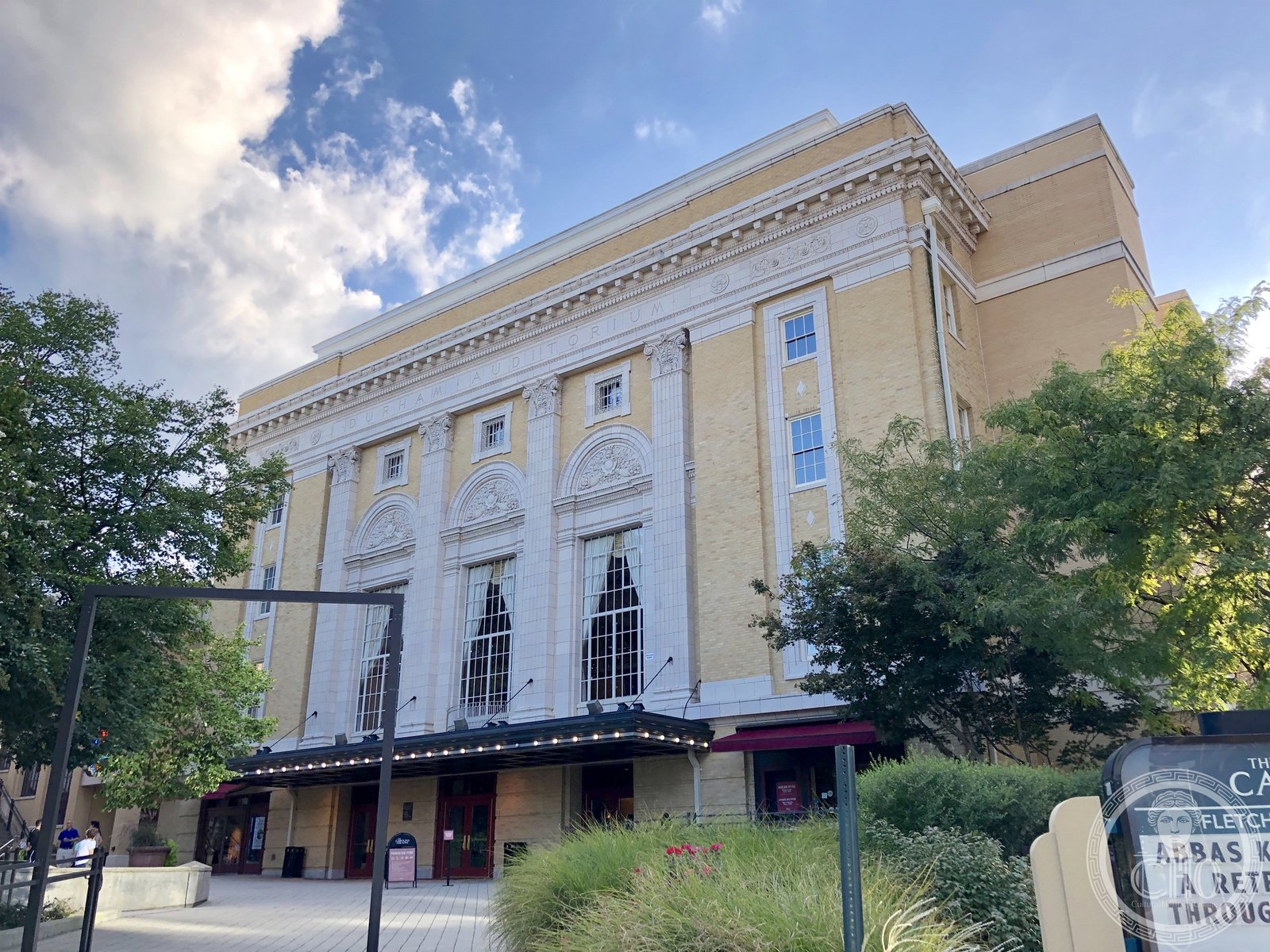
The Carolina Theatre on West Morgan Street is Durham’s most important surviving picture palace—a 1926 Spanish Renaissance Revival building that anchors the downtown arts district of a city whose transformation from tobacco manufacturing capital into a research and cultural center is one of the more striking urban reinventions in the American South.
At a glance
The Carolina Theatre at 309 W Morgan Street in downtown Durham opened in 1926 as the city’s premier entertainment venue, combining the Spanish Renaissance Revival exterior vocabulary that was fashionable for major southern theaters of the 1920s with an interior program designed to provide the full picture palace experience to the audiences of a booming tobacco city. The theater is now a nonprofit performing arts center housing two distinct performance spaces—the restored Fletcher Hall and the Film Theatre—and operates as one of the anchors of Durham’s downtown arts and entertainment district. With live performance, independent film, and educational programming, the Carolina Theatre functions as the cultural counterpart to the research and technology economy that has reshaped Durham since the late 20th century.
Key facts
- Address: 309 W Morgan Street, Durham, NC 27701
- GPS: 35.9940° N, 78.9017° W
- Built: 1926
- Style: Spanish Renaissance Revival with Art Deco decorative elements
- Status: Active nonprofit performing arts center
- NRHP: Listed on National Register of Historic Places
History
Durham in 1926 was one of the wealthiest small cities in the American South—a tobacco manufacturing center whose major firms, Washington Duke and Julian S. Carr, had generated fortunes that funded hospitals, universities (Trinity College, which would become Duke University, received the Duke endowment in 1924), and commercial development that gave the city an unusually dense concentration of civic institutions for its size. The tobacco economy that produced this wealth was also one of the starkest examples of industrial labor in the New South, and Durham’s Black business community—centered on Parrish Street (“Black Wall Street”)—had built one of the most significant African American commercial districts in the country.
The Carolina Theatre opened in 1926 as a first-run movie and vaudeville venue serving the white commercial audience of downtown Durham. The theater’s Spanish Renaissance facade—its arched entrance, ornate terracotta ornament, and the vertical sign that marked it as a major entertainment destination—expressed the commercial ambitions of a city that expected to grow. The interior program followed the lavish decorative conventions of the major picture palace: rich plasterwork, atmospheric lighting, and a proscenium designed to present the full scale of cinematic spectacle to a large downtown audience.
The Carolina Theatre operated as a movie and live performance venue through the postwar decades before facing the competitive pressures that closed most single-screen downtown cinemas. The City of Durham acquired the building in 1975 and preserved it from demolition; a subsequent restoration created the current dual-venue configuration—the main Fletcher Hall auditorium for live performance and the Film Theatre for independent cinema. The theater now operates as a nonprofit performing arts organization that programs live music, touring theater, independent and classic film, and community events, making it one of the most active cultural institutions in the Triangle region.
What you see
The West Morgan Street facade presents the Spanish Renaissance Revival in its characteristic American form: a recessed arched entrance flanked by pilasters with Baroque ornamental detail, a cornice with continuous entablature, and terra cotta ornament in the spandrels and window surrounds that recalls the churrigueresque elaboration of Spanish colonial architecture translated through American commercial theater design. The vertical sign above the entrance, reading CAROLINA, performs the same identifying function in the theater streetscape as it did in 1926. The facade composition reads well at the block scale of downtown Durham, where the theater’s ornamental richness contrasts with the more restrained commercial architecture of the surrounding buildings.
Inside, the Fletcher Hall auditorium preserves the proportions and spatial character of the original 1926 theater, with restored plasterwork in the boxes and ceiling that reflects the decorative ambition of the original design. The Film Theatre occupies a separate screening space configured for independent cinema exhibition. The lobby connects the two performance venues and contains historical displays about the theater’s history and its place in Durham’s cultural development.
Practical information
- The Carolina Theatre programs live performance (music, theater, dance), independent and classic film, and educational events; check carolinatheatre.org for the calendar.
- Located at 309 W Morgan Street in downtown Durham, adjacent to the Durham Performing Arts Center and walkable from the American Tobacco Campus and the Durham Bulls Athletic Park.
- Fully accessible; ADA seating in Fletcher Hall and the Film Theatre.
- Free or paid parking in the surrounding downtown Durham lots; the Theater District garage on Morgan Street is the closest structure.
Getting there
The Carolina Theatre is at 309 W Morgan Street in downtown Durham, North Carolina, approximately 30 miles southwest of Raleigh and 12 miles east of Chapel Hill. Raleigh-Durham International Airport (RDU) is approximately 10 miles west of the theater; take I-40 east to US-15/501 Business (Durham Freeway) north to downtown. The DATA (Durham Area Transit Authority) serves downtown Durham with bus routes; the Durham Station transit hub is 3 blocks east on Morgan Street. Interstate 85 connects Durham to Atlanta (350 miles southwest) and Richmond (230 miles north).
Nearby
- Durham Performing Arts Center (1 block east): the 2,700-seat DPAC at 123 Vivian Street is the primary venue for Broadway tours in the Triangle region; the two theaters together form the core of Durham’s downtown arts district.
- American Tobacco Campus (0.5 miles south): the adaptive reuse of the former American Tobacco Company complex on Blackwell Street — a 19th and early 20th-century industrial campus — is the anchor of Durham’s southern downtown revitalization, with offices, restaurants, and the Durham Bulls Athletic Park.
- Duke University and the Nasher Museum of Art (2 miles west): the university campus at Chapel Hill Street is home to the Nasher Museum at 2001 Campus Drive, one of the most active university art museums in the Southeast with an important contemporary art collection.
- Parrish Street / Black Wall Street (0.5 miles east): the historic center of Durham’s African American business district — which produced NC Mutual Life Insurance and other major Black-owned enterprises — is undergoing renewed recognition; the Hayti Heritage Center at 804 Old Fayetteville Street preserves the community’s history.
Sources
- Carolina Theatre, carolinatheatre.org — venue history and programming
- National Register of Historic Places, Carolina Theatre nomination
- Durham County Historic Preservation Commission records
- Cinema Treasures, “Carolina Theatre, Durham, NC” database entry
Find it on the map
See this place and what’s around it →Record researched and written by Luigi De Marchi for Cultural Heritage Online, 2026.
📷 Become a Cultural Heritage Online photographer
Share your photos of places: they stay published under your name as the author. The more they're seen, the more you get noticed — and soon a contest will reward the most appreciated photos.
Log in or sign up free to add a photoIs this page about you?
This page is read by travellers and heritage enthusiasts who find it on Google. Tell us how you are connected to this place and we will take it from there.