
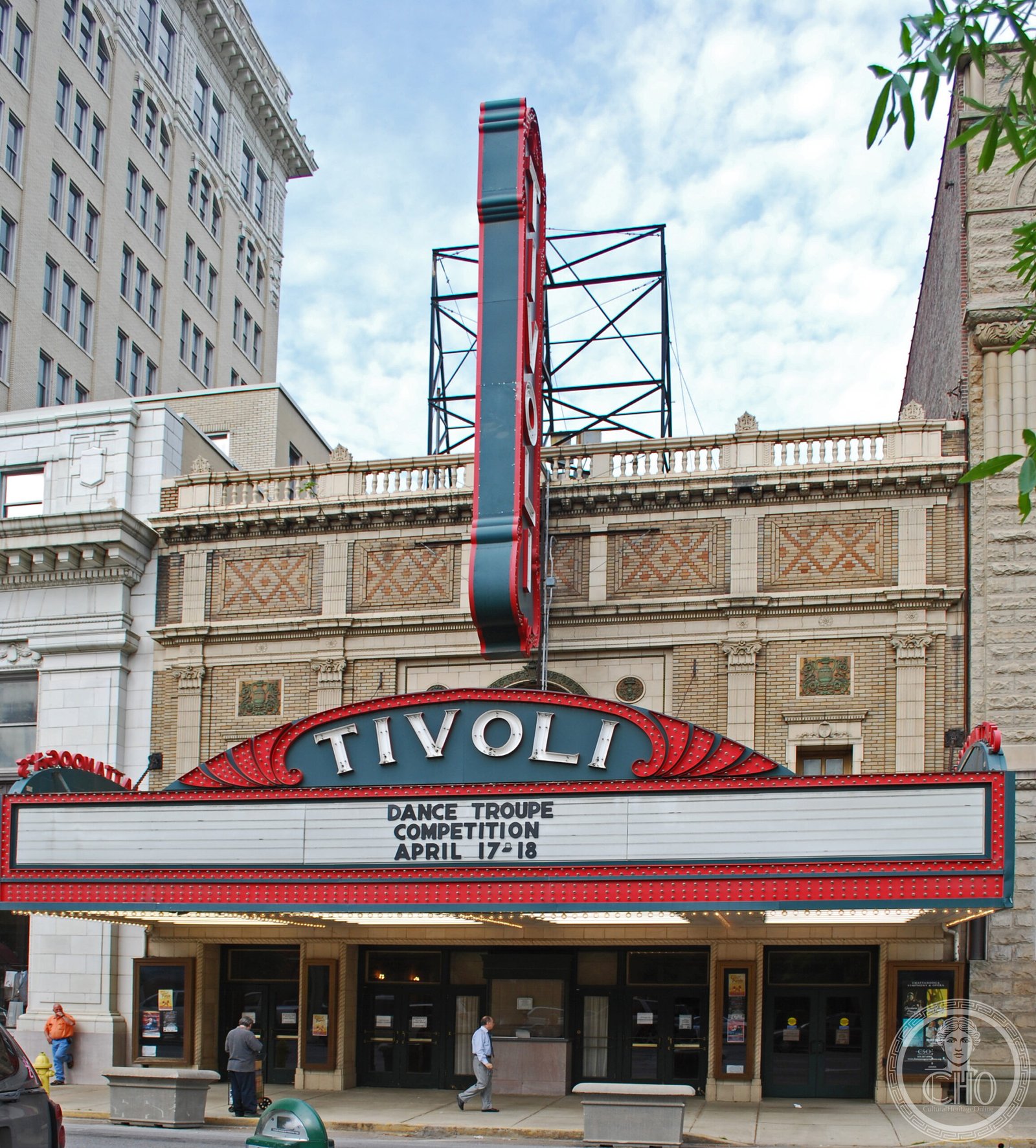
The Tivoli opened in 1921 as the most ornate theatre in Chattanooga — a domed auditorium with a chandelier of hundreds of lights, gilded plasterwork on every surface, and a programme of Italian Renaissance and Baroque ornament that made every film screening a lesson in excess.
At a glance
The Tivoli Theatre opened on 19 March 1921 as one of the grandest movie palaces in the American South. Built for the Paramount/Publix cinema circuit, the building brought the vocabulary of Italian Baroque and Renaissance ornament to downtown Chattanooga in a form that rivalled the great urban theatres of New York and Chicago. The auditorium’s domed ceiling, massive central chandelier, and extensive gilded plasterwork made it exceptional among Southern cinemas of the period. Listed on the National Register of Historic Places, the Tivoli has been restored and operates today as the Tivoli Performing Arts Center, the anchor of Chattanooga’s downtown cultural district.
Key facts
- Address: 709 Broad Street, Chattanooga, TN 37402
- Opened: 19 March 1921
- Style: Italian Renaissance / Baroque Revival — domed auditorium, gilded plasterwork, Venetian chandelier
- Capacity: Approximately 1,700 seats
- Designation: National Register of Historic Places
- Current name: Tivoli Performing Arts Center
History
The Tivoli opened at a moment when American cinema operators were competing to offer the most lavish architectural experience to attract audiences. The Paramount circuit — one of the dominant cinema chains of the early sound era — commissioned ornate theatres in cities across the United States, and Chattanooga’s Tivoli ranked among the most ambitious of these Southern commissions. The building was designed to read as a fragment of Italian palatial architecture transported to Tennessee: a domed interior with coffered plasterwork, gilded column capitals, painted ornamental panels, and a central chandelier that became the building’s signature feature.
The chandelier — suspended from the dome’s apex — carried hundreds of light bulbs arranged in tiers. In the era before fluorescent lighting, the effect of this fixture illuminating the auditorium was considered spectacular. It became the Tivoli’s defining image and a fixture of Chattanooga’s civic memory.
Like many downtown theatres of the period, the Tivoli struggled commercially from the 1960s onward as suburban multiplex cinemas drew audiences from the city centre. A sustained preservation effort prevented demolition, and the building was eventually restored and reopened as the Tivoli Performing Arts Center. The restoration addressed the plasterwork, chandelier, and mechanical systems, returning the auditorium to a condition close to its original splendour. Today it operates as a multi-use performing arts venue presenting touring Broadway shows, concerts, and community events.
What you see
The auditorium is the Tivoli’s principal architectural statement: an elliptical dome rising above the stalls, its surface coffered in ornamental plasterwork and gilded at the ribs and capitals. The chandelier at the dome’s apex — restored to its original condition — is a tiered structure of wrought iron and glass, its hundreds of lights casting a warm, diffused illumination across the gilded ceiling. The side walls carry a programme of arched niches, pilasters, and painted panels in the Italian Baroque manner, framing the balconies and box tiers in a visual sequence that draws the eye upward toward the dome.
The stage and proscenium arch are framed by elaborate carved ornament and gilded plasterwork, giving performances a theatrical setting of unusual richness. The lobby retains ornamental marble floors, carved stone at the ticket windows, and original light fittings. The Broad Street facade, though less elaborate than the interior, presents a classical composition of arched windows and carved stone ornament that announces the building’s ambition to the street.
Practical information
- Hours: Varies by programming — check the venue’s schedule for performances and events
- Tickets: Available at the box office and online through the Tivoli Performing Arts Center
- Tours: The venue occasionally offers backstage architectural tours; contact the theatre directly
- Accessibility: The restored building includes lift access to all levels; contact the venue for event-specific arrangements
Getting there
The Tivoli Theatre stands on Broad Street in central Chattanooga, one block east of Market Street and approximately three blocks north of the Tennessee Aquarium on the riverfront. Chattanooga Metropolitan Airport (Lovell Field) is approximately six miles east of the city centre; CARTA bus service connects the airport area to downtown. The building is within easy walking distance of the Tennessee Aquarium, the Hunter Museum of American Art, and the Walnut Street pedestrian bridge crossing the Tennessee River. The CARTA electric shuttle bus serves Broad Street from the riverfront. Street and garage parking are available throughout downtown Chattanooga.
Nearby
- Tennessee Aquarium — one of the largest freshwater aquariums in the world, approximately three blocks south on the riverfront
- Hunter Museum of American Art — American art collection in a clifftop building above the Tennessee River, approximately four blocks north-east
- Walnut Street Bridge — a historic pedestrian bridge (1891) crossing the Tennessee River, three blocks north
- Lookout Mountain — the famous Civil War battlefield site and Rock City attraction, approximately six miles south-west
Sources
- National Register of Historic Places nomination, Tivoli Theatre
- Tivoli Performing Arts Center — institutional history and restoration documentation
- Ben M. Hall, The Best Remaining Seats: The Golden Age of the Movie Palace (1961)
- Tennessee Historical Commission — property survey and NRHP records
- Chattanooga-Hamilton County Bicentennial Library, Local History Collection — photographic archive
Find it on the map
See this place and what’s around it →📷 Become a Cultural Heritage Online photographer
Share your photos of places: they stay published under your name as the author. The more they're seen, the more you get noticed — and soon a contest will reward the most appreciated photos.
Log in or sign up free to add a photoIs this page about you?
This page is read by travellers and heritage enthusiasts who find it on Google. Tell us how you are connected to this place and we will take it from there.