
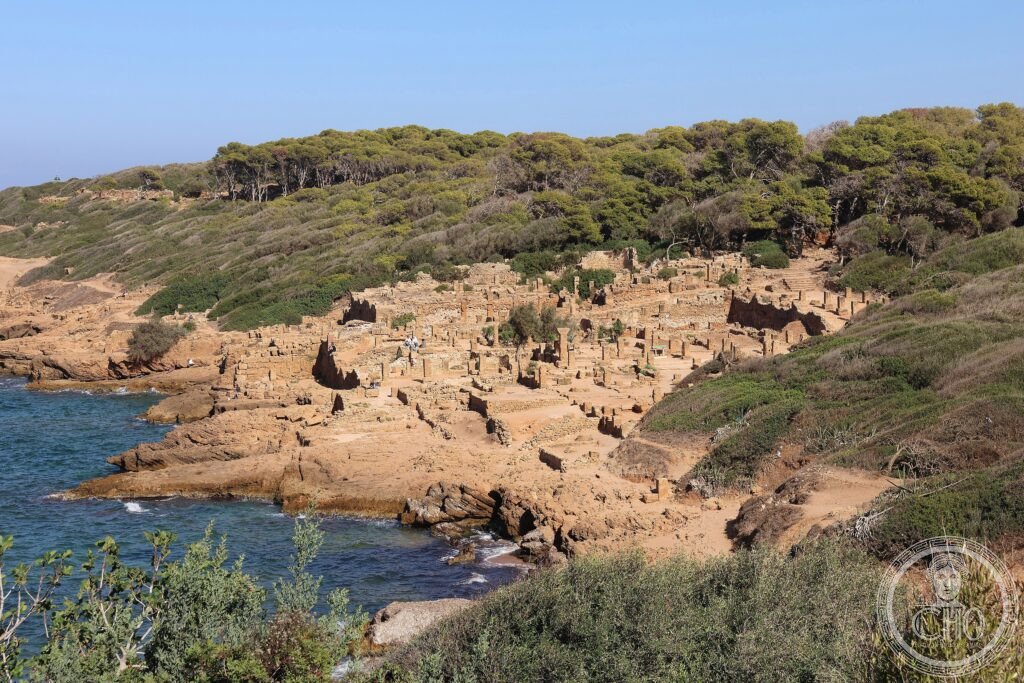
A Phoenician trading post that became a Roman city and then an early Christian centre, Tipasa lies scattered among wild thyme and sea lavender above the Mediterranean. Albert Camus, who returned here often, called it the most beautiful place on earth.
At a glance
Tipasa began as a Phoenician coastal settlement in the 6th century BCE, one link in a chain of trading posts running from the Lebanon to Iberia. The emperor Claudius raised it to the status of Roman municipium in 47 CE, and under Caracalla, in 212 CE, its inhabitants received full Roman citizenship. Vandals destroyed much of the city in the 5th century, and Justinian’s Byzantine administration partially revived it in the 6th.
The site is inseparable from Albert Camus, the Algerian-French novelist and Nobel laureate, who wrote his earliest and most exuberant essays about it. His 1938 collection Les Noces describes his visits in almost mystical terms, and he returned to write about the place again after the Second World War in Retour à Tipasa.
Key facts
- Royal Mausoleum of Mauritania: a circular tower tomb of 25 BCE on a hill above the site, built for King Juba II and Cleopatra Selene, daughter of Cleopatra VII and Mark Antony; the largest and finest pre-Roman monument in North Africa.
- Great Basilica: a seven-aisled 4th-century church dedicated to St Salsa, one of the largest early Christian basilicas in Africa, with foundations and column stumps still standing.
- Tipasa Museum: known as the Stephan Gsell Museum, founded in 1930 as the earliest archaeological museum in North Africa, holding mosaics, sculpture and inscriptions from the site, including a fine 2nd-century marine mosaic.
- Status: inscribed as a UNESCO World Heritage Site in 1982.
- Location: 36.5923° N, 2.4476° E.
History
Tipasa’s Christian life is marked by the death of St Salsa around 304 CE, who was thrown from the port cliff into the sea after destroying a pagan idol of Mithra and became the city’s patron saint. In the 4th century the community split during the Donatist schism, the same controversy that divided the church at Timgad. When the Vandal king Huneric issued a religious decree in 484 CE, the Catholic bishop of Tipasa chose exile rather than sign it, leaving behind the Letter of the Bishops of Mauritania Caesariensis, a notable document of that period.
The French Algerian archaeologist Stéphane Gsell began excavating the site in 1891. His survey of Roman Algeria established Tipasa as one of the most complete examples of an early Roman colonial city in North Africa.
What you see
The forum, laid out in the 2nd century CE, is a colonnaded square that once held the curia, a basilica and a temple on three of its sides. Its original pavement survives, and a colonnaded street runs from the forum down to the sea. Olive trees now grow among the fallen columns, giving the ruins an intimate, unusually green setting for a Roman site in North Africa.
To the east lies the necropolis, a Christian cemetery of the 4th and 5th centuries with several thousand graves, including sarcophagi and mosaic-covered floor tombs. Many of the tomb inscriptions record the beliefs of the early North African church.
Practical information
- Layout: the site is divided into two separate areas, the Roman ruins and the Royal Mausoleum hill, which require separate visits.
- Best time to visit: spring and autumn are generally recommended, avoiding the height of summer.
- Tickets and hours: check the current admission arrangements through the site’s own visitor information before travelling.
- Reading for the visit: Camus’s Les Noces makes an apt companion for a walk through the ruins.
Getting there
Tipasa lies on the Algerian coast west of Algiers, reached by the coastal road. Travellers usually fly into Algiers and continue by hire car or an organised day tour, as there is no direct public bus service to the site.
Nearby
- Cherchell (Caesarea) — the former capital of the Kingdom of Mauritania under Juba II, whose museum holds a large collection of Hellenistic and Roman sculpture, including a marble portrait of Cleopatra Selene; the ancient harbour is visible from the modern port.
- Algiers — home to the Ottoman Casbah, a UNESCO World Heritage Site inscribed in 1992, with steep alleys, Ottoman palaces and the Djamaa el-Djedid mosque of 1660, alongside the Musée National des Beaux-Arts and the Musée du Bardo, which holds Roman mosaics, Phoenician objects and prehistoric North African rock art.
Sources
- Wikipedia
- UNESCO
Find it on the map
See this place and what’s around it →📷 Become a Cultural Heritage Online photographer
Share your photos of places: they stay published under your name as the author. The more they're seen, the more you get noticed — and soon a contest will reward the most appreciated photos.
Log in or sign up free to add a photo