
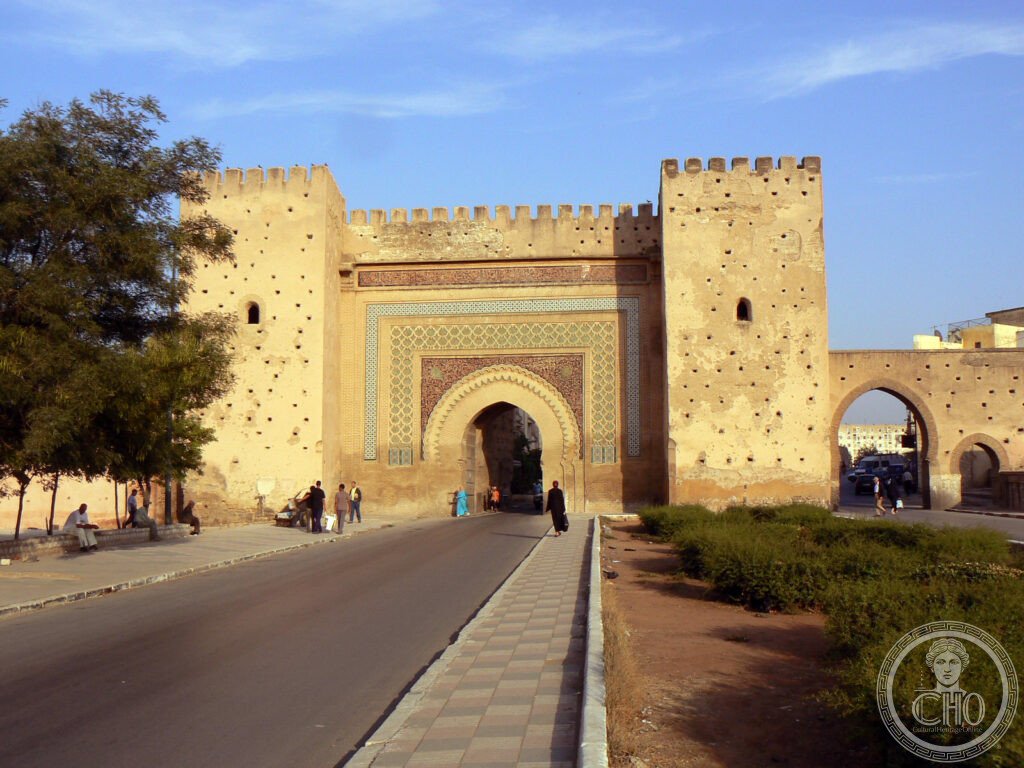
Meknès is Morocco’s least visited Imperial City, built by Sultan Moulay Ismail as his own answer to Versailles. Behind kilometres of ramparts lie vast granaries, a mausoleum open to non-Muslims, and Bab Mansour el-Aleuj, widely considered the finest gate in the country.
At a glance
Meknès began as an Almoravid foundation in the 11th century, but its defining chapter came under Sultan Moulay Ismail, who ruled from 1672 to 1727 and made it his imperial capital. He unified Morocco after a century of civil war and used the resources of the state, including thousands of slaves and prisoners, to raise a walled city with some 40 kilometres of ramparts and around 20 ceremonial gates, along with gardens, mosques and a mellah.
Among the surviving structures is the Heri es-Souani, the imperial stables and granary complex said to have accommodated 12,000 horses and 35,000 soldiers. Its underground vaulted granaries, roughly 35 metres wide, were kept remarkably cool by an evaporation system, and parts have been restored. The Agdal basin, a huge cistern fed by an 18th-century hydraulic system, still holds water today.
Key facts
- Bab Mansour el-Aleuj: completed in 1732, after Moulay Ismail’s death, and named for the converted Christian slave who designed it; its four Corinthian marble columns were taken from the Roman city of Volubilis.
- Mausoleum of Moulay Ismail: built by the sultan for himself in the 17th to 18th century and unusually open to non-Muslims, with zellige tilework, carved stucco and painted cedar ceilings, plus a collection of antique clocks given by Louis XIV of France.
- Volubilis: a Roman site 28 kilometres away, once used by Moulay Ismail as a stone quarry, and the natural day-trip companion to Meknès.
- Medina: founded in the 11th century under the Almoravids, with the Medersa Bou Inania, a Marinid building of 1350, among its finest monuments.
- Status: the Medina of Meknès was inscribed as a UNESCO World Heritage Site in 1996.
History
The Lisbon earthquake of 1 November 1755, estimated at magnitude 8.5 to 9, caused major destruction as far as Meknès, and large parts of Moulay Ismail’s imperial city collapsed as a result. The ruined state of the stables today is a consequence of that earthquake rather than of simple neglect, and the imperial palace area has remained partly in ruins ever since.
The Mellah, the Jewish quarter established by Moulay Ismail in the 17th century, is counted among the best-preserved in Morocco. Its houses show the balconied upper storeys and wooden-latticed windows typical of Moroccan Jewish urban architecture.
What you see
The medina retains its 11th-century Almoravid foundations and is generally quieter and less commercialised than those of Fes or Marrakesh. Its souks include the souk des bijoutiers for jewellery and the souk des tissus for cloth, and the Medersa Bou Inania survives with carved stucco, cedar work and a former student dormitory for Quranic scholars.
The Place el-Hedim, whose name means Square of Ruins, was built by Moulay Ismail from material taken from buildings he demolished to construct his imperial city. It sits in front of Bab Mansour and functions as the city’s main gathering square, smaller and calmer than Marrakesh’s Djemaa el-Fna but serving the same purpose for storytellers, musicians and snake charmers.
Practical information
- Entry: access to the imperial city is free; the mausoleum and certain sites charge a small entrance fee, best checked on arrival or via official channels.
- Time needed: a full day is recommended for Meknès itself, with a further half day for Volubilis.
- Where to stay: the Riad Bahia, in the medina, is built on the former palace of Moulay Ismail’s harem.
- Local wine: the surrounding plain produces Gris de Guerrouane, a rosé, along with reds from Cinsault and Grenache grapes, available at local restaurants.
Getting there
Meknès is reached by flying into Fes and continuing by train or bus, or by direct train from Casablanca. The train station lies in the new city, a short taxi ride from the medina.
Nearby
- Volubilis — about 28 kilometres north, roughly 40 minutes by car or grand taxi; the finest Roman ruins in Morocco, best seen in the late afternoon light; not a UNESCO World Heritage Site according to this source.
- Fes — 60 kilometres east, about an hour by train; a UNESCO World Heritage Site since 1981, with the Chouara tanneries and the al-Qarawiyyin mosque, founded in 859, considered the oldest continuously operating university built around a mosque; Meknès makes a quiet base for day trips there.
Sources
- Wikipedia, Meknès
- Wikipedia, Moulay Ismail ibn Sharif
- Wikipedia, Bab Mansour
- UNESCO, Medina of Meknès, WHS reference 793
Find it on the map
See this place and what’s around it →📷 Become a Cultural Heritage Online photographer
Share your photos of places: they stay published under your name as the author. The more they're seen, the more you get noticed — and soon a contest will reward the most appreciated photos.
Log in or sign up free to add a photo