
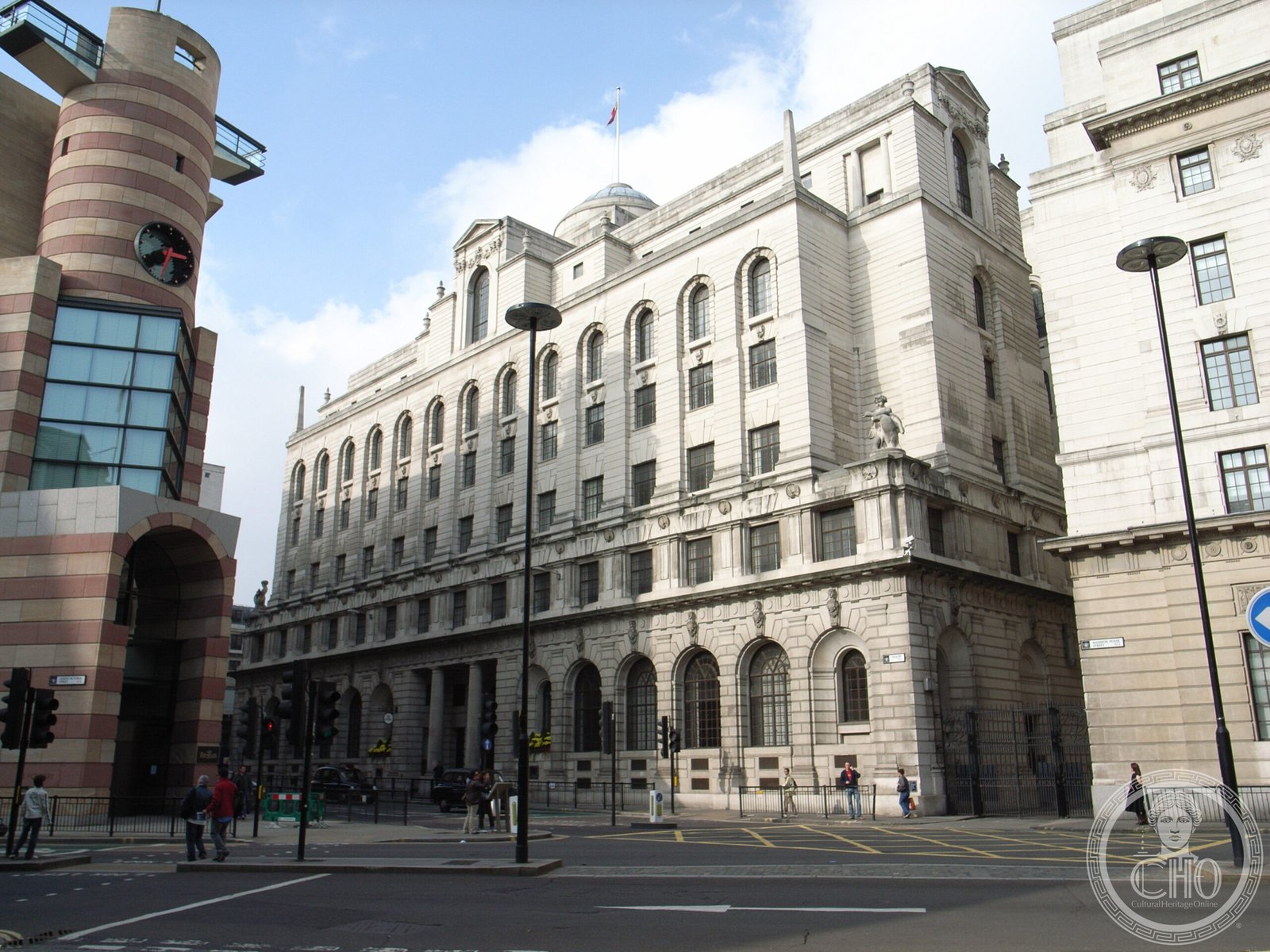
Lutyens’ grandest City building spent eight decades as a bank headquarters and a decade empty before reopening under the architect’s own nickname.
At a glance
The Ned occupies the former head office of Midland Bank at 27 Poultry, on the corner of Princes Street in the City of London, a few steps from the Bank of England. Designed by Sir Edwin Lutyens and begun in 1924, the building rose in phases over fifteen years and is listed at Grade I — the highest tier of statutory protection in England. Historic England, which added it to the list on 5 June 1972, describes it as one of Lutyens’ finest urban buildings. Since 2017 it has operated as a hotel and members’ club run by Soho House together with the Sydell Group, named after the nickname by which Lutyens was known: Ned.
Key facts
- Original function: head office of Midland Bank
- Architect: Sir Edwin Lutyens
- Construction: begun 1924, built in phases; Lutyens returned to extend the building in 1935–37, with completion usually dated 1939
- Protection: Grade I listed, 5 June 1972 (Historic England list entry 1064598, as “Midland Bank”)
- Conversion: 2017, hotel and members’ club (Soho House and Sydell Group)
- Name: “The Ned”, after Lutyens’ lifelong nickname
History
Midland Bank commissioned Lutyens — by then the most celebrated British architect of his generation, fresh from New Delhi and the Cenotaph — to build its head office on Poultry, one of the short streets converging on the Bank junction at the financial heart of the City. Work began in 1924 and proceeded in phases as the bank acquired ground and the building grew along Princes Street. Lutyens himself returned to extend it in 1935–37, and completion is usually dated to 1939, on the eve of the war.
The building served as Midland’s headquarters for most of the twentieth century. After the banking group’s absorption and the departure of its offices, the vast interior stood largely unused until Soho House and the New York-based Sydell Group undertook its conversion, completed in 2017. Rather than strip the banking floor for redevelopment, the conversion preserved the original structure and its principal interiors, and the new hotel took its name from the architect.
What you see
From Poultry and Princes Street the building presents the composed classical monumentality that made Lutyens’ reputation: a stone office palazzo scaled to hold its own beside the Bank of England, its long elevations handled with the subtle games of proportion — recessions, rustication, calculated diminutions — that Historic England singles out in ranking it among his finest urban work.
Inside, the 2017 conversion kept the spaces that made the bank famous. The original banking hall survives as the great public room of the hotel, its forest of green verdite columns intact; the marble staircase and the bank’s boardroom were likewise preserved, as documented by The Lutyens Trust. The result is one of the rare City interiors of the interwar period that can still be experienced much as its architect composed it.
Practical information
- Address: 27 Poultry, London EC2R 8AJ, United Kingdom
- Access: the exteriors on Poultry and Princes Street are visible from the street at any time; the former banking hall now houses the hotel’s ground-floor restaurants, while upper floors and club spaces are reserved for guests and members
- Contact: via the hotel, thened.com/london
Getting there
The building stands directly at the Bank junction, served by Bank Underground station (Central, Northern and Waterloo & City lines, plus the DLR); the station’s exits open within sight of the facade. St Paul’s station on the Central line is a short walk west along Cheapside.
Nearby
- Bank of England and its museum — directly across the Bank junction
- Royal Exchange — two minutes on foot
- Mansion House, official residence of the Lord Mayor — across Poultry
- St Paul’s Cathedral — about ten minutes’ walk west along Cheapside
Sources
- Historic England, list entry 1064598, “Midland Bank” — historicengland.org.uk
- The Lutyens Trust, on the Midland Bank headquarters and its conversion — lutyenstrust.org.uk
- Premier Construction News, “The Ned” (24 April 2017) — premierconstructionnews.com
- The Week, “In the bank: The Ned brings luxury to an iconic building” — theweek.com
Find it on the map
See this place and what’s around it →
📷 Become a Cultural Heritage Online photographer
Share your photos of places: they stay published under your name as the author. The more they're seen, the more you get noticed — and soon a contest will reward the most appreciated photos.
Log in or sign up free to add a photoIs this page about you?
This page is read by travellers and heritage enthusiasts who find it on Google. Tell us how you are connected to this place and we will take it from there.