
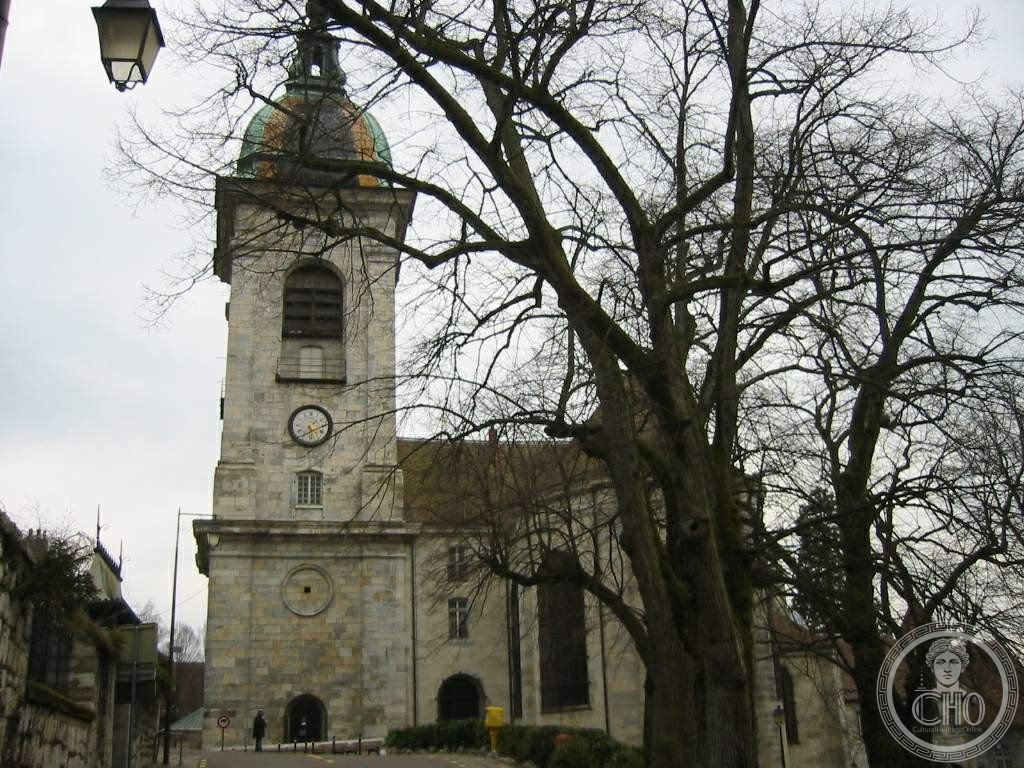
As at Nevers, here too two apses face one another instead of a single one — an architectural rarity that makes the cathedral of Besançon unique in France. Since 1860 a monumental astronomical clock of 30,000 components and 60 dials has given 122 different readings, all interconnected.
At a glance
Besançon Cathedral (Cathédrale Saint-Jean) traces its origins to a 3rd-century Franc-Comtois Carolingian basilica, rebuilt multiple times over the following centuries, notably in the 9th and 11th centuries, and combining Romanesque, Gothic, and Baroque elements within a single building. Its most architecturally distinctive feature is a rare double-apse design — two opposing apses rather than the single choir typical of most cathedrals — that makes it architecturally unique among French cathedrals, a configuration some historians connect to comparable double-apse arrangements elsewhere, including at Nevers. Since 1860, the cathedral has also housed one of France’s most celebrated astronomical clocks: built by clockmaker Auguste-Lucien Vérité between 1858 and 1860 at the request of Archbishop Mathieu, the monumental mechanism comprises some 30,000 individual components driving 60 dials that together provide 122 different interconnected indications, officially classified as a French historic monument in 1991.
Key facts
- Origins: 3rd-century Franc-Comtois Carolingian basilica, rebuilt notably in the 9th and 11th centuries; combines Romanesque, Gothic, and Baroque elements
- Double apse: a rare architectural feature giving the cathedral two opposing apses rather than a single choir — architecturally unique in France, comparable to the Nevers cathedral configuration
- Astronomical clock: built 1858-1860 by Auguste-Lucien Vérité for Archbishop Mathieu; approximately 30,000 components, 60 dials, 122 different interconnected indications; classified French historic monument in 1991
- Earlier clock attempt: a first astronomical clock, installed by Constant Flavien Bernardin 1851-1857, proved too mechanically complex and frequently malfunctioned, prompting the commission of Vérité’s more successful replacement
- Minor basilica status: the cathedral holds the designation of minor basilica and is seat of the Roman Catholic Archdiocese of Besançon; classified historic monument since 1875
History
Besançon Cathedral’s centuries-long sequence of reconstructions, from its 3rd-century Carolingian-period origins through major campaigns in the 9th and 11th centuries and subsequent Gothic and Baroque additions, reflects the kind of continuous, layered building history typical of major early French ecclesiastical sites, with each period’s architects and patrons adapting and extending the earlier structure rather than starting entirely afresh. The building’s rare double-apse configuration, sharing this distinctive feature with only a small number of other French cathedrals including Nevers, likely reflects similarly incomplete or deliberately preserved earlier choir structures left standing when later reconstruction campaigns added new liturgical east ends rather than demolishing what already existed — though the precise circumstances behind Besançon’s specific double-apse arrangement are documented with less certainty than at some comparable sites.
The astronomical clock’s own history within the cathedral illustrates a specific pattern of technical ambition followed by practical difficulty and eventual successful resolution: Archbishop Mathieu’s initial commission to Constant Flavien Bernardin in 1851 produced a mechanism whose complexity exceeded what contemporary clockmaking technology could reliably sustain, leading to frequent malfunctions across its six years of operation before the archbishop turned to Auguste-Lucien Vérité, a more established figure in French monumental clockmaking, to build an entirely new mechanism from 1858 to 1860. Vérité’s replacement, with its roughly 30,000 components and 122 interconnected indications across 60 dials, proved substantially more reliable and durable, remaining in operation and eventually earning formal historic monument protection in 1991 — a recognition of both its technical sophistication and its status as one of the most complete surviving 19th-century monumental astronomical clocks in France.
What you see
The double-apse configuration is the building’s essential architectural distinction, and walking the full length of the cathedral to observe both opposing east ends gives visitors a direct sense of this genuinely rare design choice, shared with only a handful of comparable French examples. The astronomical clock, housed in a dedicated space within the cathedral and accessible via separate paid admission (not guaranteed year-round), rewards visitors with its extraordinarily dense mechanical display across 60 interconnected dials, a level of horological ambition rarely matched even among France’s other notable monumental clocks. The cathedral’s Fra Bartolomeo painting, “Virgin with Saints,” and its broader combination of Romanesque, Gothic, and Baroque decorative elements add further layers to a building whose architectural history spans well over a millennium.
Practical information
- Cathedral opening hours: daily 9:00-19:00 (9:00-18:00 from All Saints to Easter); free admission
- Astronomical clock: access not guaranteed year-round; paid admission, approximately €5; last entry 30 minutes before closing
- Address: 10 Rue de la Convention, 25000 Besançon
Getting there
Besançon has direct TGV rail connections from Paris (approximately 2.5 hours). From Besançon Viotte station, the cathedral is approximately 2.1 km, reachable by bus lines L3 or L5, or tram line T2. By car, Besançon sits on the A36 motorway. GPS: 47.2336° N, 6.0304° E.
Nearby
- Citadelle de Besançon — a short walk from the cathedral; a Vauban-designed fortress, UNESCO World Heritage as part of the “Fortifications of Vauban” series since 2008
- Besançon historic centre — on a loop of the Doubs river surrounding the cathedral; birthplace of Victor Hugo
- Musée des Beaux-Arts et d’Archéologie de Besançon — in the city centre; one of France’s oldest public museums, founded 1694
Sources
- Cathédrale de Besançon et son horloge astronomique — official visitor portal (horloge-astronomique-besancon.fr)
- Diocèse de Besançon — official cathedral information (diocese-besancon.fr)
- Besançon Tourisme — official visitor information (besancon-tourisme.com)
- Wikipedia — “Cathédrale Saint-Jean de Besançon” and “Horloge astronomique de Besançon” (fr.wikipedia.org)
Find it on the map
See this place and what’s around it →📷 Become a Cultural Heritage Online photographer
Share your photos of places: they stay published under your name as the author. The more they're seen, the more you get noticed — and soon a contest will reward the most appreciated photos.
Log in or sign up free to add a photoIs this page about you?
This page is read by travellers and heritage enthusiasts who find it on Google. Tell us how you are connected to this place and we will take it from there.