
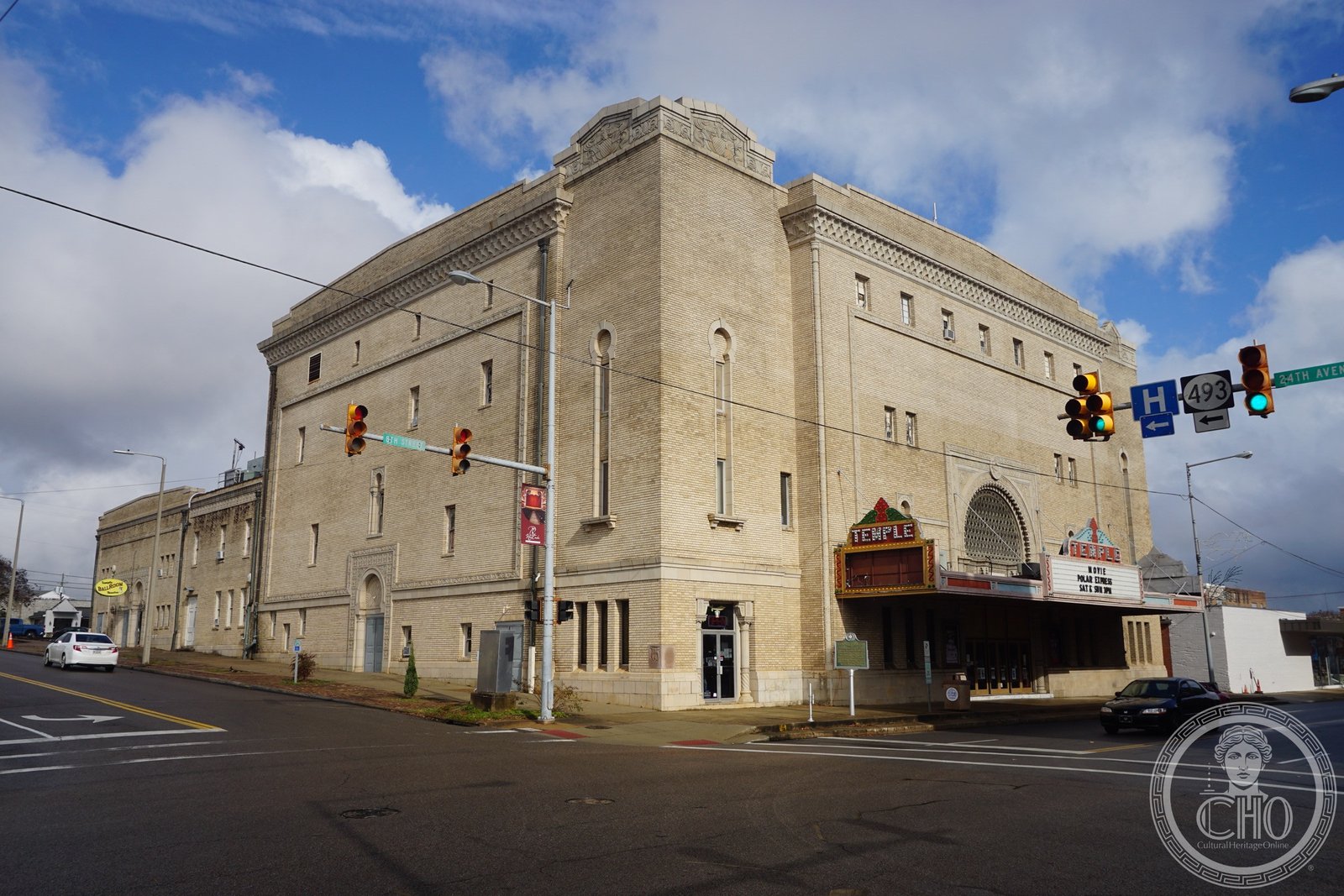
On Fifth Street in the heart of downtown Meridian, the Temple Theater stands as Mississippi’s finest surviving example of the Atmospheric movie palace tradition — a 1927 building whose elaborately decorated interior creates the illusion of an open-air courtyard beneath a night sky, making it one of the most distinctive architectural experiences in the American South.
At a glance
The Temple Theater on Fifth Street is a rare surviving example of the Atmospheric theater type pioneered by architect John Eberson in the 1920s — a design approach in which the auditorium interior simulates an outdoor Mediterranean courtyard under a deep blue ceiling studded with electric stars, creating the immersive theatrical environment that distinguished Atmospheric theaters from conventional movie palaces. Opened in 1927 at the height of the silent film era, the Temple Theater served as Meridian’s premier cinema for decades, its extraordinary interior making the experience of attending a film feel like a journey to another world. Listed on the National Register of Historic Places, it has been the subject of preservation efforts that have maintained the integrity of its remarkable interior.
Key facts
- Location: Fifth Street, downtown Meridian, MS 39301
- Opened: 1927
- Style: Atmospheric theater (Spanish/Mediterranean Revival)
- Interior motif: Open-air Mediterranean courtyard with electric star ceiling
- Designation: National Register of Historic Places
- GPS: 32.3643° N, 88.7037° W
History
Meridian in the 1920s was the largest city in Mississippi — a railroad junction city built on the intersection of the Mobile and Ohio and Southern railways whose commercial importance to the surrounding region supported a downtown of genuine urban ambition. The city’s position as the economic hub of east-central Mississippi gave it the population and the commercial confidence to sustain the kind of entertainment investment that Atmospheric theaters represented.
The Atmospheric theater concept, developed by architect John Eberson in the early 1920s, addressed a specific problem: how to give moviegoers the most pleasurable possible environment for watching films in an era when air conditioning was either unavailable or unreliable. Eberson’s solution was to design auditoriums that simulated outdoor courtyards — a Mediterranean palace garden or a Spanish colonial plaza — with a deep blue ceiling pierced by electric stars and fitted with apparatus to project moving clouds, giving audiences the sensation of sitting beneath an open sky on a warm evening. The theatrical effect of these interiors was extraordinary: the auditorium became a destination in itself, independent of whatever film happened to be playing.
The Temple Theater brought this tradition to Meridian, providing the city’s audiences with an interior experience that rivaled anything available in much larger American cities. Its 1927 opening coincided with the last years of the silent film era; the arrival of sound cinema the following year did not diminish its appeal, and the theater served Meridian through the golden age of Hollywood and into the postwar decades. The subsequent history of downtown Meridian — like many American cities, shaped by suburban development and demographic change — eventually reduced the theater’s active role, but preservation recognition ensured that the building’s distinctive interior was not lost to demolition or insensitive renovation.
What you see
The Fifth Street facade presents the Temple Theater as a substantial commercial building whose architectural character signals the importance of its contents without revealing them: a formal composition of stone and ornamental detail that gives the theater its presence on downtown Meridian’s main commercial street. The exterior is the building’s introduction; the interior is its argument.
The auditorium is one of the most remarkable interiors in Mississippi: walls finished to simulate the stucco surfaces of a Mediterranean courtyard, with decorative architectural elements — balconies, arched windows, ornamental towers — creating the illusion of a building within a building. The ceiling is the defining feature: a deep blue field with electric stars that creates the sensation of a night sky over an open courtyard, with apparatus capable of simulating the movement of clouds across the field of stars. The total effect is of a space that has removed the audience from any ordinary interior context and placed them in an imagined southern European outdoors.
Practical information
- Current status: Preservation site; check local Meridian arts organizations for current programming and access information
- Downtown Meridian: The theater is in the historic Fifth Street corridor; downtown Meridian has undergone revitalization efforts centered on its historic architecture
- Mississippi as a whole: Meridian sits at the junction of I-20 and I-59, making it accessible from Birmingham, Jackson, and New Orleans
Getting there
Meridian is at the intersection of Interstate 20 and Interstate 59 in east-central Mississippi, approximately 90 miles east of Jackson and 90 miles west of Birmingham, Alabama. Key Field (MEI) is Meridian’s regional airport. Amtrak’s Crescent (New York–New Orleans) stops at Meridian’s historic passenger depot. Downtown Meridian’s Fifth Street commercial district is compact and walkable from the rail station.
Nearby
- Meridian Amtrak Station / Union Station (1906) — the historic passenger terminal that has served Meridian since the railroad era, still active as an Amtrak stop on the Crescent route; the building is a document of Meridian’s importance as a railroad junction in the early twentieth century
- Jimmy Rodgers Museum — the museum dedicated to the “Father of Country Music,” Meridian-born Jimmie Rodgers (1897–1933), whose recording career in the late 1920s established the foundations of country music and whose Blue Yodel series remains one of the most influential bodies of recorded work in American music history
- Meridian Museum of Art — the regional art museum serving east Mississippi, housed in the former Carnegie Library building; the collection covers American and regional art with particular strength in Southern folk and self-taught traditions
- Okatibbee Lake — the reservoir and recreation area west of Meridian, offering water sports, camping, and the natural landscape of the Piney Woods region of east-central Mississippi; a contrast to the city’s urban core
Sources
- National Register of Historic Places, Temple Theater nomination
- Mississippi Department of Archives and History architectural documentation
- Ben M. Hall, The Best Remaining Seats: The Story of the Golden Age of the Movie Palace (1961)
- Ben Schlanger and Michael Miller, Atmospheric theater documentation, Theatre Historical Society of America
- Meridian Star archives — Temple Theater history
Find it on the map
See this place and what’s around it →📷 Become a Cultural Heritage Online photographer
Share your photos of places: they stay published under your name as the author. The more they're seen, the more you get noticed — and soon a contest will reward the most appreciated photos.
Log in or sign up free to add a photoDo you manage this place?
This page is read by travellers and heritage enthusiasts who find it on Google. Keep it accurate — and make it work for you. Free for non-profit heritage institutions.