

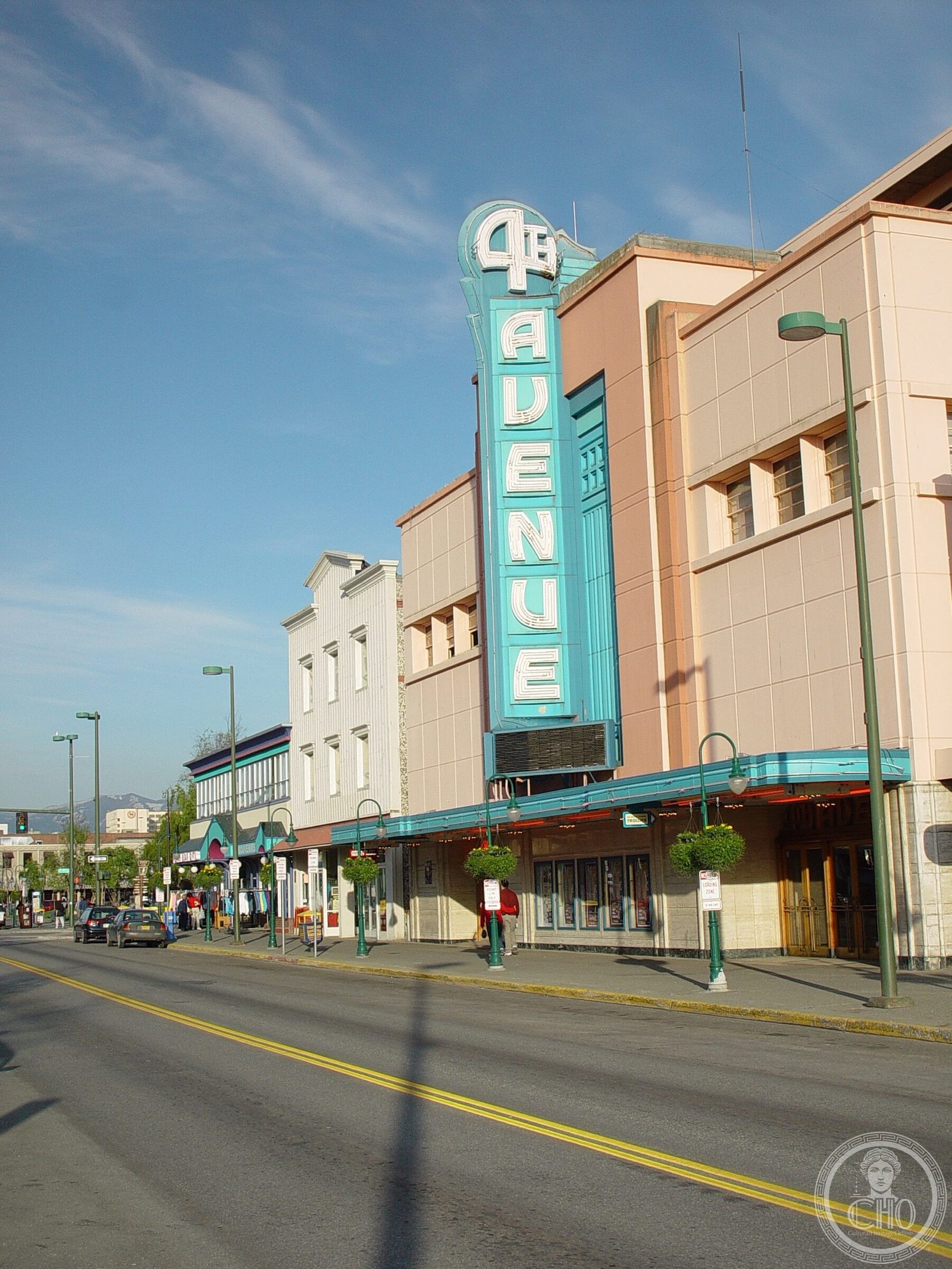
On West 4th Avenue in the heart of downtown Anchorage, the 4th Avenue Theatre stands as the finest Art Deco building in Alaska — a 1947 movie palace whose exuberant facade incorporates Alaska wildlife and Northern imagery into the geometric vocabulary of the style, creating a building that is simultaneously a masterwork of mid-century theatrical design and a uniquely Alaskan cultural monument.
At a glance
The 4th Avenue Theatre at 630 W 4th Avenue is the most architecturally distinguished building in Anchorage and one of the most distinctive regional expressions of Art Deco design anywhere in the United States. Built in 1947 — after the Second World War, as Anchorage was beginning its transformation from a small railroad town into the urban center of a growing territory — the theater combined the geometric vocabulary and atmospheric interior of the Art Deco movie palace with decorative programs specific to Alaska: relief carvings and ornamental details drawn from the natural world of the Arctic and Subarctic, the indigenous cultures of the North, and the landscapes of the territory’s mountains and coastline. The result is a building that would be remarkable anywhere and is extraordinary in Alaska, where it stands as the premier historic cultural venue of the state’s largest city.
Key facts
- Address: 630 W 4th Avenue, Anchorage, AK 99501
- Opened: 1947
- Style: Art Deco with Alaska-specific decorative program
- Designation: National Register of Historic Places
- GPS: 61.2175° N, 149.8990° W
History
Anchorage in 1947 was a city in rapid transformation. Founded in 1915 as a construction camp for the Alaska Railroad, it had grown through the 1930s into the principal commercial center of south-central Alaska and had been dramatically expanded during the Second World War by the construction of military bases — Fort Richardson and Elmendorf Air Force Base — that brought tens of thousands of military and civilian personnel to the region. By 1947, Anchorage was the largest city in the Alaska Territory and was positioning itself as the center of Alaska’s postwar development.
The construction of the 4th Avenue Theatre in this context was an act of civic confidence: the assertion that Anchorage had arrived as a city deserving a first-class entertainment venue. The design incorporated the full vocabulary of the Art Deco movie palace — the ornate facade, the atmospheric interior, the careful design of lobby, foyer, and auditorium as a total aesthetic experience — while adapting its decorative program to the specific character of Alaska. The theater’s facade and interior details drew on the wildlife, landscapes, and indigenous visual traditions of Alaska in ways that made the building unmistakably of its place even as it participated in the broader national vocabulary of midcentury theatrical design.
The theater opened two years before Alaska became the forty-ninth state in 1959 and served Anchorage through the transformation from territory to statehood, through the extraordinary economic development of the oil era following the 1968 discovery of the Prudhoe Bay field, and through the earthquake of 1964 that damaged much of downtown Anchorage. Listed on the National Register of Historic Places, the building has been the subject of preservation advocacy that has recognized its exceptional importance as Alaska’s most significant historic commercial building.
What you see
The 4th Avenue facade presents the theater’s Art Deco character with regional specificity: the geometric ornamental program incorporates bears, salmon, and Alaska wildlife alongside the stylized lettering and architectural detail characteristic of the national Art Deco vocabulary. The marquee and vertical sign create the building’s presence on 4th Avenue — the main commercial street of downtown Anchorage — in the manner of the great movie palaces of the continental United States, but with decorative content specific to Alaska.
The interior is the building’s defining achievement: an auditorium whose decorative program extends the Alaska theme into the design of the room itself, with murals and ornamental elements that create an immersive environment unlike anything in the forty-eight contiguous states. The integration of regional imagery into the Art Deco formal language was accomplished with the kind of sophistication that distinguished the best examples of the style from mere decoration.
Practical information
- Current status: Closed for renovation/redevelopment; check local Anchorage arts organizations for current status and access
- Downtown Anchorage: The theater is in the heart of downtown Anchorage, surrounded by the city’s commercial and cultural facilities; the Anchorage Museum at Rasmuson Center is nearby
- Best season: Summer (June–August) for maximum daylight and the full range of Anchorage’s outdoor life; winter for aurora and the unique experience of a subarctic city
Getting there
Anchorage is accessible via Ted Stevens Anchorage International Airport (ANC), one of the world’s busiest cargo airports and the primary gateway to Alaska, with flights connecting to Seattle, Los Angeles, Chicago, and other major cities as well as direct international service. Downtown Anchorage is approximately 6 miles from the airport via the Seward Highway. The 4th Avenue Theatre is on West 4th Avenue in the heart of downtown, walkable from the major downtown hotels and the transit center. Amtrak does not serve Alaska; rail connections within Alaska are via the Alaska Railroad.
Nearby
- Anchorage Museum at Rasmuson Center — the premier museum of Alaska history, art, and science, two blocks from the theater; the museum’s collections cover Alaska Native cultures, the territory-to-statehood era, the oil industry, and contemporary Alaska art in a building that is itself one of Anchorage’s architectural landmarks
- Alaska Native Heritage Center — the cultural center six miles from downtown dedicated to the eleven distinct Alaska Native cultural groups, with traditional buildings, performances, and collections documenting the extraordinary diversity of the indigenous cultures of Alaska; essential context for understanding the decorative program of the 4th Avenue Theatre
- Chugach State Park — the 495,000-acre wilderness area directly adjacent to the eastern edge of Anchorage, with mountains rising from sea level to over 8,000 feet visible from downtown; the park provides hiking, skiing, and wildlife viewing within minutes of the city center, creating the juxtaposition of urban and wilderness that defines the Anchorage experience
- Tony Knowles Coastal Trail — the eleven-mile paved trail along the western edge of Anchorage following Cook Inlet, with views of the Alaska Range and Denali on clear days; the trail passes through Earthquake Park, which preserves the terrain deformed by the 1964 Good Friday Earthquake
Sources
- National Register of Historic Places, 4th Avenue Theatre nomination
- Alaska State Historic Preservation Office documentation
- Anchorage Historic Properties inventory
- Anchorage Daily News archives — 4th Avenue Theatre history
- Anchorage Museum research collections
Find it on the map
See this place and what’s around it →Record researched and written by Luigi De Marchi for Cultural Heritage Online, 2026.
📷 Become a Cultural Heritage Online photographer
Share your photos of places: they stay published under your name as the author. The more they're seen, the more you get noticed — and soon a contest will reward the most appreciated photos.
Log in or sign up free to add a photoIs this page about you?
This page is read by travellers and heritage enthusiasts who find it on Google. Tell us how you are connected to this place and we will take it from there.