

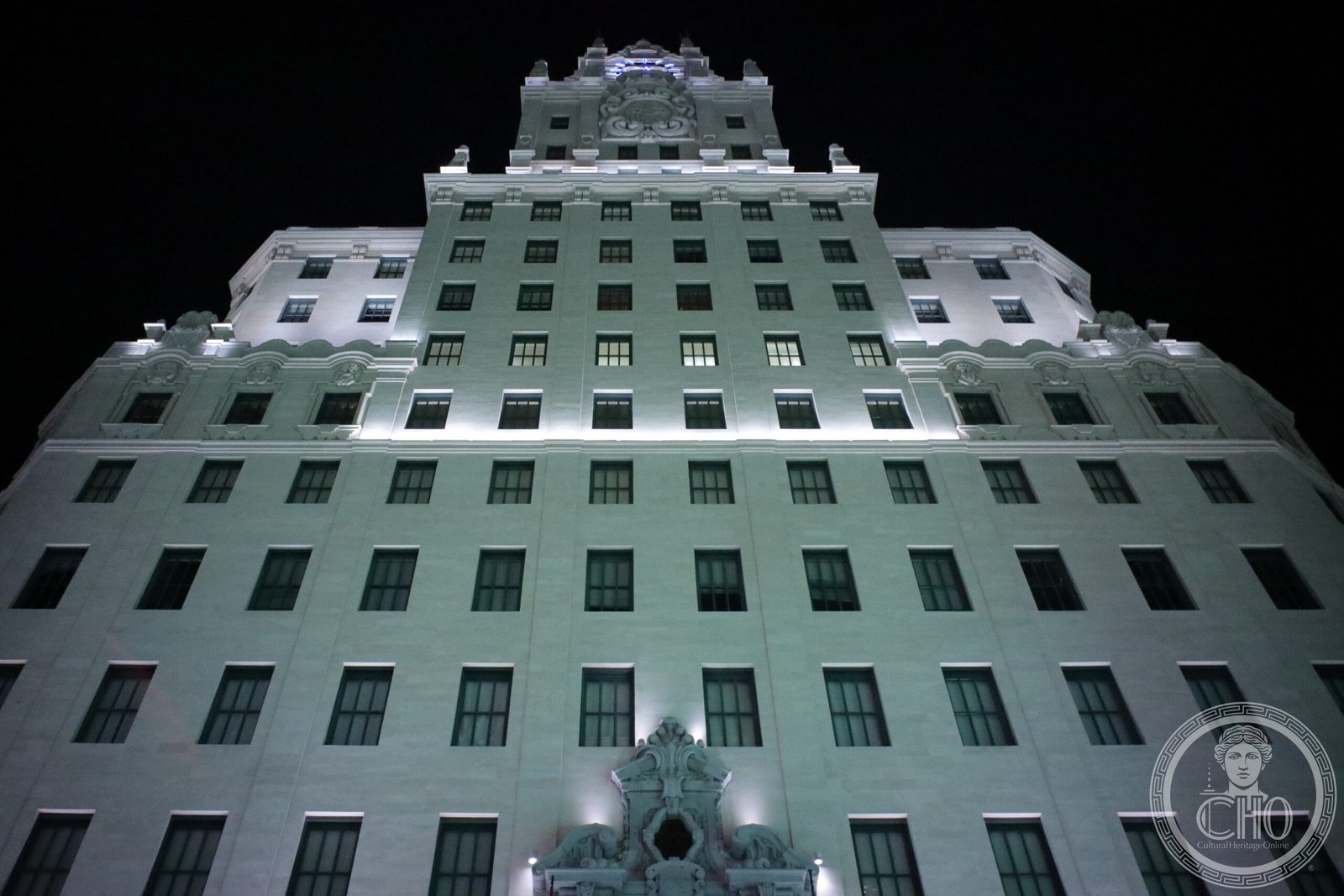
The Telefónica Building rises 89 metres above the Gran Vía in central Madrid, a bold fusion of American skyscraper ambition and Spanish Baroque ornament that was Europe’s tallest building when it opened in 1930. Completed in 1929 to designs by Ignacio de Cárdenas, the fourteen-storey tower housed the national telephone company and became an observation post for Republican forces during the Spanish Civil War, witnessing some of the most intense fighting in the city. Today it is home to the Fundación Telefónica and a public cultural centre.
At a glance
- Type
- Office tower / cultural centre
- Period
- 1926–1929 (construction); officially opened 1 January 1930
- Style
- Art Deco with Spanish Churrigueresque ornamentation
- Location
- Gran Vía 28, 28013 Madrid, Spain
- Coordinates
- 40.4200° N, 3.7019° W
- Architect(s)
- Ignacio de Cárdenas (with Louis S. Weeks as consulting architect)
Overview
The Telefónica Building anchors one of the most prominent intersections on Madrid’s Gran Vía boulevard, its pale stone tower piercing the skyline in a way that still commands attention nearly a century after its completion. At 14 storeys and 89 metres to the top of its lantern, it held the title of Europe’s tallest building from 1930 until 1940. Today the Fundación Telefónica operates the building as a cultural venue, hosting permanent and temporary exhibitions on art, science and telecommunications history, alongside a publicly accessible auditorium.
History
Construction of the tower began in 1926 as part of Compañía Telefónica Nacional de España’s ambitious modernisation programme, employing over 1,000 workers at a cost of approximately 32 million pesetas. The building was completed in March 1929 and officially inaugurated on 1 January 1930. During the Spanish Civil War (1936–1939) it served as a critical Republican observation post and communications hub; journalists including Ernest Hemingway and Antoine de Saint-Exupéry filed dispatches from its upper floors while Nationalist artillery targeted the building repeatedly. It remained Madrid’s tallest structure until 1953.
Architecture & Design
Ignacio de Cárdenas looked to the American skyscraper model — particularly New York’s Beaux-Arts towers — while working with consulting architect Louis S. Weeks to achieve the height and structural engineering required. The result is a hybrid: a steel-framed tower clad in limestone that steps back as it rises, topped by a Baroque lantern that references churrigueresque stonework tradition. The fusion reflects the period’s effort to absorb international modernism without abandoning national architectural identity, placing it in a parallel dialogue with Western Art Déco while maintaining a distinctly Iberian character. Ornamental reliefs on the upper storeys contrast with the clean verticals of the shaft below.
Cultural significance
The Telefónica Building carries layered significance: as a symbol of Spain’s industrial and commercial modernisation in the 1920s, as a witness to the Spanish Civil War in the heart of Madrid, and as an enduring architectural landmark on the Gran Vía. Its conversion into the Fundación Telefónica cultural centre has brought the building into the contemporary art and science discourse, while its skyline presence continues to define the character of central Madrid for residents and visitors alike.
Visiting today
The Fundación Telefónica occupies the lower floors and is open to the public free of charge for most exhibitions. The permanent collection covers the history of communications technology alongside contemporary art. Temporary exhibitions on the ground and upper floors change seasonally. An auditorium hosts lectures, concerts and screenings. Opening hours are Tuesday to Sunday; check the Fundación Telefónica website for current exhibition schedules and any ticketed events.
Getting there
The nearest Madrid Metro stations are Gran Vía (Line 5, red line) and Callao (Lines 3 and 5), both less than three minutes’ walk from the building’s entrance at Gran Vía 28. Several EMT Madrid bus lines serve the Gran Vía corridor. The area is pedestrian-friendly and easily reached from Plaza de España or Sol on foot. Bicycle docking stations of BiciMAD are located along the Gran Vía nearby.
Sources & resources
Find it on the map
See this place and what’s around it →Record researched and written by Luigi De Marchi for Cultural Heritage Online, 2026.
📷 Become a Cultural Heritage Online photographer
Share your photos of places: they stay published under your name as the author. The more they're seen, the more you get noticed — and soon a contest will reward the most appreciated photos.
Log in or sign up free to add a photoIs this page about you?
This page is read by travellers and heritage enthusiasts who find it on Google. Tell us how you are connected to this place and we will take it from there.