
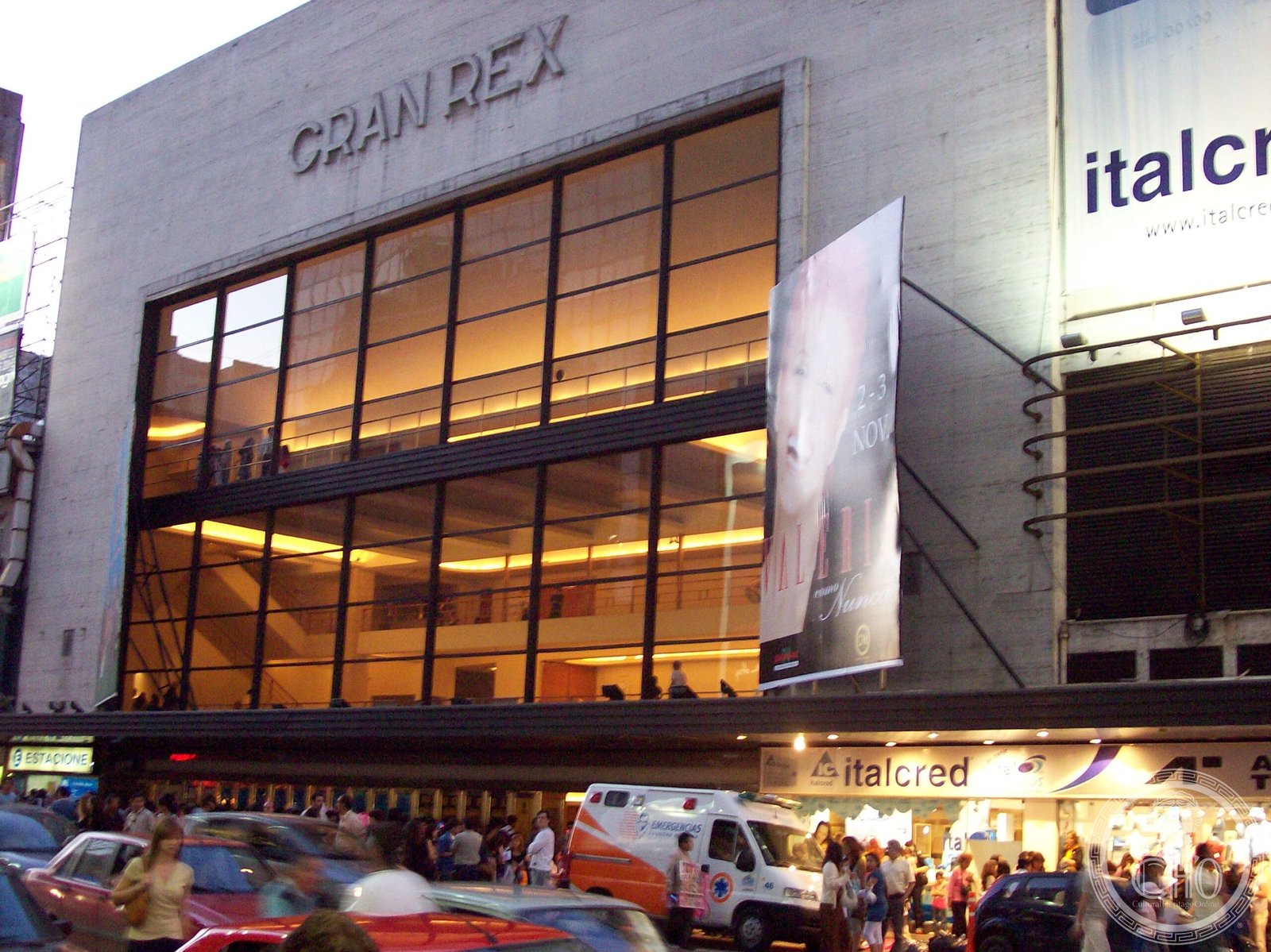
Opened in July 1937 on Corrientes Avenue, Teatro Gran Rex is Buenos Aires’s finest surviving Art Deco theatre, designed by architect Alberto Prebisch in just seven months. With 3,300 seats and an interior inspired by New York’s Radio City Music Hall, it stands as one of South America’s great monuments of interwar modernism and remains the city’s premier venue for international live performances.
At a glance
- Type
- Theatre and Cinema
- Period
- 1936–1937
- Style
- Art Deco
- Location
- 857 Corrientes Avenue, San Nicolás, Buenos Aires
- Coordinates
- 34.6033° S, 58.3789° W
- Architect(s)
- Alberto Prebisch (with engineer Adolfo Moret)
Overview
Teatro Gran Rex anchors the cultural life of Corrientes Avenue, Buenos Aires’s famous “street that never sleeps.” Designed by Alberto Prebisch — the same architect who conceived the Obelisk of Buenos Aires — the theatre opened on 8 July 1937 as the largest cinema in Argentina. Today it hosts some 3,300 spectators across a single grand auditorium and, alongside the Teatro Opera on the opposite side of Corrientes, forms a pair of Art Deco landmarks that define the city’s theatre district.
History
Construction of the Gran Rex was completed in a remarkable seven months during 1936–1937, a testament to the ambitions of its backers and the efficiency of Prebisch’s design process. On opening night the theatre caused a sensation: Argentine intellectual Victoria Ocampo praised it from the pages of her literary journal Sur as an outstanding example of modern architecture. Its original function as a cinema gradually gave way to live performances and international touring productions. In the 1990s the children’s musical Chiquititas, performed every winter holiday season from 1996 to 2001, sold over one million tickets, with the 1998 run setting a house record of 240,000 seats sold in a single season — numbers that cemented the Gran Rex’s place in Argentine popular culture.
Architecture & Design
Prebisch designed the Gran Rex as a pure expression of the Art Deco aesthetic: a streamlined street facade of cream-coloured stone with strong vertical lines, geometric ornamentation in low relief, and minimal classical reference. The interior draws direct inspiration from Radio City Music Hall in New York — a vast, unobstructed single-tier auditorium with curved walls, concealed lighting troughs that produce a warm amber wash, and acoustically refined surfaces. The stage is one of the largest in Argentina, designed for both film projection and live performance. Every surface, from the brass door fittings to the carpet patterns, was treated as part of a coherent decorative programme, making the Gran Rex a rare surviving example of total Art Deco interior design in South America.
Cultural significance
The Teatro Gran Rex stands at the intersection of Argentine modernism and popular culture. Alberto Prebisch, who designed it alongside the Obelisk, used the commission to argue for a crisp, international modern idiom over ornamental eclecticism. The building’s immediate critical success — endorsed by Victoria Ocampo’s influential circle — helped legitimate Art Deco as the prestige style of Buenos Aires’s boom years. Over the decades it has hosted Bob Dylan, Björk, Tony Bennett, Paco de Lucía, and dozens of other international artists, sustaining its role as a cultural crossroads between Argentina and the world.
Visiting today
The Teatro Gran Rex operates as a live-performance venue year-round and does not offer standalone architectural tours; the best way to experience the interior is to attend a show. Tickets are available through the theatre’s box office at 857 Corrientes Avenue and from major Argentine ticketing platforms. The building’s Art Deco facade can be appreciated from the street at any time. The theatre is fully accessible and air-conditioned.
Getting there
The Teatro Gran Rex is located at 857 Avenida Corrientes in the San Nicolás district. The nearest Subte (metro) station is Carlos Pellegrini (Lines B, C, and D intersect at nearby Diagonal Norte / 9 de Julio), a five-minute walk east along Corrientes. Multiple city bus lines (colectivos) run along Corrientes Avenue. Taxis and ride-share services stop directly in front of the theatre.
Sources & resources
Find it on the map
See this place and what’s around it →📷 Become a Cultural Heritage Online photographer
Share your photos of places: they stay published under your name as the author. The more they're seen, the more you get noticed — and soon a contest will reward the most appreciated photos.
Log in or sign up free to add a photoDo you manage this place?
This page is read by travellers and heritage enthusiasts who find it on Google. Keep it accurate — and make it work for you. Free for non-profit heritage institutions.