

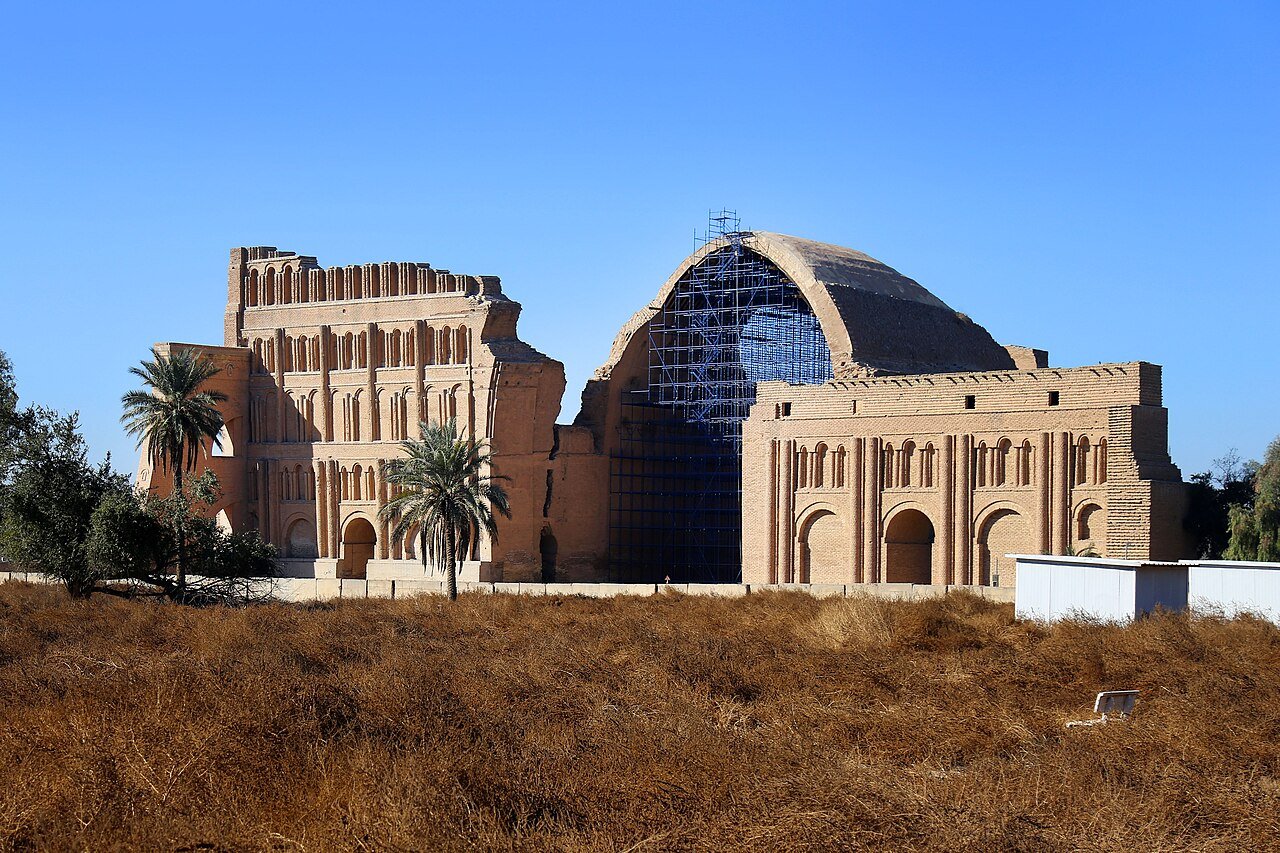
On the eastern bank of the Tigris 35 km southeast of Baghdad, a single brick arch 37 metres tall — the sole surviving above-ground remnant of the Sassanid imperial capital of Ctesiphon — still stands after 1,500 years as the largest single-span brick vault ever constructed in the ancient world, and as the ghost of what was once the most populous city on earth.
At a glance
The Taq-i Kisra (Persian: arch of Khosrow) is the vaulted audience hall of the palace of Sassanid king Khosrow I, constructed approximately 540 AD. Its arch spans 25 metres and rises 37 metres above the Mesopotamian plain; the barrel vault is composed of baked brick laid without centring using the pitched-brick technique — a feat of Sassanid engineering unsurpassed in the ancient world. The city of Ctesiphon, of which this arch is the last above-ground remnant, was at its 6th-century height the most populous city in the world, with an estimated 500,000–800,000 inhabitants. It fell to the Arab armies of Sa’d ibn Abi Waqqas in 637 AD. Today only the arch remains in situ, increasingly threatened by rising Tigris groundwater, and is the focus of ongoing UNESCO advisory and Iraqi conservation efforts.
Key facts
- Height: 37 metres — largest single-span brick arch in the ancient world
- Builder: Khosrow I (Anushirvan), Sassanid king, r. 531–579 AD; arch c. 540 AD
- City: Ctesiphon, Sassanid capital; largest city in the world c. 570 AD (est. 500,000–800,000)
- Fall: 637 AD to Arab forces under Sa’d ibn Abi Waqqas after Battle of Qadisiyyah
- Carpet of Khosrow: Legendary throne-room carpet sewn with gold thread and gemstones; cut and distributed as plunder in 637 AD
- Threat: Rising Tigris groundwater undermining foundations; eastern wing collapsed in 1888 flood
- Location: Near Salman Pak (ancient Madain), 35 km southeast of Baghdad
History
Ctesiphon was founded as the Parthian winter capital on the eastern Tigris bank opposite Seleucia. Under the Sassanid dynasty (226–651 AD), it became the permanent imperial capital and grew into the largest city on earth. Khosrow I, one of the most celebrated rulers in Iranian tradition, expanded the palace complex and constructed the great iwan whose arch survives today. Under his rule the Sassanid Empire stretched from Syria to the borders of India; Persian literature and Zoroastrian scholarship flourished; chess was introduced from India; and the Carpet of Khosrow — a formal spring garden carpet woven in gold thread, rubies, and precious stones, estimated at 27 by 27 metres — was commissioned for the throne hall. When Arab forces captured the city in 637 AD, the carpet was the most famous single piece of plunder: cut into sections and distributed among the soldiers as spoil, its estimated value generating awe in medieval Arab sources.
After the Arab conquest, Ctesiphon was quickly abandoned as the new Islamic capital Al-Kufah was founded nearby, and later Baghdad (762 AD) became dominant. The city’s buildings were systematically dismantled for building material; by the medieval period the palace complex was reduced to foundations. The great arch survived only because no practical method existed to demolish it. It was recorded by European travellers from the 16th century, surveyed by British military officers in the 19th century, and excavated by German and American teams in the 20th century. Today it stands alone in agricultural land, its eastern wing collapsed in the 1888 Tigris flood, its western wing increasingly threatened by groundwater infiltration.
What you see
The surviving wing of the arch demonstrates the structural audacity of Sassanid engineering. The vault is built from fired brick approximately 23 by 23 by 6 cm, laid without wooden centring using the pitched-brick technique: each ring slightly inclined toward the previous, allowing construction to proceed without scaffolding. The facade is articulated with five tiers of blind arcade niches in the characteristic Sassanid manner, creating a rhythm of shadow and surface across the enormous brick expanse. The interior of the hall would have measured approximately 37 metres wide, 25 metres deep, and 50 metres to the crown of the vault; the scale of the space remains fully legible from the single surviving wing.
Around the base of the arch, excavation has revealed foundations of palace buildings, a reception courtyard, and fragments of ornate stucco and mosaic decoration. The Iraq Museum Baghdad holds some decorative material; the in-situ excavated area is visible to visitors. The broader Ctesiphon complex — city walls, subsidiary palaces, the twin city of Seleucia across the river — survives only as low earthen mounds across the surrounding agricultural landscape, readable from the elevated position of the arch.
Practical information
- Location: Near Salman Pak, 35 km southeast of Baghdad on the east bank of the Tigris
- Access: Day trip from Baghdad; the site is open to visitors; verify current security conditions
- Best time: October to March (summer temperatures exceed 45°C)
- Facilities: Minimal on-site; bring water; nearest town is Salman Pak
- Heritage status: Iraqi national heritage monument; UNESCO advisory support for conservation
Getting there
From Baghdad (35 km northwest): take the highway south toward Kut, exit toward Salman Pak; the arch is visible from the approach road. Taxi from Baghdad is the standard approach for individual visitors. Organised day tours from Baghdad are available through local agencies; confirm current access conditions as the Salman Pak area has been sensitive at various periods.
Nearby
- Baghdad — 35 km northwest; the Iraq Museum holds Sassanid material including Ctesiphon finds
- Babylon — 90 km south; UNESCO World Heritage Site, ancient Babylonian capital
- Seleucia — Across the Tigris, the Hellenistic predecessor city; archaeological mounds visible
- Aqar Quf (Dur-Kurigalzu) — 60 km northwest of Baghdad; Kassite ziggurat rising 57 metres above the plain
Sources
- Reuther, Oscar (1929). Die Ausgrabungen der Deutschen Ktesiphon-Expedition im Winter 1928/29. Berlin
- Al-Tabari. Tarikh al-Rusul wa al-Muluk — primary source on fall of Ctesiphon, 637 AD
- Kröger, Jens (1982). Sasanidischer Stuckdekor. Mainz: Philipp von Zabern
- UNESCO World Heritage advisory documentation on Ctesiphon conservation
- Mesopotamian Heritage Foundation: conservation documentation (mesopotamianheritage.org)
Find it on the map
See this place and what’s around it →📷 Become a Cultural Heritage Online photographer
Share your photos of places: they stay published under your name as the author. The more they're seen, the more you get noticed — and soon a contest will reward the most appreciated photos.
Log in or sign up free to add a photoIs this page about you?
This page is read by travellers and heritage enthusiasts who find it on Google. Tell us how you are connected to this place and we will take it from there.