

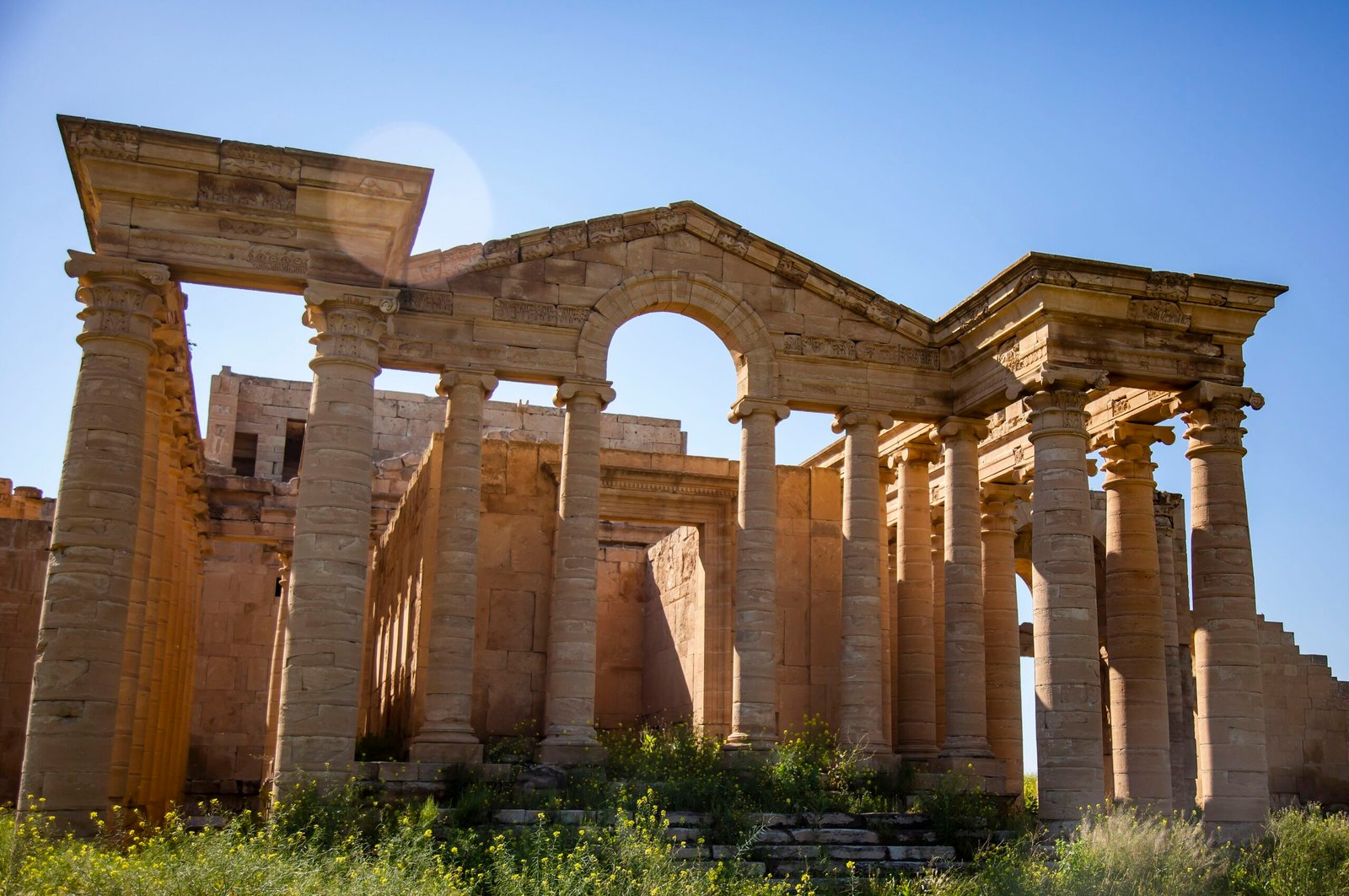
In the Iraqi desert 290 km northwest of Baghdad, the circular walled city of Hatra preserves the most complete Parthian urban complex ever excavated — a multicultural trading capital whose colossal barrel-vaulted temples withstood two Roman sieges, and whose irreplaceable sculptures were demolished by ISIS in 2015.
At a glance
Hatra was founded approximately 300 BC as a Parthian settlement in the semi-arid Jazira plateau of northern Iraq, and grew into the wealthiest caravan city on the route between the Euphrates and Tigris. At its height (1st century BC to 3rd century AD) it was a city of roughly 50,000 enclosed within circular walls approximately 2 km in diameter, fortified with towers at 25-metre intervals. Its temples — built as great barrel-vaulted iwan halls opening onto a central precinct — housed an ecumenical assembly of deities: the sun god Shamash, Nergal, the Arabian goddess Allat, Syrian Atargatis, and Roman Mercury. This coexistence of Mesopotamian, Arabian, Syrian, Iranian, and Greco-Roman religious traditions within a single planned urban complex is unique in the ancient Near East. UNESCO inscribed Hatra in 1985. In February 2015, ISIS forces occupied the site and destroyed Parthian sculptures with sledgehammers and explosives; UNESCO declared this a war crime. The site was liberated by Iraqi forces in April 2017.
Key facts
- Founded: c. 300 BC (Parthian Empire); apogee 1st century BC – 3rd century AD
- Destroyed: 241 AD by Sasanian king Shapur I; sculptures demolished by ISIS, February 2015
- UNESCO: World Heritage Site 1985; on Danger list since 2015
- Location: Nineveh Governorate, Iraq; 110 km southwest of Mosul
- Layout: Circular walled city, ~2 km diameter; fortified inner precinct with six great iwans
- Deities: Shamash, Nergal, Allat, Atargatis, Mercury — five traditions coexisting
- Military: Withstood sieges by Trajan (116–117 AD) and Septimius Severus (198–199 AD)
History
Hatra flourished as a trading city and religious centre of the Parthian Empire from approximately the 1st century BC. Its strategic position on the caravan route between the Euphrates and Tigris made it extremely wealthy: tolls on merchant traffic funded the construction of monumental temples at its heart, and its circular walls — a form echoing the Parthian capital at Ctesiphon — made it militarily formidable. When the Roman emperor Trajan besieged Hatra in 116–117 AD, and again when Septimius Severus attacked in 198–199 AD, the walls held: ancient sources record that Trajan retreated after his forces were struck by stones and arrows; Severus spent twenty days attempting to breach the defences before withdrawing. The city fell only in 241 AD to Shapur I of the Sasanian Empire, who demolished it to deny it to rivals.
After its destruction, Hatra lay uninhabited for seventeen centuries. Systematic excavation began under the Iraqi Directorate of Antiquities in 1951 and continued through the 1970s, revealing extraordinary sculptural fragments now in the Iraq Museum, Baghdad. UNESCO inscribed the site in 1985, recognising it as “the best preserved example of a Parthian city.” In February 2015, ISIS fighters entered Hatra and used sledgehammers and power tools to destroy the monumental cult statues within the temples, including colossal figures of Shamash, Allat, and enthroned royal statues in the iwans. Further damage came from explosives. The UNESCO Director-General called it a war crime. Iraqi forces liberated the site in April 2017.
What you see
The most dramatic surviving elements are the six great iwans — barrel-vaulted rectangular halls with open facades — enclosing the inner sacred precinct. The largest, the Great Iwan, is approximately 30 metres wide, its facade decorated with carved stone vine scrolls, eagle motifs, and portrait medallions blending Parthian, Hellenistic, and Mesopotamian sculptural traditions. The facades of the smaller temples are pierced by arched niches that once contained the cult statues; the arch construction using stone voussoirs anticipates the development of the Islamic arch. The outer circular walls, now substantially ruined, once extended for approximately 6.4 km with projecting bastions; the north gate, partially intact, conveys the original fortification scale.
Before 2015, the site contained over 200 intact or partially intact stone sculptures, including enthroned royal figures, standing goddess images (notably the “Hatra Aphrodite,” a rendering of Allat in Hellenistic style), and the eagle — symbol of Hatra — repeated across all architectural elements. Many have now been destroyed. The Iraq Museum Baghdad holds the major sculptural collection, including pre-ISIS excavation finds; some fragments visible in situ within the surviving temple ruins.
On screen: The Exorcist (1973)
William Friedkin’s The Exorcist (1973) opens with an extended archaeological dig sequence set in northern Iraq, where the elderly priest Father Merrin (Max von Sydow) discovers a Pazuzu statuette that foreshadows the film’s events. Friedkin cited Hatra specifically as the architectural and atmospheric reference for the prologue, and the sequence was filmed in the Nineveh region. The ominous stone figures, the desert light, and the ancient ritual landscape of Hatra provided the template for one of cinema’s most celebrated opening sequences — a masterpiece of location-based dread.
Practical information
- Access: 110 km southwest of Mosul; requires coordination with local authorities and security clearance for foreign visitors
- Status: Liberated April 2017; significant damage from ISIS occupation; ongoing conservation assessment
- Best time: October to March (summer temperatures are extreme)
- Iraq Museum, Baghdad: Holds pre-2015 sculptural collection from Hatra excavations
- UNESCO: World Heritage Site (in Danger list since 2015)
Getting there
From Mosul (110 km northeast): road via Hamam Al-Alil. From Baghdad (290 km): via Tikrit and the Mosul road. Organised archaeological tours from Baghdad or Erbil are the safest option for foreign visitors; verify current security conditions with your embassy before any travel to Nineveh Governorate.
Nearby
- Nimrud (Kalhu) — Ancient Assyrian capital, 70 km northeast; also severely damaged by ISIS in 2015
- Nineveh — Ancient Assyrian capital on the outskirts of Mosul, 110 km northeast
- Ashur — UNESCO-listed Assyrian capital on the Tigris, 110 km southeast
- Iraq Museum, Baghdad — Holds Parthian and Assyrian collections; essential complement to any visit to northern Iraq
Sources
- UNESCO World Heritage List: Hatra (No. 277)
- UNESCO World Heritage in Danger: Hatra (2015)
- Al-Salihi, Wathiq (1987). Hatra: City of the Sun God. Baghdad: Iraqi Directorate of Antiquities
- Dirven, Lucinda (1999). The Palmyrenes of Dura-Europos. Leiden: Brill
- Iraq Museum, Baghdad — Parthian sculpture collection documentation
Find it on the map
See this place and what’s around it →Historical events at this place (1)
📷 Become a Cultural Heritage Online photographer
Share your photos of places: they stay published under your name as the author. The more they're seen, the more you get noticed — and soon a contest will reward the most appreciated photos.
Log in or sign up free to add a photo