

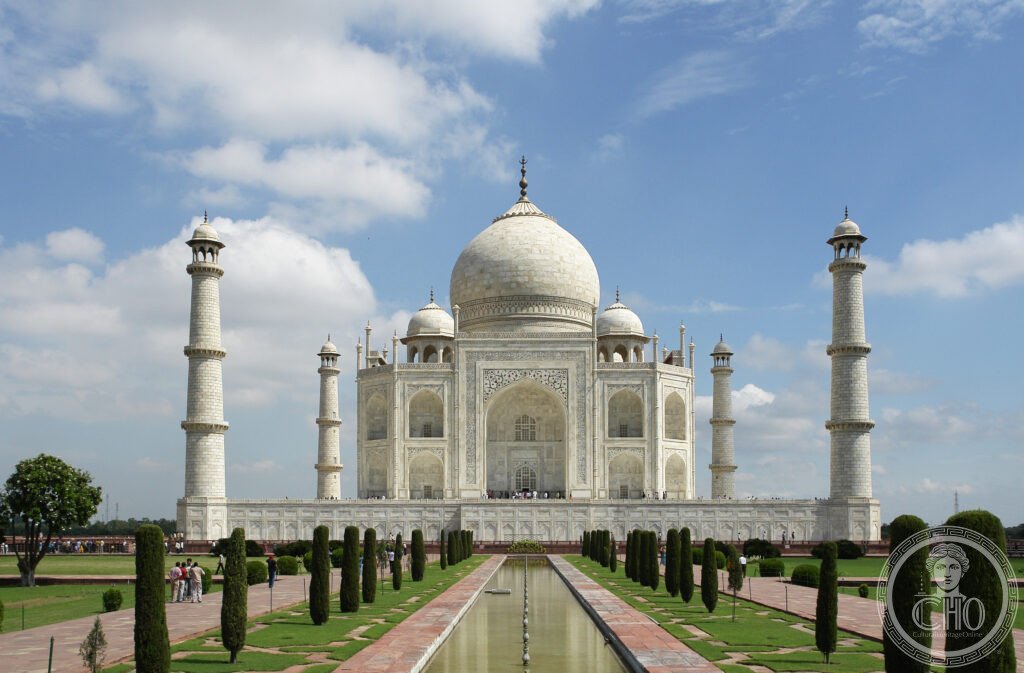
The most celebrated building in the world and the supreme expression of Mughal architecture. The Taj Mahal, built by Emperor Shah Jahan between 1632 and 1653 as a mausoleum for his beloved wife Mumtaz Mahal, is a white marble testament to love, grief, and imperial ambition that has been called the finest example of architectural perfection in human history.
At a glance
The Taj Mahal (UNESCO WHS 1983) is inscribed as an entire complex: the main mausoleum, the mosque, the jawab (the mirror building), the gardens and the gateway. It receives approximately 7–8 million visitors per year and is the most visited monument in India. Behind it is the most famous love story in the history of architecture: Shah Jahan (Mughal Emperor r. 1628–1658) and Mumtaz Mahal (born Arjumand Banu Begum; 1593–1631), his favourite wife, who died giving birth to their 14th child in Burhanpur in June 1631. Shah Jahan was reportedly so grief-stricken that his beard turned grey overnight; according to the court chronicle, he said he would build a monument that would be the envy of the world — the most ambitious architectural grief response in history. The construction began in 1632, a year after her death, and 20,000 artisans were employed; the Taj was substantially complete by 1643 and the full complex (including the great gate) was completed in 1653. The total cost is estimated at 32 million rupees in 1653 — the most expensive single building construction in Mughal India. The marble came from the Makrana quarries in Rajasthan, the most important marble quarries in India, the same quarries that supplied the marble for the Rashtrapati Bhavan presidential palace in Delhi.
Key facts
- The architecture of the Taj Mahal: the most perfectly balanced building in the world. The design (attributed to the Persian-Indian architect Ustad Ahmad Lahauri — the most frequently cited single architect of the Taj Mahal; the attribution is based on a contemporary account (the Badshahnama) and a family memoir; other sources suggest a committee of architects and Shah Jahan himself was closely involved; the most diplomatically handled architectural attribution in Mughal art history). The symmetry (the most important single visual principle of the Taj: the perfect bilateral symmetry on every axis — the main mausoleum, the garden, the gateway, the mosque, and the jawab are all arranged on the same north-south axis; the only building on the complex not perfectly centred is the mosque (it is slightly west of centre to allow it to face Mecca) — the most significant asymmetry in the most symmetrical building in the world). The four minarets (a common misunderstanding: the minarets are not part of the main mausoleum building; they stand on the four corners of the plinth as independent structures, 40 m high, and were designed to lean 2–3° outward so that in an earthquake they would fall away from the tomb; the most earthquake-proactive structural decision in Mughal architecture). The pietra dura (the inlaid stone decoration: 28 types of semi-precious and precious stones (jasper, jade, turquoise, lapis lazuli, coral, onyx, carnelian, amethyst, and more) are used in flower, leaf, and arabesque patterns covering every marble surface; the most extensive single programme of pietra dura decoration in any building in the world; individual flowers were composed of up to 60 separate pieces of stone each cut to perfect shape and laid into the marble without adhesive — the most precise stone inlay technique in any historic monument).
- The Taj at different times of day: the changing appearance of the building. The light is the most important thing to understand about visiting the Taj Mahal: the white Makrana marble changes colour completely through the day. At dawn the Taj is a pale glowing white with the first light, particularly beautiful on a misty morning when the dome emerges from the river mist — the most atmospheric approach to the monument. At noon it is bleached white against a blue sky, with the detail of the pietra dura most clearly visible: the best light for architectural photography. At sunset it turns pink and gold, the most romantic light and the most photographed moment on Instagram. At full moon comes the most dramatically different view: the marble glows silver, the shadows are deep blue and the pool reflects the moonlit dome. Full-moon viewing is offered on certain nights and is the most limited-access viewing experience at any Indian UNESCO monument — only 400 tickets per night, sold out months in advance. The best view is not from within the Taj but from the Mehtab Bagh, the “Moonlit Garden” across the Yamuna River directly north of the Taj: the view from across the river, with the Yamuna in the foreground and the dome behind, is the same view for which Shah Jahan allegedly planned a black marble mirror-Taj for himself, before his son Aurangzeb imprisoned him in Agra Fort — the most romantic lost architectural project in Indian history.
- Shah Jahan and the Mughal golden age: the emperor who built the Taj. Shah Jahan (born Shahab-ud-din Muhammad Khurram; 1592–1666) was the 5th Mughal Emperor (r. 1628–1658) and the most prolific patron of Mughal architecture: he built not only the Taj Mahal but also the Red Fort in Delhi (the most important single Mughal fortress in India), the Jama Masjid in Delhi (the largest mosque in India), the Moti Masjid (Pearl Mosque) in Agra Fort, and the Shahjahanabad quarter of Old Delhi (the finest surviving medieval planned city in India). The fall came when Shah Jahan fell ill in 1657 and his sons fought a war of succession: Aurangzeb, the most puritanical and militarily successful of the 4 sons, defeated his brothers and imprisoned his father in the Musamman Burj tower of Agra Fort in 1658. Shah Jahan spent the last 8 years of his life imprisoned in comfortable quarters with a view of the Taj Mahal across the river — the most romantic prison sentence in architectural history: he could see the Taj from his window every day until his death in 1666. He was buried next to Mumtaz Mahal in the Taj, the only asymmetric element in the entire Taj interior: the two cenotaphs are side by side but not centred, Mumtaz’s is centred and Shah Jahan’s is off-centre — the most beloved asymmetry in any symmetrical monument.
- Heritage: UNESCO World Heritage Site, Taj Mahal, inscribed 1983.
- GPS: 27.1751° N, 78.0421° E.
History
The Mughal Empire (1526–1857) was the most important Islamic dynasty in India. It was founded by Babur (Zahirud-din Muhammad; 1483–1530), a Timurid prince from Fergana, Uzbekistan, who defeated the Lodi Sultanate at the First Battle of Panipat in 1526 — the most consequential single battle in the history of the Indian subcontinent, and the battle that established the Mughal dynasty. The architectural heritage of the Mughals is the most extensive programme of monument-building in Indian history. Construction of the Taj Mahal began in 1632 CE, with the most comprehensive craftsman assembly in Mughal history: 20,000 artisans from across the Islamic world. Among the most important of them were Ustad Isa, the Persian architect who may have designed the dome, and the calligrapher Amanat Khan Shirazi, the finest Mughal calligrapher of his age: his name appears in the calligraphy of the Taj as the only non-royal signature on the building — the most confidently self-promoting act of a Mughal artisan. The marble was brought from the Makrana quarries in Rajasthan, 300 km away, in the most ambitious stone transport project in Mughal construction history; 1,000 elephants were used to move the marble blocks. In the British colonial period the Taj was well maintained, but Lord William Bentinck (Governor-General of India 1828–1833) considered demolishing the Taj and other Mughal monuments and selling the marble — the most philistine proposal in the history of British India. It was not carried out, because of the low price offered for the marble at auction. UNESCO WHS 1983.
What you see
The Taj Mahal visit begins at the Darwaza-i-rauza, the Great Gate, in red sandstone: the first view of the Taj is through the arched central doorway of the gate — the most dramatically framed first sight of any monument in the world, with the entire Taj appearing in the frame of the gate arch as visitors approach. On entering the garden the view changes completely as the monument expands in the frame. The garden is the charbagh: the 4-part garden divided by water channels, with the hauz-e-kausar, the long central pool aligned on the main axis, holding the perfect reflection of the dome — best in the early morning. The main plinth is a platform 6.7 m high and 95 m square, in white marble with pietra dura inlay throughout. In the mausoleum, the inner chamber holds the two cenotaphs, the marble sarcophagi of Mumtaz and Shah Jahan, covered in pietra dura flowers and enclosed by the marble jali screens — the finest pierced marble screens in Mughal India, with the light through the screens falling on the cenotaphs in changing patterns throughout the day. The actual graves are in the crypt below, accessible only to the Muslim caretakers. The dome interior has an echoing acoustic: a single sound reverberates for approximately 28 seconds under the dome — the most acoustically dramatic single space in any Indian monument.
Practical information
- Getting there: Agra Cantt Railway Station (AGC) is the best-connected station for Agra. The Gatimaan Express from New Delhi Hazrat Nizamuddin takes 1h 40min at 160 km/h: it is the fastest train to Agra, with 2 departures per day, and the most comfortable and fastest surface transport between Delhi and Agra. The Shatabdi Express from New Delhi takes 2h, runs daily and includes business class: the most reliable single train for day-trip visitors from Delhi. By car from Delhi it is 200 km via the Yamuna Expressway, 3h, the most convenient option for visitors with more than one Agra monument on the itinerary. Agra Airport (AGR; Pandit Deen Dayal Upadhyay Airport) is 9 km from the Taj but has limited service: Air India flights from Varanasi and Khajuraho, the most obscure scheduled route to any major Indian monument. The ticket: entry is INR 1,100 for foreign nationals (approximately USD 13 — the most expensive monument admission in India for foreigners and among the best value in world heritage tourism given what you see) and INR 250 for Indian nationals; it includes Agra Fort entry, and sunrise tickets (INR 1,600) are required for the earliest entry. The pollution problem: inside the Taj Mahal Environmental Zone vehicles are restricted within 500 m of the monument, and cars must use electric golf carts from the designated car parks. Air pollution from industry and vehicle exhaust has caused yellowing of the white marble, and a clay pack treatment is periodically applied to draw out the pollutants — the most extensively maintained single surface in any Indian monument.
- The Agra Fort and the Golden Triangle: Agra’s second UNESCO monument. The Agra Fort (UNESCO WHS 1983), the Agra Red Fort or Qila-i-Akbari, stands 2.5 km west of the Taj and is the most important Mughal fortress in India: the Lal Qila of Delhi is larger, but the Agra Fort is older and more historically complex. It was built by Akbar the Great (r. 1556–1605), the greatest Mughal emperor and the most tolerant and most militarily successful of the Mughals, who raised the red sandstone core of the Agra Fort from 1565. It was extended by Shah Jahan, who added the white marble palace buildings including the Khas Mahal, the Musamman Burj (the tower where Shah Jahan was imprisoned and from which he could see the Taj), and the Sheesh Mahal (mirror palace). The Golden Triangle is the most popular tourist circuit in India: Delhi (the Mughal capital; the Red Fort; the Jama Masjid; Humayun’s Tomb, a UNESCO WHS) + Agra (the Taj Mahal; the Agra Fort; Fatehpur Sikri, the abandoned Mughal city 40 km west — the most perfectly preserved Mughal city and the only one built entirely of red sandstone) + Jaipur (the “Pink City”; the Amber Fort, the finest Rajput fort in India and the most photographed fort on an Indian hillside; the City Palace, the largest palace complex in Rajasthan). Allow 4 nights and 5 days for the full circuit.
- Varanasi and the Ganges: the most sacred city in Hinduism. Varanasi lies 300 km east of Agra (5h by train via Allahabad) and is both the most sacred city in Hinduism and the oldest continuously inhabited city in South Asia, with approximately 3,000 years of continuous settlement — the longest continuously inhabited city in India and one of the oldest in the world. The ghats are the 84 bathing and cremation steps descending to the Ganges. The Manikarnika Ghat is the most important cremation ghat: cremations operate 24h a day, 365 days per year, the most continuously active cremation site in the world; the wood takes approximately 300 kg per body and the price is approximately INR 3,000–15,000 per cremation. The Dashashwamedh Ghat is the most important bathing ghat and the setting of the Ganga Aarti ceremony, every evening at sunset: the most visually dramatic religious ceremony in India, with 5–6 priests simultaneously performing the aarti ritual with fire, bells, and incense on the main ghat while hundreds of boats crowd the river in front — the most atmospheric religious spectacle accessible to non-Hindus in Asia.
Getting there
Gatimaan Express from New Delhi (1h 40min; fastest train to Agra). Entry INR 1,100 for foreigners (sunrise INR 1,600). Closed Fridays. Best light: dawn or 30min before sunset. GPS: 27.1751, 78.0421.
Nearby
- Agra Fort and Fatehpur Sikri (both UNESCO WHS 1983). 2.5 km and 40 km from the Taj respectively. The finest Mughal fortress in India and the most perfectly preserved abandoned Mughal city. Described in the Practical section. The Agra 2-day itinerary: Day 1 (Taj at sunrise; Taj gardens; Agra Fort in the afternoon; Taj from Mehtab Bagh at sunset). Day 2 (Fatehpur Sikri (the abandoned Mughal capital built by Akbar in 1571; abandoned 1585 due to water shortage; 40 km west of Agra; the Buland Darwaza (the largest gateway in the world: 54 m high; 26 m wide); the Jama Masjid; the Salim Chishti Tomb (the most delicate white marble tomb at Fatehpur Sikri; covered in jali screens; women pray for children here — the most continuous act of pilgrimage at any Mughal monument except the Taj))).
- Jaipur. The Pink City (UNESCO WHS 2019). 230 km west (4h drive or 5h by train). The finest Rajput city in India and one of the most photogenic urban heritage sites in Asia. The Amber Fort stands 14 km from Jaipur city centre and is the most important Rajput hill fort in India: the view from the palace roof over the Maota Lake and the Aravalli Hills is the finest single panorama visible from any Rajput palace. The Hawa Mahal, the “Palace of the Winds”, has 953 windows in a 5-storey pink sandstone facade designed so that the purdah women of the court could observe street festivals without being seen — the most architecturally specialised voyeurism facility in any royal palace. The Jantar Mantar is the largest stone astronomical observatory in the world, built by Maharaja Jai Singh II (1727); its Samrat Yantra is the largest sundial in the world, 27 m high and accurate to 2 seconds — the most precise pre-modern astronomical instrument in India.
- Ranthambore National Park. 160 km south (2h 30min drive from Jaipur). The finest tiger reserve in India and the most accessible national park for reliable tiger sightings. The Royal Bengal Tiger is the most charismatic single wildlife species in India and the most dangerous large predator in any South Asian national park. Ranthambore is consistently rated the most reliable park in India for tiger sightings: the tigers are relatively habituated to jeep traffic compared to more remote reserves, which makes it the most likely park in India for a first-time visitor to see a tiger in the wild. The Ranthambore Fort, the 10th-century Rajput fort in the centre of the national park, is the only Rajput fort surrounded by a wildlife reserve: the view from the fort over the tiger habitat is the most unusual heritage-wildlife combination viewpoint in South Asia, and the fort is accessible on foot from the Ranthambore gate during the day.
Sources
- Wikipedia, Taj Mahal. Shah Jahan. Mumtaz Mahal. Pietra dura, accessed June 2026.
- UNESCO, Taj Mahal, WHS reference 252, inscribed 1983.
- Giles Tillotson, Taj Mahal, Profile Books, 2008.
Find it on the map
See this place and what’s around it →Historical events at this place (1)
📷 Become a Cultural Heritage Online photographer
Share your photos of places: they stay published under your name as the author. The more they're seen, the more you get noticed — and soon a contest will reward the most appreciated photos.
Log in or sign up free to add a photoIs this page about you?
This page is read by travellers and heritage enthusiasts who find it on Google. Tell us how you are connected to this place and we will take it from there.