

Medina of Marrakesh

Marrakesh medina Djemaa el Fna Koutoubia Morocco UNESCO World Heritage
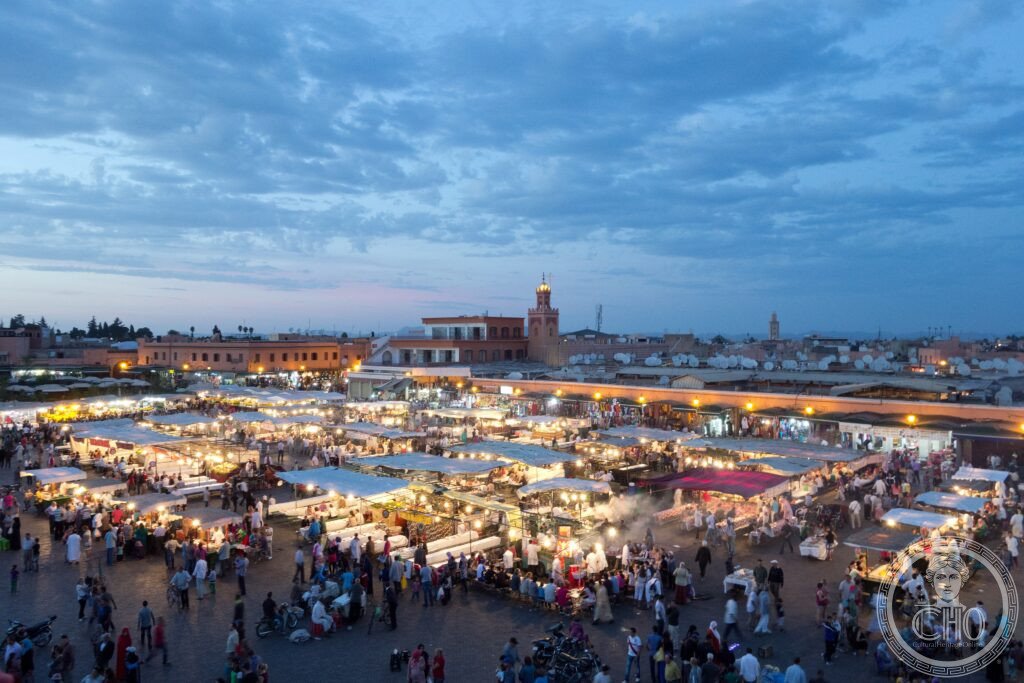
The Koutoubia Mosque (Jamaa el Fna el Koutoubiyine; “the Mosque of the Booksellers”; the most important Islamic monument in Marrakesh and the most recognisable silhouette in Morocco; the minaret (the prototype for the Giralda in Seville and the Hassan Tower in Rabat — the three great Almohad minarets built during the reign of Caliph Yaqub al-Mansur (r. 1184–1199 CE); the Koutoubia was the first and the model for the others; the minaret (the proportions: 12.8 m square × 69 m high — the square tower rises to 5.4 × the base; the formula that every Almohad minaret was designed to achieve; the most influential single architectural proportion in western Islamic architecture; the most important 12th-century Islamic tower design in the Maghreb (North Africa west of Egypt)); the tower decoration (the five zones of decorative masonry separated by cornices; the interlaced arch motifs (the sebka screen; the muqarnas cornice (the most elaborate stone stalactite decoration in any Almohad minaret)); the golden balls (4 copper balls decreasing in size at the top of the minaret; the most frequently cited single ornament in Moroccan Islamic architecture)), viewed from the Djemaa el Fna, Marrakesh, Marrakesh-Safi Region, Morocco — UNESCO World Heritage Site 1985. Photo via Wikimedia Commons.
Marrakesh, Marrakesh-Safi Region, Morocco · founded 1070 CE (Almoravids; Yusuf ibn Tashfin); the Koutoubia Mosque (the most important Almohad building in Morocco; minaret 69m; prototype for Seville’s Giralda); the Djemaa el Fna (the most important public square in Africa; UNESCO Intangible Cultural Heritage 2001); the Saadian Tombs (sealed 1672; rediscovered 1917); the Ben Youssef Madrasa (the largest Quranic school in North Africa; finest zellige + stucco + cedarwood in Morocco); the souks; the Bahia Palace (finest 19th-c riad garden in Morocco); the Jardin Majorelle (Yves Saint Laurent) · UNESCO World Heritage 1985

Medina of Marrakesh

The most enchanting historic city in North Africa and one of the great meeting-places of the Islamic world — the Medina of Marrakesh, founded in 1070 CE by the Almoravid dynasty as their imperial capital, is a living labyrinth of mosques, madrasas, souks, and gardens that has been the crossroads of the Saharan caravan trade, the Andalusian exile, and the European imagination for nearly a thousand years.

At a glance

The Medina of Marrakesh (UNESCO WHS 1985; the medina is the historic walled city founded in 1070 CE; the walls (approximately 19 km of rammed-earth ramparts (pisé; the most extensive surviving rammed-earth city walls in North Africa); the most important geographic feature of Marrakesh: the rose-red colour of the walls and buildings (the colour comes from the local clay soil; Marrakesh is called “the Red City” (Marrakech la Rouge) — the most frequently used single colour adjective in any African city nickname; the buildings are painted with a terracotta-rose limewash that intensifies in the late-afternoon light to produce the most luminous urban glow in North Africa)); the Djemaa el Fna (the most important open space in Africa: a 2.5-ha public square that has been continuously used since the 11th century as a marketplace, entertainment ground, and social heart of the city; the activity (the most complex and the most continuously changing public spectacle in any city in the Islamic world: by day: orange juice vendors, henna artists, snake charmers, acrobats, and monkey handlers; by evening: the 100+ food stalls that appear every night in less than 30 minutes — the most rapid transformation of any public square from open space to covered market in any city in the world; by night: the music of the Gnawa musicians (the sub-Saharan spiritual tradition brought to Morocco by enslaved people from west and central Africa (the most important single musical heritage of the trans-Saharan slave trade; the Gnawa instrument: the krakeb (large iron castanets) and the sentir (3-string bass guembri lute); the trance music of the Lila ceremony (the most directly therapeutic ritual in any North African musical tradition)); UNESCO Intangible Cultural Heritage 2001 — the first Moroccan tradition to receive this status and the first North African tradition on the list).

Key facts

  • The Djemaa el Fna: the most continuously active public square in Africa — the Djemaa el Fna (the name: two interpretations — “Assembly of the Dead” (from the Arabic jam’a = assembly + al-fana = death; the square was used as a site of public executions in the Saadian period (the most frequent single site of capital punishment in Morocco in the 16th–17th centuries; the severed heads were displayed on the gate; the most unsettling derivation for a name associated with a tourist attraction) — or “Mosque of Annihilation” (referring to a mosque that was under construction but never completed; the most architecturally anti-climactic explanation for a name)); the halqa (the performance circles: the traditional story-telling circles in which a haggard (a bard) stands in the centre of a circle of listeners telling traditional tales, poems, and oral histories; the most important surviving public oral literature tradition in the Islamic world; the haqqaoui are storytellers who perform epics from the Thousand and One Nights and other classical Arabic literature for audiences who may be illiterate but who know the stories by heart; the most continuous oral literary performance in any African city); the food stalls (the 100+ grilled-meat and harira soup stalls that appear every evening as the sun sets; the communal tables, the competing calls of the stall owners, the smoke, the speed, and the universal equality of the seating — every visitor sits at the same long tables as locals; the finest and the most democratic street food experience in North Africa)
  • The Ben Youssef Madrasa: the finest Islamic interior in Morocco — the Medersa Ben Youssef (the “Islamic college of Ben Youssef”; built alongside the Ben Youssef Mosque; the current building dates from the Saadian dynasty, 1565 CE (the reign of Abdullah al-Ghalib; the most architecturally productive Saadian sultan); the largest Quranic school in North Africa (900 students; 130 dormitory cells around the central courtyard — the most impressive single courtyard in Morocco)); the interior (the 3 materials that cover every surface from floor to top: the zellige (the lower 2 m of each wall; the geometric mosaic tilework in terracotta, white, green, and black; approximately 16 distinct tile shapes in each repeat pattern; the most intricate decorative programme in the Marrakesh medina); above the zellige: the plaster (the stucco carved into arabesque patterns and Quranic inscriptions; the most labour-intensive surface in the madrasa: each panel was carved in situ by master craftsmen working from memory without templates — the most impressive improvised architectural decoration in any Moroccan building); above the stucco: the cedarwood (the carved cedar corbels, window frames, and overhanging eaves; the cedar from the Atlas Mountains (the best-quality cedar in Morocco; the most fragrant building material in any North African monument); the pool (the central courtyard pool reflects the carved arcade columns and the sky; the most architecturally perfect mirror image in any Moroccan courtyard))
  • The Jardin Majorelle and Yves Saint Laurent: the most visited garden in Morocco — the Jardin Majorelle (the garden created by the French painter Jacques Majorelle (1886–1962) in Marrakesh from 1923 onward; the most important single private garden project in 20th-century North Africa; the cobalt blue (the most distinctive colour in Marrakesh’s private gardens: the intense cobalt blue (registered as “Majorelle Blue” — the most frequently copyrighted single paint colour in any garden in the world) that covers the garden pavilion and the terracotta pots; Majorelle spent 40 years perfecting the palette, which is inspired by the blue worn by Berber men in the Sahara); the YSL connection (Yves Saint Laurent and Pierre Bergé purchased the garden in 1980 to save it from a planned hotel development; the most important single act of Moroccan heritage preservation by a French fashion designer; Saint Laurent used the garden as an escape and source of inspiration for his collections until his death in 2008; his ashes are scattered in the garden; the most literally intertextured designer-garden relationship in fashion history; the Musée Yves Saint Laurent Marrakech (opened 2017; 2 km from the Jardin Majorelle; the museum of the designer’s Moroccan-inspired work; the most visited design museum in Africa))
  • Heritage: UNESCO World Heritage Site, Medina of Marrakesh, inscribed 1985
  • GPS: 31.6258° N, -7.9892° E

History

The founding (1070 CE; the Almoravid dynasty (al-Murabitun; “the people of the ribat”; a Berber confederation from the Sahara who conquered Morocco and founded Marrakesh as their capital; the founder: Abu Bakr ibn Umar (the Almoravid general who established the city) and Yusuf ibn Tashfin (the greatest Almoravid ruler (r. 1061–1106); he conquered the Iberian Peninsula as far north as Zaragoza and united Morocco, Algeria, and Al-Andalus under Almoravid rule — the most extensive single Berber empire in history); the city plan (the Almoravid city had the Koutoubia Mosque (first built), the city walls, the souks, and the khettara water system (the underground channels that bring water from the Atlas Mountains to the city — the most important civil engineering achievement of the Almoravid city)); the Almohad dynasty (1147–1269 CE; the Almohads conquered the Almoravids and demolished much of the existing city; they built the Koutoubia Mosque in its current form and the kasbah quarter); the Saadian dynasty (1549–1659 CE; the golden age of Marrakesh: the Ben Youssef Madrasa (1565); the Saadian Tombs (the royal necropolis built 1578–1603; sealed by Moulay Ismail in 1672 after he moved the capital to Meknes; the tombs were unknown to the outside world until discovered by a French aerial survey in 1917 — the most completely unexpected archaeological discovery in Moroccan history; the finest Saadian interior: 66 royal tombs in 3 chambers; the central chamber with the 12 white marble columns — the finest single interior in Marrakesh); the French Protectorate (1912–1956; the Ville Nouvelle (new town) built adjacent to the medina; the Guéliz quarter; the Majorelle garden); independence (1956); UNESCO WHS 1985.

What you see

The Marrakesh medina visit (the essential sequence: arrive by mid-morning at the Djemaa el Fna (before the full heat of the day); spend the morning at the Ben Youssef Madrasa (the most important single architectural interior; arrive early — it opens at 9am and crowds build by 11am; the Ben Youssef Mosque (the courtyard; the zellige; the courtyard pool — allow 1h 30min); the souks (the souks of Marrakesh are organized by craft district in the medieval tradition: the Souk Semmarine (the main thoroughfare; leather goods); the Souk des Teinturiers (the dyers’ souk; the coloured skeins of wool drying overhead — the most photographed single souk view in Marrakesh); the Souk des Babouches (the yellow slipper souk); the Souk des Ferronniers (metalworkers; the Lantern makers); the Bahia Palace (the 19th-century vizier’s palace; the finest example of a riad garden in Marrakesh; the painted cedarwood ceilings (the most elaborate painted ceiling in any Moroccan palace); the Saadian Tombs (the most architecturally refined interior in Marrakesh; the Koutoubia Mosque (the exterior only, as non-Muslims cannot enter; the best overall view of the Koutoubia from the Djemaa el Fna at sunset when the minaret turns gold); the Djemaa el Fna food stalls (the evening meal — non-negotiable).

Practical information

  • Getting there: Marrakesh Menara Airport (RAK; 5 km south of the medina; the most-served Moroccan airport by European low-cost carriers; direct flights from London (3h 30min; easyJet, Ryanair, British Airways — multiple daily); Paris (2h 45min; Royal Air Maroc and Air France; the most frequent connection from France); Madrid (2h; Iberia and Vueling); Brussels, Amsterdam, and Frankfurt (all approximately 3h 30min; the most convenient Moroccan destination for northern European visitors); the medina (the old city; a 15-minute taxi or 45-minute bus (line 19) from the airport; the most chaotic airport-to-city transfer experience in North Africa (the taxis at Marrakesh airport are the most aggressively negotiated taxis in any Moroccan city; fix the price firmly before entering the cab; the fair fixed price is approximately MAD 80–100 (about EUR 7–9)); the riads (the most recommended accommodation: a traditional riad (a courtyard house with an internal garden pool and no street presence) within the medina; the riad experience is unique to Marrakesh, Fez, and a few other Moroccan medinas; the most completely different hotel-from-the-outside vs. hotel-from-the-inside experience in the world (the street door opens onto a narrow dark corridor that leads to a sudden revelation of the central courtyard, the fountain, the orange tree, and the sky))
  • The Atlas Mountains and the Sahara: the essential Moroccan landscapes beyond Marrakesh — the Atlas Mountains (the High Atlas rises immediately south of Marrakesh; the Toubkal National Park (the Jebel Toubkal (4,167 m; the highest peak in North Africa; the most accessible 4,000+ m summit in Africa for non-technical climbers: the standard ascent from the Imlil trailhead (75 km from Marrakesh; 1h 30min drive through the valley of Ourika) is 2 days: 7h to the refuge at 3,200 m; 3–4h to the summit; the most frequently climbed alpine summit in Morocco)); the Ait Benhaddou (50 km north of Ouarzazate; 4h from Marrakesh; the most important ksar (fortified Berber village) in Morocco; UNESCO WHS 1987; the film location (the most frequently used Moroccan location in cinema: it has appeared in Lawrence of Arabia (1962), Gladiator (2000), The Mummy (1999), and Game of Thrones — the most recognisable single film-location landscape in Africa)); the Sahara (Merzouga Dunes; 560 km south of Marrakesh; 6h drive; the Erg Chebbi sand dunes (the finest dune field accessible from Marrakesh; up to 150 m high; the camel trek at sunset to a Berber camp is the most requested single overnight experience in Moroccan tourism))
  • Fez al-Bali (UNESCO WHS 1981): the finest surviving medieval Islamic city in the world — Fez (the oldest of the four Imperial Cities of Morocco; founded 789 CE by Moulay Idris II; the Fez el-Bali (the old medina; the largest car-free urban area in the world; the tanneries (the Chouara Tannery; the most photogenic artisan district in Morocco: the circular stone tubs of coloured dye (red from poppy flowers; blue from indigo; yellow from saffron; white from pigeon droppings (the most unsettling single tanning ingredient in any traditional tannery; the ammonia in the droppings opens the leather pores for the dye); viewed from the terraces of the surrounding leather shops — the most organised tourist vantage point in any Moroccan artisan district); the Qarawiyyin Mosque and University (founded 859 CE by Fatima al-Fihri — a woman; the oldest continuously operating university in the world (the most contested claim in the history of higher education; the institution has operated continuously since 859 CE but received its university charter in 1963; the most precisely dated and most debated founding of any educational institution in Africa)

Getting there

Marrakesh Menara Airport (RAK) 5 km south. Direct low-cost flights from London 3h 30min, Paris 2h 45min, Madrid 2h. Fixed taxi fare to medina ~MAD 80-100. GPS: 31.6258, -7.9892.

Nearby

  • Ait Benhaddou (UNESCO WHS 1987) — 200 km south (3h 30min drive via Ouarzazate); the finest fortified Berber village (ksar) in Morocco and the most famous film location in Africa — described in the Practical section; the essential southern Morocco circuit from Marrakesh: Day 1 (Ait Benhaddou afternoon; Ouarzazate night); Day 2 (Draa Valley; rose harvest country in spring); Day 3 (Merzouga; Sahara dunes; camel trek at sunset; Berber desert camp)
  • Essaouira (UNESCO WHS 2001) — 175 km west (2h 30min drive or 3h bus); the finest Portuguese-Moroccan walled port city in Africa — Essaouira (formerly Mogador; the most wind-swept and most artistically important coastal city in Morocco; the ramparts (the Portuguese-designed sea fortifications of the 1760s (Théodore Cornut; the finest Vauban-influenced military architecture in Africa); the wind (the most reliably windy city on the Moroccan Atlantic coast; the Alizé trade winds; the world-capital of board-kite-surfing (the Essaouira wind is the most consistent of any Atlantic town used for board-sports); the music (Essaouira is the most important centre of Gnawa music in Morocco; the Gnawa World Music Festival in June (the largest world-music festival in Africa; 500,000+ visitors in 4 days))
  • Fez al-Bali (UNESCO WHS 1981) — 330 km north (4h by train via Casablanca or 5h direct bus); the oldest and finest surviving medieval Islamic city in the world — described in the Practical section; the essential Moroccan Imperial Cities tour: Marrakesh (3 nights) → Essaouira day-trip → train to Fez (4h via Casablanca) → Fez (2 nights: tanneries; Qarawiyyin; medina) → Chefchaouen (the Blue City in the Rif Mountains; 2h from Fez; the most photographed painted town in Africa; the buildings painted in 40 shades of blue by the Jewish community who settled here after the 1492 Expulsion from Spain; the most visible architectural legacy of the Spanish Reconquista on any Moroccan mountain city)

Sources

  • Wikipedia, Marrakesh; Djemaa el Fna; Koutoubia Mosque; Ben Youssef Madrasa, accessed June 2026
  • UNESCO, Medina of Marrakesh, WHS reference 331, inscribed 1985
  • Mohamed Métalsi, Marrakech, the Red City, Flammarion, 2001

Hero image: Koutoubia Mosque / Djemaa el Fna, Marrakesh, Wikimedia Commons. Editorial text © Cultural Heritage Online, 2026.

📷 Diventa un fotografo di Cultural Heritage Online

Condividi le tue foto dei luoghi: restano pubblicate con la tua firma come autore. Più vengono viste, più ti fai conoscere — e presto un concorso premierà le foto più apprezzate.

Accedi o registrati gratis per aggiungere una foto
📋 Copy & share on social
Scroll to Top