

Yellowstone National Park

Yellowstone Grand Prismatic Spring geyser Wyoming USA UNESCO World Heritage
Yellowstone National Park (the aerial view of the Grand Prismatic Spring — the most famous hydrothermal feature in Yellowstone and the most colourful natural body of water in the world; the statistics: 91 m diameter (the largest hot spring in the USA and the 3rd largest in the world); temperature 70°C; the colour rings (the most extraordinary natural colour gradient in any body of water: the deep sapphire-blue centre (pure water too hot for microbial life at the vent centre; 89°C); the rings of increasingly lower-temperature water supporting successive microbial mats that run through yellow, orange, and red at the cooler outer edges; the pigments are produced by thermophilic (heat-loving) bacteria and archaea — the most remarkable life-forms in the park; the same types of organisms that biochemists use as the source of the Taq polymerase enzyme (the critical enzyme in the polymerase chain reaction (PCR) — the most important biotechnology tool in molecular biology; discovered from the Thermus aquaticus bacterium isolated from the Mushroom Pool in Yellowstone in 1969 (the most consequential single biological discovery in the history of Yellowstone National Park))), Yellowstone National Park, Teton County, Wyoming, USA — UNESCO World Heritage Site 1978. Photo via Wikimedia Commons.
Yellowstone National Park, Wyoming/Montana/Idaho, USA · world’s first national park (1872); 8,983 km²; the Yellowstone supervolcano (the most dangerous potential geological event in North America; last full eruption 640,000 years ago); 10,000 hydrothermal features (more than anywhere else on Earth); 500 geysers (60% of world total); Old Faithful (geyser; every 35-120min; 56m high; 44,000L per eruption); the Grand Canyon of the Yellowstone (27m × 308m waterfall; yellow-orange rhyolite walls); bison herd (5,000; largest in world in any single park) · UNESCO World Heritage 1978

Yellowstone National Park

The world’s first national park and the largest concentration of hydrothermal features on Earth — Yellowstone, sitting atop a supervolcanic hotspot in the Rocky Mountains of Wyoming, Montana, and Idaho, holds more geysers, hot springs, and fumaroles than the rest of the world combined, and protects the largest intact temperate ecosystem in the northern hemisphere.

At a glance

Yellowstone National Park (UNESCO WHS 1978 — the first natural site to be placed on the inaugural World Heritage List; the world’s first national park (established 1 March 1872 by President Ulysses Grant — the most consequential single act of conservation legislation in world history; the model for every national park created subsequently in the USA and internationally); the geology (the most important single fact about Yellowstone: the park sits directly over the Yellowstone Hotspot — a column of superheated mantle rock rising from deep in the Earth’s interior; the caldera (the Yellowstone Caldera: 72 km × 55 km; the most studied supervolcanic caldera in the world; the caldera was formed 640,000 years ago by the most recent of 3 major eruptions (the eruptions at 2.1 million years ago, 1.3 million years ago, and 640,000 years ago were among the most powerful volcanic events in the geological history of North America); the ground deformation (the caldera floor rises and falls by up to 10 cm per year as the magma body beneath moves — the most measurable supervolcano breathing in the world); the hydrothermal system (the 10,000 hydrothermal features of Yellowstone: the most extensive hydrothermal system on any landmass in the world; powered by the heat of the Yellowstone Hotspot (the magma chamber approximately 5–15 km below the surface heats the groundwater to temperatures of up to 390°C; the pressurised hot water and steam are the most energetic geothermal system accessible to the public anywhere in the world)).

Key facts

  • Old Faithful and the world’s geysers: the most predictable geyser on Earth and the hydrothermal system — Old Faithful (the most famous geyser in the world; located in the Upper Geyser Basin (the highest concentration of geysers in any area of comparable size in the world: approximately 150 geysers within 2.6 km²)); the eruption (the Old Faithful geyser (eruptions: approximately every 35–120 minutes (the interval varies depending on the duration of the previous eruption; the ranger prediction accuracy is ±10 minutes; the most reliable geyser prediction in the world (other geysers are less predictable); each eruption lasts 1.5–5 minutes; ejects approximately 14,000–32,000 litres of water per eruption; the column reaches 32–56 m (the highest reliable geyser column in the world that can be predicted in advance)); the other geysers of the Upper Geyser Basin (the Grand Geyser (the tallest predictable geyser in the world; erupts approximately every 8–12 hours; 49–61 m high; 10 minutes duration — the tallest geyser eruption that can be reliably predicted); the Castle Geyser (the oldest geyser cone in Yellowstone — the estimated age of the geyser sinter cone is 10,000–15,000 years (the most ancient geyser cone in the USA); erupts every 10–12 hours; 27 m high)); the Steamboat Geyser (in the Norris Geyser Basin (the hottest geyser basin in Yellowstone; the most thermally active area of the caldera); the world’s tallest active geyser (90+ m; an eruption that can reach 115 m — the most powerful geyser eruption in the world; but irregular (the major eruptions occur at intervals of days to years); the most powerful and the least predictable geyser in Yellowstone — the ideal geyser for visitors with unlimited time and flexibility))
  • The Yellowstone supervolcano: the most studied potential natural catastrophe in the world — the Yellowstone Hotspot (a mantle plume — a column of superheated rock rising from approximately 660 km deep in the Earth’s mantle; the hotspot is stationary while the North American Plate moves slowly south-west over it at approximately 2.3 cm per year — the most precisely measured plate movement in North America; the caldera (the Yellowstone Caldera was formed 640,000 years ago when the roof of a magma chamber 8,000 km³ in volume collapsed after an eruption; the most voluminous eruption in the geological history of North America in the past 2 million years; the ashfall (the 640,000-year eruption deposited ash over 2/3 of the North American continent; the most extensive single ashfall in North American geological history)); the current magma body (the magma body beneath the caldera: the upper chamber approximately 10×85 km; the lower chamber approximately 400×85 km; the most precisely imaged magma body in the USA (via seismic tomography)); the risk (the USGS Yellowstone Volcano Observatory monitors ground deformation, seismicity, and hydrothermal activity on a continuous basis; the risk of a full caldera eruption (the most studied geological hazard in the USA; the consensus probability: approximately 1 in 730,000 per year — less than the annual probability of dying in a car accident; the most misunderstood geological risk in American public discourse (media coverage dramatically overstates the imminence of an eruption; the scientific consensus is that no full eruption is expected within thousands of years))
  • Wildlife: the most spectacular wildlife spectacle in the temperate Americas — the Yellowstone ecosystem (the most complete intact temperate ecosystem in the northern hemisphere: the park and surrounding area support all of the large wildlife species that inhabited the region before European settlement — the only intact assemblage of this kind in the lower 48 states); the bison (the Yellowstone bison herd: approximately 5,000 bison — the largest bison herd in the world within any single protected area; the last remaining wild genetically pure bison population in the USA; the bison that survived the systematic extermination of 1865–1890 (from 30 million to approximately 1,000 individuals — the most rapid population collapse of any large mammal in the history of North America)); the wolves (the Yellowstone wolf reintroduction of 1995: the most important wildlife reintroduction in American conservation history; 14 wolves from Jasper National Park, Canada were released in the Lamar Valley in January 1995; by 2026 the Yellowstone wolf population has approximately 100 wolves in 9–10 packs; the most studied wolf population in the world (the Yellowstone Wolf Project monitors individual wolves by ID number; the longest-running wolf study in the world)); the Lamar Valley (the finest wildlife watching in Yellowstone: dawn and dusk in June–October produce sightings of bison, elk, pronghorn, coyote, and wolf within a single field of view — the most reliable multi-large-mammal wildlife viewing in the USA)
  • Heritage: UNESCO World Heritage Site, Yellowstone National Park, inscribed 1978
  • GPS: 44.4280° N, -110.5885° E

History

Indigenous history (the Shoshone people (Tukudika; “Sheep Eaters”; the indigenous people who lived in the Yellowstone area year-round; the most cold-adapted Native American community in the Rocky Mountains; they hunted bighorn sheep in the high mountains in summer and survived on stored meat in winter); archaeological evidence of human presence in the Yellowstone area for at least 11,000 years — the most continuous human occupation of any Rocky Mountain national park area); European exploration (the first confirmed non-indigenous accounts of Yellowstone’s hydrothermal features: John Colter (a member of the Lewis and Clark Expedition who explored the area alone in the winter of 1807–1808; his accounts of geysers and hot springs were so extraordinary that they were dismissed as fantasy and the area was nicknamed “Colter’s Hell” — the most comprehensively disbelieved geological report in American exploration history; Jim Bridger (the mountain man and explorer who visited Yellowstone in the 1830s and gave the most imaginatively embellished descriptions of the thermal features in the American West); the Washburn-Langford-Doane Expedition (1870; the most important single expedition in Yellowstone history: the first organized survey of the region; the campfire debate (the legendary campfire conversation on 19 September 1870 at the junction of the Firehole and Gibbon Rivers at which the members of the expedition allegedly discussed their personal land claims and instead proposed a national park — the most consequential single campfire conversation in American history; the factual basis of the legend is debated but the outcome was the establishment of the world’s first national park in 1872)); the national park (1 March 1872; President Ulysses Grant; UNESCO WHS 1978).

What you see

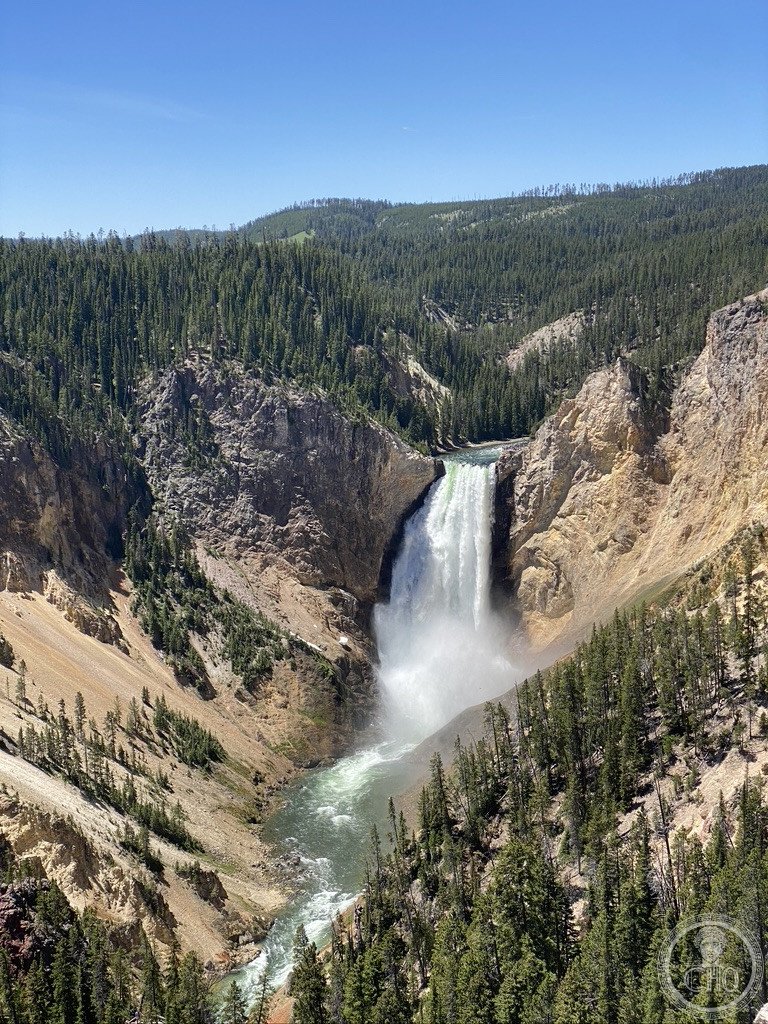
The Yellowstone visit (the Grand Loop Road: the figure-8 road system (282 km total) that passes the major thermal areas and wildlife habitats; the Upper Geyser Basin (the Old Faithful geyser complex; the largest concentration of geysers in any accessible area; allow 3h minimum; the Old Faithful Inn (1903–1904; the largest log-structure hotel in the world; the most impressive National Park lodge building in the USA; the Robert Reamer design; the 76-foot log-and-shingle main building; the lobby with the 8-storey fireplace hearth; the most dramatic interior space in any American national park facility)); the Grand Canyon of the Yellowstone (the most visually spectacular non-thermal feature in Yellowstone: the 27-km-long canyon of yellow and orange rhyolite carved by the Yellowstone River; the Lower Falls (the most important waterfall: 94 m high — twice the height of Niagara Falls; the most photographed waterfall in Wyoming; the red and yellow walls below (coloured by iron oxides in the rhyolite)); the Norris Geyser Basin (the most scientifically interesting geyser basin: the hottest and the most geologically dynamic; the Steamboat Geyser; the Porcelain Basin); the Lamar Valley (the prime wildlife area; described in Key Facts)).

Practical information

  • Getting there: Jackson Hole Airport (JAC; Jackson, Wyoming; 90 km south; the closest commercial airport; served daily from Denver (1h 30min), Dallas (3h), Salt Lake City (1h 15min), Los Angeles (2h 30min), Chicago (3h 30min); the most convenient airport for the southern entrance (South Entrance via Grand Teton); the only commercial airport inside a US national park); Billings Logan International Airport (BIL; Billings, Montana; 230 km north; the closest major airport for the north entrance (Gardiner, MT)); West Yellowstone Airport (WYS; West Yellowstone, Montana; 3 km from the West Entrance; seasonal service (May–September; daily from Salt Lake City); the closest airport to Old Faithful); the entry fee (USD 35 per vehicle; America the Beautiful Annual Pass USD 80; free re-entry for 7 days from purchase); the season (the peak season June–August has the most visitors; the bear activity (highest; black bears and grizzlies are both present; bear spray is the most important safety item in the park — more effective than firearms at close range according to the NPS); the shoulder seasons (May and September–October: the best wildlife viewing in the Lamar Valley for wolves and bears; the geysers operate year-round))
  • Grand Teton National Park: the most dramatic mountain skyline adjacent to any national park in the USA — Grand Teton (immediately south of Yellowstone; the Teton Range (the most abrupt mountain front in the contiguous USA: the peaks rise 2,100 m directly from the Jackson Hole valley floor with no foothills — the most dramatic vertical relief of any mountain range visible from a valley in the USA; the Grand Teton (4,199 m; the highest peak; a 5,100-ft face visible from the Jackson Hole Valley floor — the finest mountain wall in the USA visible from a paved road); the Snake River (the most photographed river in Wyoming: the oxbow curve of the Snake River at Oxbow Bend with the Teton Range reflected in the still morning water (the morning reflection of the Tetons in the Snake River is the most imitated Ansel Adams composition in amateur landscape photography)); the moose (the Jackson Hole moose are the largest moose in the world (Alces alces shirasi; the Shiras moose subspecies; the most massive North American land animal after bison; the males weigh up to 750 kg; the antler spread up to 1.8 m; the Oxbow Bend moose watching (moose are reliably seen in the willows along the Snake River at Oxbow Bend from October through May — the most reliable single large wildlife watching location in the Yellowstone-Teton area))
  • The Beartooth Highway and Montana: the most scenic road in the USA — the Beartooth Highway (US-212; from Red Lodge, Montana to the North-east Entrance of Yellowstone; 109 km; the most spectacular driving road in the USA (according to Charles Kuralt (the most authoritative single opinion on American highway aesthetics; stated in his CBS Sunday Morning television programme; the designation “the most beautiful drive in America” has been repeated in every travel guide to Montana since 1968)); the road (the highway climbs to 3,350 m at Beartooth Pass — the highest elevation highway in Montana and Wyoming; switchbacks across alpine tundra; the view at the pass (360° panorama of the Beartooth Plateau (the most extensive alpine tundra landscape in the continental USA); the grizzly bears (the Beartooth-Absaroka wilderness surrounding the highway is the finest grizzly bear habitat in the lower 48 states; the most reliably occupied grizzly range outside Alaska that is accessible by paved road))

Getting there

Jackson Hole Airport (JAC) 90 km south. West Yellowstone Airport (WYS) seasonal (May–Sep). Entry USD 35/vehicle. Year-round access (most areas); some roads closed Nov–April. Bear spray essential. GPS: 44.4280, -110.5885.

Nearby

  • Grand Teton National Park — immediately south (connected by the John D. Rockefeller Jr. Memorial Parkway); the finest mountain-front scenery in the lower 48 states — described in the Practical section; the essential Yellowstone itinerary: 3 days Yellowstone (Upper Geyser Basin + Lamar Valley + Grand Canyon of the Yellowstone) + 2 days Grand Teton (Jackson Hole valley + Oxbow Bend + Jenny Lake + Death Canyon hike)
  • Glacier National Park (Going-to-the-Sun Road) — 550 km north (6h drive via Bozeman, MT); the most dramatic mountain road in North America and the finest hiking in the northern Rockies — Glacier National Park (the Going-to-the-Sun Road: 80 km of alpine highway crossing Logan Pass (2,026 m) through the heart of the Lewis Range; the most spectacular single road in a North American national park; the beargrass meadows (Xerophyllum tenax; the white-plumed wildflower that blooms in profusion on Glacier’s south-facing slopes in July — the most distinctive single wildflower landscape in any American national park); the glaciers (150 glaciers in 1850; 25 remaining in 2026 — the most alarming documented glacier retreat in any US national park; it is projected that all glaciers will be gone by 2030–2050 (the most urgently consequential single climate data set in American heritage conservation))
  • Craters of the Moon National Monument — 360 km south-west (4h drive via Idaho Falls); the most otherworldly volcanic landscape in the continental USA — Craters of the Moon (the Idaho Snake River Plain; a field of basaltic lava flows from eruptions between 15,000 and 2,000 years ago — the most recently erupted lava in Idaho; the lava tubes (the largest accessible system of lava tubes in the USA; formed when the outer crust of a lava flow solidified while the molten interior drained away; the Indian Tunnel (the largest accessible lava tube in the monument: 46 m wide; 18 m tall; 240 m long; the most spacious single natural tube passage accessible to the public in the Rocky Mountain region); the kipukas (islands of older vegetation surrounded by younger lava — the most biologically interesting features in the monument; the most isolated plant communities in Idaho, separated from the surrounding vegetation by impassable lava for 2,000 years))

Sources

  • Wikipedia, Yellowstone National Park; Yellowstone Caldera; Old Faithful; Yellowstone wolf reintroduction, accessed June 2026
  • UNESCO, Yellowstone National Park, WHS reference 28, inscribed 1978
  • Lee H. Whittlesey, Death in Yellowstone: Accidents and Foolhardiness in the First National Park, Roberts Rinehart, 2014

Hero image: Grand Prismatic Spring, Yellowstone, Wikimedia Commons. Editorial text © Cultural Heritage Online, 2026.

📷 Diventa un fotografo di Cultural Heritage Online

Condividi le tue foto dei luoghi: restano pubblicate con la tua firma come autore. Più vengono viste, più ti fai conoscere — e presto un concorso premierà le foto più apprezzate.

Accedi o registrati gratis per aggiungere una foto
📋 Copy & share on social
Scroll to Top