
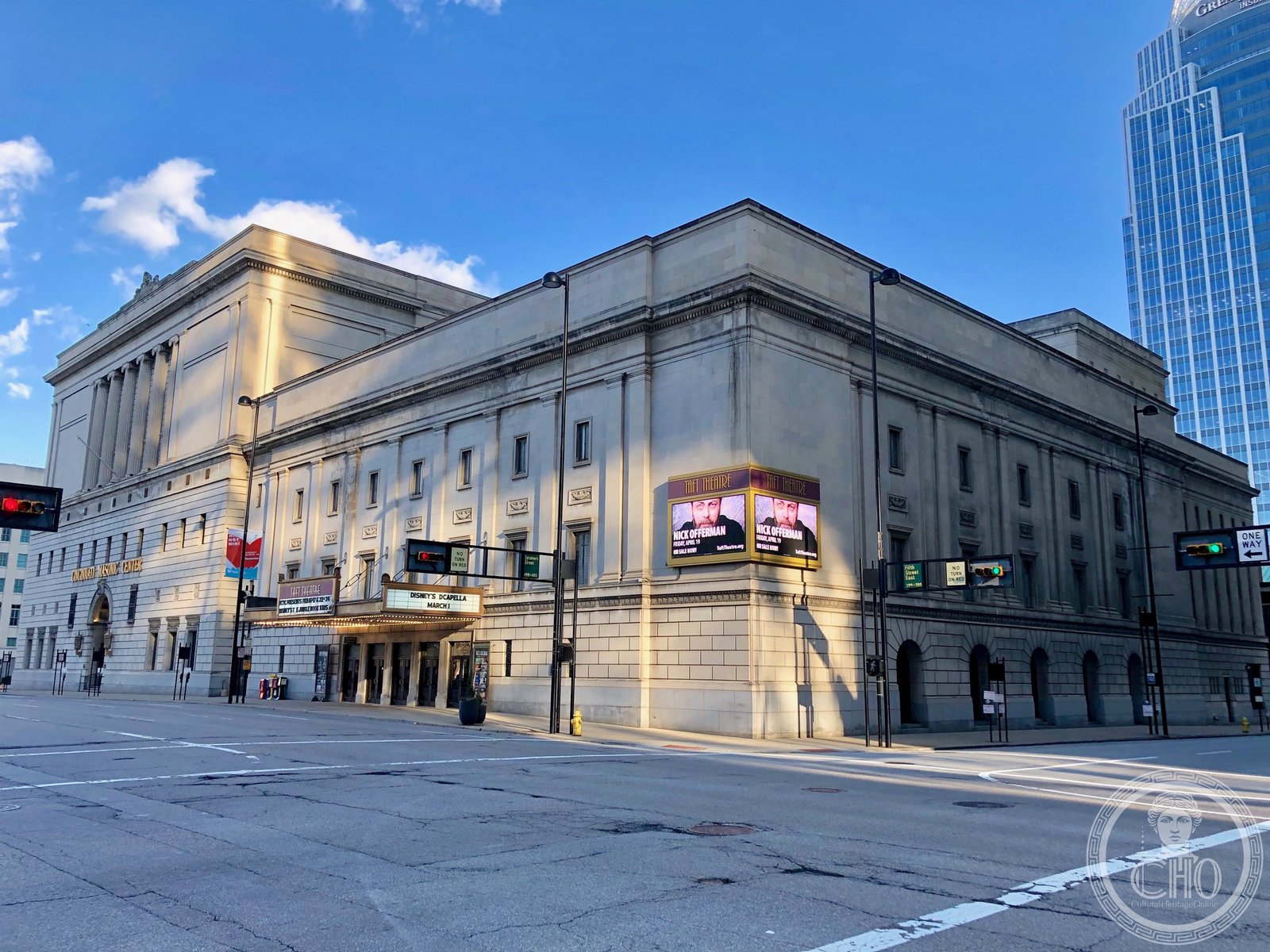
The Taft Theatre on East Fifth Street stands as downtown Cincinnati’s most distinguished surviving picture palace—a 1928 monument to the city’s cultural ambitions named for the Taft family whose influence shaped both the politics and the architecture of Ohio’s largest city.
At a glance
The Taft Theatre at 317 E Fifth Street in downtown Cincinnati is a 1928 performing arts venue built during the golden age of American movie palace construction and named for Cincinnati’s most prominent family—the Tafts, whose roster includes a US president, senators, publishers, and philanthropists who helped shape the cultural institutions of Ohio’s leading city. The theater’s exterior presents a refined example of the Italian Renaissance-influenced Art Deco that was fashionable for major urban theaters in the 1920s: restrained but authoritative, designed to signal institutional permanence on a downtown street where banks and office buildings competed for civic presence. The Taft now operates as a concert venue hosting touring artists across multiple genres, making it one of the most actively programmed performing arts spaces in the Cincinnati metropolitan area.
Key facts
- Address: 317 E Fifth Street, Cincinnati, OH 45202
- GPS: 39.1008° N, 84.5124° W
- Built: 1928
- Style: Art Deco / Italian Renaissance Revival
- Named for: The Taft family of Cincinnati
- Status: Active concert venue
- NRHP: Listed on National Register of Historic Places
History
Cincinnati in the 1920s was a city of substantial commercial and industrial wealth whose cultural ambitions were expressed through investment in architecture that could compete with the major institutions of Chicago, New York, and Philadelphia. The Taft family had been central to this cultural project since the 19th century: Charles Phelps Taft, brother of President William Howard Taft, was one of Cincinnati’s most important art patrons and real estate developers, and the family’s investment in civic institutions gave their name a particular resonance in the city’s cultural geography.
The Taft Theatre opened in 1928 as one of Cincinnati’s finest entertainment venues—a movie palace designed to serve the concentrated commercial district along Fifth Street in downtown Cincinnati. The theater’s design followed the fashionable Italian Renaissance-influenced Art Deco aesthetic that distinguished the major urban movie palaces of the late 1920s from the pure Baroque or Gothic eclecticism of the previous decade. The auditorium’s decorative program was executed with the richness of detail that audiences expected from a first-class downtown theater, establishing the Taft as one of the landmark entertainment destinations in the region.
The postwar decline of the single-screen movie palace followed a familiar pattern in Cincinnati as in other American cities: suburban competition, changing entertainment habits, and the economics of maintaining a large single-purpose building brought the theater through a series of programming transitions. Preservation and renovation efforts eventually returned the Taft to active use as a concert and performing arts venue, and the building now hosts a year-round program of musical performances that draws audiences from throughout the Cincinnati metropolitan area and northern Kentucky.
What you see
The Fifth Street facade is a composed expression of the Italian Renaissance mode that characterized the most restrained 1920s theater architecture: arched window openings, a cornice with classical molding, and a surface treatment that uses stone and brick to achieve a sense of institutional solidity. The marquee—the commercial sign that identifies the building’s function—provides the contemporary contrast against the period ornament of the upper stories. The composition reads as civic architecture as much as entertainment building, which is consistent with the Taft family’s investment in the building’s civic character.
Inside, the auditorium carries the decorative vocabulary of the Italian Renaissance in the plasterwork of the boxes, ceiling, and proscenium arch. The scale of the house—its depth and width reflect the ambition of a theater designed to seat a substantial downtown audience—creates the sense of occasion that distinguished the picture palace from the neighborhood cinema. The concert configuration maintains the visual relationship between performer and audience that the original theater architects designed into the building’s proportions.
Practical information
- The Taft Theatre programs concerts across multiple genres including rock, pop, comedy, and performing arts; check tafttheatre.org for the current calendar.
- Located on Fifth Street in downtown Cincinnati, walkable from the central business district and a short distance from Fountain Square.
- Fully accessible; ADA seating available.
- Cincinnati’s downtown parking garages are concentrated in the blocks surrounding Fifth Street; the 5th and Race Parking Garage is directly adjacent.
Getting there
The Taft Theatre is at 317 E Fifth Street in downtown Cincinnati. Cincinnati/Northern Kentucky International Airport (CVG) is approximately 13 miles south of downtown via I-275 and I-71/I-75; drive or taxi time is 20-30 minutes. The Cincinnati Bell Connector streetcar serves the downtown loop with stops near Fountain Square (4th and Walnut) approximately 3 blocks west. Interstate 71 and 75 converge in downtown Cincinnati; Fifth Street is one of the primary east-west through streets in the central business district. Columbus, Ohio is 100 miles northeast via I-71; Indianapolis is 110 miles northwest via I-74.
Nearby
- Fountain Square (3 blocks west): Cincinnati’s central public square at Fifth and Vine, anchored by the Tyler Davidson Fountain (1871), hosts outdoor concerts, ice skating in winter, and serves as the community gathering point of the downtown.
- Cincinnati Art Museum (2 miles northeast in Eden Park): the museum at 953 Eden Park Drive holds one of the largest encyclopedic art collections in the country, free general admission; the Art Deco and decorative arts holdings are notable.
- Cincinnati Music Hall (1 mile northwest): the 1878 High Victorian Gothic masterpiece at 1241 Elm Street — a National Historic Landmark — hosts the Cincinnati Symphony Orchestra and Cincinnati Pops; a companion institution to the Taft in the city’s performing arts landscape.
- Roebling Suspension Bridge (1 mile south): John Roebling’s 1866 bridge over the Ohio River — the prototype for the Brooklyn Bridge — connects Cincinnati to Covington, Kentucky; walking the span is free.
Sources
- Taft Theatre, tafttheatre.org — venue history and current programming
- National Register of Historic Places, Cincinnati Downtown Historic District documentation
- Cincinnati Preservation Association records
- Cinema Treasures, “Taft Theatre, Cincinnati” database entry
Find it on the map
See this place and what’s around it →Record researched and written by Luigi De Marchi for Cultural Heritage Online, 2026.
📷 Become a Cultural Heritage Online photographer
Share your photos of places: they stay published under your name as the author. The more they're seen, the more you get noticed — and soon a contest will reward the most appreciated photos.
Log in or sign up free to add a photoIs this page about you?
This page is read by travellers and heritage enthusiasts who find it on Google. Tell us how you are connected to this place and we will take it from there.