
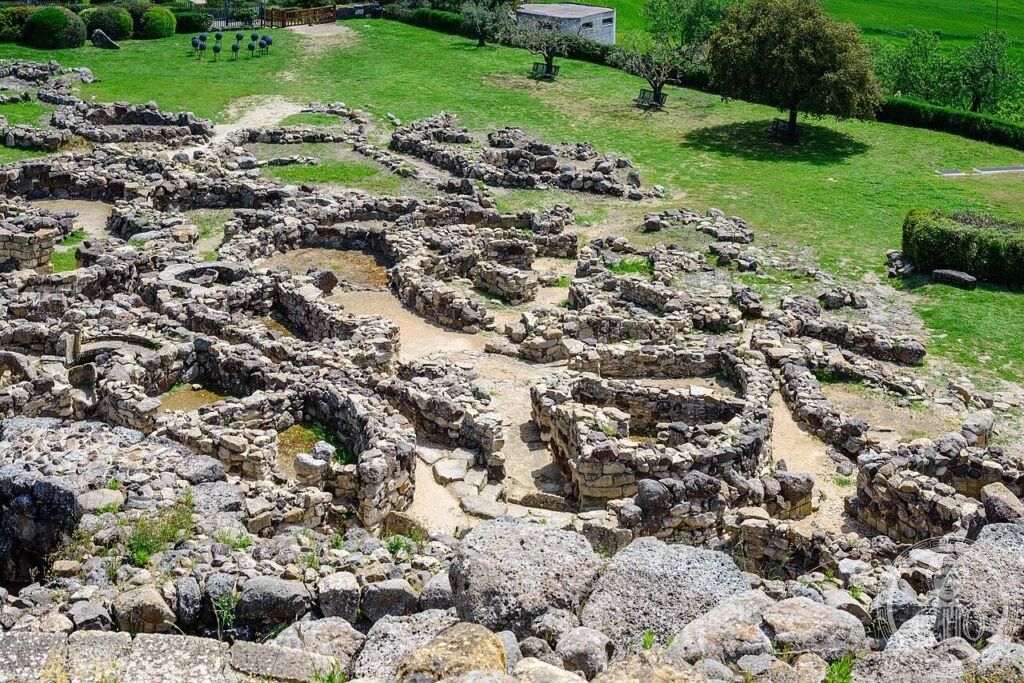
Su Nuraxi di Barumini is the most complex and best-preserved nuraghe in Sardinia — a type of Bronze Age stone tower-fortress unique to the island, of which approximately 7,000 survive in varying states of preservation — and is, together with the surrounding prehistoric village of some 200 huts, the most complete surviving example of nuragic architecture, the dominant building tradition of Sardinia from approximately 1500 BCE to the Roman conquest in the 3rd century BCE.
At a glance
Su Nuraxi (the word means simply “the nuraghe” in Sardinian) is a UNESCO World Heritage Site inscribed in 1997 (ref. 833) as “Su Nuraxi di Barumini.” The site is located in the municipality of Barumini (province of Sud Sardegna, Sardinia), 45 km north of Cagliari in the central Campidano plain. The inscription covers the nuragic complex consisting of the central tower (torre madre or mastio), the surrounding trilobate bastion with four corner towers, the outer curtain wall, and the extensive prehistoric village of huts surrounding the fortification. Su Nuraxi was excavated between 1950 and 1957 by Giovanni Lilliu (1914-2012), the “father of Sardinian archaeology,” and is managed by the Fondazione Barumini Sistema Cultura.
Key facts
- Construction phases: The central tower (torre madre) was built first, in the Late Bronze Age (c. 1500-1300 BCE), in dry-stone basalt masonry using the nuragic corbelling technique (successive courses of stones projected inward until the space is closed, a technique that allows stable vaulted chambers without a keystone arch); the tower originally stood approximately 17 m tall (today approximately 14.5 m survive); the interior has three superimposed circular chambers (the tholos rooms) connected by internal staircases; in the Early Iron Age (c. 1000-700 BCE), a trilobate bastion with four corner towers was added around the central tower, and the outer curtain wall was built
- The nuraghe as building type: Nuraghi are truncated-cone stone towers, built without mortar, using the corbelling technique, by the Bronze Age population of Sardinia; approximately 7,000 survive on the island in various states; the “simple” nuraghe (single tower) is the most common; “complex” nuraghi (central tower + bastion + outer walls) are rarer — Su Nuraxi is the most complex surviving example; the function of the nuraghi is debated (defensive fortress, residence of a local chief, cult/ceremonial structure, or territorial marker — probably combinations of these at different periods)
- The prehistoric village: Surrounding the fortification is a village of approximately 200 circular huts, also in dry-stone basalt, built in two phases (Early Iron Age, c. 900-700 BCE, and the Punic-Sardinian period, c. 500-238 BCE); the huts have single rooms with central hearths; the layout is irregular, following the terrain; the village was occupied until approximately the 2nd-1st century BCE, when the Roman conquest of Sardinia (238 BCE) brought new settlement patterns and the nuragic culture gradually disappeared
- Giovanni Lilliu (1914-2012): The archaeologist who excavated Su Nuraxi from 1950, removing the earth cover (the entire complex had been buried under metres of accumulated soil, making it appear as a natural hill in the landscape before excavation) and establishing the chronology and cultural attribution of the nuragic civilization; his major work La Civiltà dei Sardi (1963) remains the standard reference on nuragic culture
- UNESCO: 1997, ref. 833
- GPS: 39.7069, 9.0124 — Google Maps
History
The nuragic civilization of Sardinia (c. 1800-238 BCE) is one of the most distinctive prehistoric cultures of the western Mediterranean — a society that built approximately 7,000 stone tower-fortresses across an island of 24,000 km², developed a sophisticated metalworking tradition in bronze (the famous “bronzetti nuragici” — small bronze votive figures now distributed across museums worldwide, particularly prominent in the Museo Nazionale Preistorico ed Etnografico “Luigi Pigorini” in Rome and the Museo Nazionale Archeologico di Cagliari), and maintained their cultural identity through the Phoenician and Punic periods (c. 800-238 BCE) before being gradually assimilated after the Roman conquest of 238 BCE.
The nuragic people had no writing system and left no texts: our knowledge of their social organisation, belief systems, and cultural practices comes entirely from the archaeological evidence (the nuraghi themselves, the bronzetti, the “betyl” sacred stones, and the “sacred wells” — nuraghic ritual structures built over natural springs). The oral tradition of Sardinian culture preserved no memory of the nuragic period that was useful to historians, and the nuraghi remained mysterious structures — sometimes attributed to mythological giants, sometimes to the Carthaginians or the Romans — until systematic archaeological study began in the late 19th century.
What you see
The Su Nuraxi site is entered from the visitor centre (Fondazione Barumini Sistema Cultura) at the west side of the archaeological area; guided visits of 45-60 minutes are mandatory (the site is too complex to navigate without guidance). The visit proceeds around the exterior curtain wall, then through the bastion (the four corner towers and the central courtyard between them), and up into the central tower to the surviving tholos chamber at the first level (the upper levels are inaccessible). The village huts to the south and east of the fortification are visible from the raised walkways around the bastion.
The most important viewing point is from the internal courtyard of the bastion (the central space between the five towers): looking up at the towers rising around the courtyard gives the clearest sense of the architectural scale and the precision of the dry-stone basalt masonry (the stones are fitted without mortar but with extraordinary precision; courses are horizontal; the corbelling of the tholos chambers is visible from below through the tower doorways). The basalt stone is dark grey-black, giving the complex a much more massive and fortress-like character than the limestone or sandstone nuraghi of the northern parts of the island.
Gallery
Practical information
- Su Nuraxi di Barumini (Fondazione Barumini Sistema Cultura): Viale Su Nuraxi 41, Barumini; open daily 9:00-sunset; guided visits only (lasting 45-60 min); departures every 30-60 min depending on season. Admission ~€12 (reduced ~€7). Book online at fondazionebarumini.it or on site. Groups (10+ people) should book 3-5 days in advance.
- Casa Zapata Museum: Piazza Maria Carta 7, Barumini (500m from Su Nuraxi); a 16th-century Spanish baronial manor built directly over a Bronze Age nuragic village — the excavated village is visible through a glass floor in the museum; open daily 9:30-17:30 (winter), 9:30-18:30 (summer). Admission ~€5 (combined with Su Nuraxi: ~€14).
- Season: Su Nuraxi is an open-air site; best April-October (long daylight, warmer temperatures); summer can be hot (very little shade in the archaeological area); bring sun protection and water.
Getting there
Viale Su Nuraxi 41, Barumini (SU), Sardegna. Barumini is 45 km north of Cagliari in the Campidano plain. By car: from Cagliari, SS131 north then SR197 east (45 km, 50 min) — car is the most practical option, as public transport is limited. By bus: ARST buses from Cagliari (2 departures per day, 1h30; check current timetables at arstspa.info); from Sanluri (25 km north, ARST bus to Barumini 40 min; Sanluri is a main ARST node with more frequent connections to Cagliari). By air: Cagliari-Elmas airport (50 km south); car rental at the airport is the most practical option for visiting Su Nuraxi.
Nearby
- Cagliari — 45 km south; the capital of Sardinia; the Cittadella dei Musei (including the Museo Nazionale Archeologico with the largest collection of Nuragic bronzetti in the world), the Bastione di San Remy (panoramic terrace over the city), the Roman amphitheatre (2nd century CE, partly carved into the rock), and the Santuario di Nostra Signora di Bonaria (pilgrimage church, origin of the name of Buenos Aires — the Aragonese sailors who settled the Rio de la Plata in the 1530s named the city after the patron saint of their Sardinian port)
- Barumini historic centre — immediately adjacent to Su Nuraxi; the Casa Zapata museum (16th-century Spanish manor over a nuragic village, see above); the medieval church of Santa Tecla (15th century)
- Giara di Gesturi — 10 km north-east; a flat basalt plateau (624 m altitude, 42 km²) and the last habitat of the Giara horse (Cavallino della Giara) — a semi-wild pony breed (approximately 700 surviving individuals) that lives free on the plateau and is the symbol of Sardinian prehistoric fauna; accessible via 4WD or hiking from Gesturi or Genoni
Sources
- UNESCO: whc.unesco.org/en/list/833
- Wikipedia EN: Su Nuraxi
- Lilliu, Giovanni: La Civiltà dei Sardi, RAI Radiotelevisione Italiana, 1963 (3rd ed. 1988)
- Fondazione Barumini Sistema Cultura: fondazionebarumini.it
Find it on the map
See this place and what’s around it →📷 Become a Cultural Heritage Online photographer
Share your photos of places: they stay published under your name as the author. The more they're seen, the more you get noticed — and soon a contest will reward the most appreciated photos.
Log in or sign up free to add a photo