
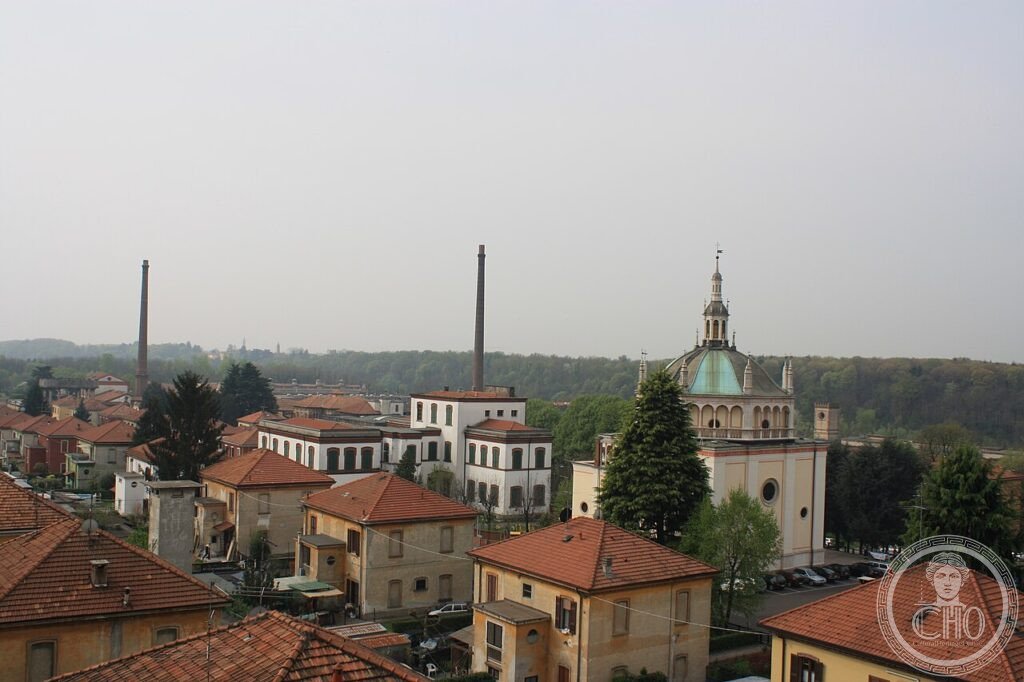
Crespi d’Adda is the best-preserved 19th-century company town in Europe — a complete planned workers’ village built between 1878 and the 1930s by the Crespi cotton-mill dynasty on the bank of the Adda river, where the owner provided not just housing but every social institution its workers needed from birth to death: a school, a church, a hospital, sports facilities, a wash-house, and a cemetery with a neoclassical mausoleum, all laid out with a clarity that reads today as a utopian social experiment preserved in almost intact form.
At a glance
Crespi d’Adda (frazione of Capriate San Gervasio, province of Bergamo, Lombardia) is a UNESCO World Heritage Site inscribed in 1995 (ref. 730) as “Crespi d’Adda.” The inscription covers the entire planned village on the left bank of the Adda river: the cotton mill (now closed, private property), the workers’ housing (approximately 100 detached houses in three different typologies corresponding to three levels of seniority), the Villa Crespi (the owner’s residence, on the main axis of the village), the church, the hospital, the sports ground, the school, the wash-house, and the cemetery. The village remains inhabited (approximately 1,000 residents in the workers’ houses) and is privately owned. Access to the public areas (the streets, the cemetery, the church, the exterior of the mill) is free; the mill interior is not accessible to the public.
Key facts
- Cristoforo Benigno Crespi (1833-1920): Bergamo-born cotton merchant who inherited a textile business and expanded it, building his first mill at Crespi sul Serio (Ponte Nossa, Val Seriana) in 1868; in 1875, he acquired land on the Adda at Capriate San Gervasio and built the main Cotonificio Crespi (cotton-spinning and weaving mill), completed in 1878; he commissioned Ernesto Pirovano and then Pietro Brunati to design the workers’ village, which grew between 1878 and the 1920s to approximately 100 houses and all the support facilities; his son Silvio Crespi (1868-1944), who later became a senator and diplomat, completed the village and ran the company until the interwar crisis.
- Village layout: The Cotonificio Crespi occupies the riverfront; behind it, the workers’ village is laid out in a rectilinear grid with a central tree-lined avenue (Viale Crespi) connecting the mill gates to the Villa Crespi at the far end; the workers’ houses are in three typologies (single-room cottages for unskilled workers; double-story semi-detached houses for skilled workers; larger detached villas for management); the church, school, and hospital are distributed along the central avenue; the cemetery is at the north end, with the Crespi family mausoleum (neoclassical, 1905) on the main axis.
- Building styles: The architecture is eclectic neo-Gothic and neo-Romanesque, with elements of the Arts and Crafts movement (reflecting the owners’ familiarity with English industrial villages such as Saltaire and Port Sunlight); the mill chimney (a 76-metre red brick tower) is visible from the whole village and from the Adda valley.
- The mill: The Cotonificio Crespi was one of the largest cotton mills in Italy at its peak (1920s), employing approximately 4,000 workers from the surrounding villages; it closed in 2004 (last owner: Marzotto Group); the mill buildings (red brick, late 19th century) are privately owned and not accessible; a project for a design and culture hub is periodically discussed but not yet realized.
- UNESCO: 1995, ref. 730.
- GPS: 45.5877, 9.5242 — Google Maps.
History
The company town tradition that Crespi d’Adda belongs to emerged in the mid-19th century as a response to the problem of providing labor for industrial plants built in rural locations far from existing urban centers (in the case of Crespi, the location on the Adda river was chosen for water power, not proximity to workers). English examples — Saltaire (1853, Titus Salt), Bournville (1879, George Cadbury), Port Sunlight (1888, William Lever) — and European continental equivalents (Le Creusot, France; Noisiel, France) established the model of the self-contained workers’ settlement as an instrument of industrial paternalism: the owner provided housing, social facilities, and institutions, in exchange for worker loyalty and a disciplined, stable workforce.
Crespi d’Adda differs from English examples in the degree of stylistic ambition: the eclectic neo-Gothic and neo-Romanesque buildings (particularly the church, the cemetery, and the villa) reflect a specifically Italian late-19th-century idiom for “noble” architecture associated with Catholic social values and civic paternalism. The Crespi family, who were practising Catholics and prominent in the Bergamo social Catholic tradition, used the village as an instrument not only of industrial organisation but of social and moral formation: the church was central, attendance was expected, and the cemetery with its hierarchy of burial plots (the Crespi mausoleum at the apex, workers’ plots in ranked sections below) physically expressed the social order of the village in death as in life.
What you see
The village is freely accessible on foot. The main entry point is from the Capriate San Gervasio main road (Via C.B. Crespi), where the mill gate is still the dominant feature — a neo-Gothic arch in red brick that marks the transition from the public road to the factory grounds. From the mill gate, Viale Crespi (the central avenue) runs north through the workers’ village for approximately 500 metres: the church of the Sacra Famiglia (1891, neo-Romanesque, with a mosaic facade and interior frescoes) is on the right; the school (now a private residence) on the left; the hospital (now apartments) further along. The Villa Crespi (the owner’s neo-Gothic mansion, 1889, with towers and a garden) closes the northern end of the avenue — it is privately occupied and not accessible.
The workers’ houses (both typologies) are easily seen from the streets, which remain public. The wash-house (lavatoio, 1891) is on the Adda riverside, accessible via a path from the village — a long narrow building with individual stone wash-basins along the walls, now restored and sometimes used for cultural events. The cemetery (open daily) is the most elaborate architectural ensemble in the village: the central avenue leads to the Crespi mausoleum, a domed neoclassical structure (1905, Angelo Colla) that terminates the axis with a dome visible from the village streets.
Gallery
Practical information
- Access: The village streets and cemetery are freely accessible daily. The church interior: open during services (Sunday morning, check with parish); otherwise apply at the parish office (Via C.B. Crespi 4). The mill exterior: visible from the street; not accessible to the public. Duration: 1.5-2 hours for the complete village circuit on foot (village streets + cemetery + Adda riverside).
- Season: Year-round. The Adda riverside path (Alzaia dell’Adda) south of the village provides 3 km of natural walking along the river to the Lenna gorge (Parco dell’Adda Nord) — bring walking shoes.
- Note: Crespi d’Adda is an inhabited village; residents live in the historic workers’ houses. The streets are public but the houses and gardens are private property.
Getting there
Via C.B. Crespi, Capriate San Gervasio (BG), Lombardia. GPS 45.5877, 9.5242. By car: from Bergamo, SS342 west then south toward Trezzo sull’Adda (25 km, 30 min); from Milan, A4 autostrada to Trezzo sull’Adda exit then SP128 north (35 km from Milan, 40 min). Limited free parking at the village entrance on Via C.B. Crespi. By public transport: from Bergamo, TPER bus line 1Z or 1P to Capriate San Gervasio (2 km from the village, 25 min walk) — very infrequent service; car is strongly recommended for visitors without local transport. Alternatively, the Adda riverside cycling route (Lungo Adda) connects Crespi to Bergamo via a 25 km cycle path (mostly flat, marked).
Nearby
- Bergamo — 25 km north-east; the Città Alta (medieval upper city, funicolare-connected) with the Cappella Colleoni (Amadeo, 1476, the most elaborate Lombard Renaissance facade in the province), the Palazzo della Ragione (12th c., the oldest municipal building in Lombardia), the Duomo, the Basilica di Santa Maria Maggiore (Romanesque exterior, Baroque interior with Lotto tapestries); the Accademia Carrara (Botticelli, Raphael, Lorenzo Lotto, Moroni collection).
- Trezzo sull’Adda — 5 km south; the ruins of the Visconti castle (Gian Galeazzo Visconti, 1370, with a 56-metre tower overlooking the Adda gorge; partially restored); the Centrale idroelettrica Taccani (1906, Gaetano Moretti — a hydroelectric power station in Art Nouveau industrial style, sometimes open for visits and described as “the most beautiful power station in the world”).
- Lago di Lecco (Como/Lecco) — 25 km north; the Lake Como east arm (Ramo di Lecco) with the Villa Manzoni at Lecco (home of Alessandro Manzoni, now a museum).
Sources
- UNESCO: whc.unesco.org/en/list/730.
- Wikipedia EN: Crespi d’Adda.
- Carera, Aldo: Il cotonificio Crespi d’Adda. Fabbrica e villaggio operaio, Fondazione Dalmine, 1996.
- Parco dell’Adda Nord: parcoaddanord.it.
Find it on the map
See this place and what’s around it →📷 Become a Cultural Heritage Online photographer
Share your photos of places: they stay published under your name as the author. The more they're seen, the more you get noticed — and soon a contest will reward the most appreciated photos.
Log in or sign up free to add a photo