
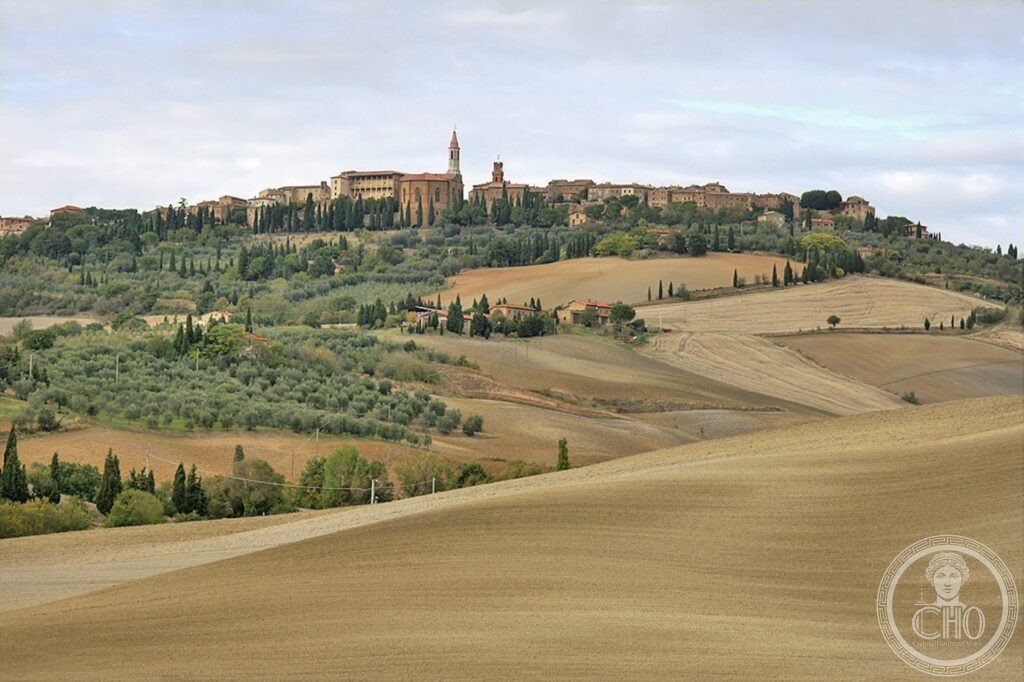
Pienza is the most complete surviving realization of the Renaissance “ideal city” as a building project: in 1459, Pope Pius II (born Enea Silvio Piccolomini in Corsignano, 1405) commissioned the Florentine architect Bernardo Rossellino to transform his small home village into a model of humanist urban planning — and in just three years (1459-1462), before the Pope’s death halted the project, Rossellino created the Cathedral, the Palazzo Piccolomini, the Palazzo Pubblico, and the Piazza Pio II (the first planned Renaissance civic square in Italy) according to principles derived directly from the De Re Aedificatoria of Leon Battista Alberti, the founding text of Renaissance architectural theory.
At a glance
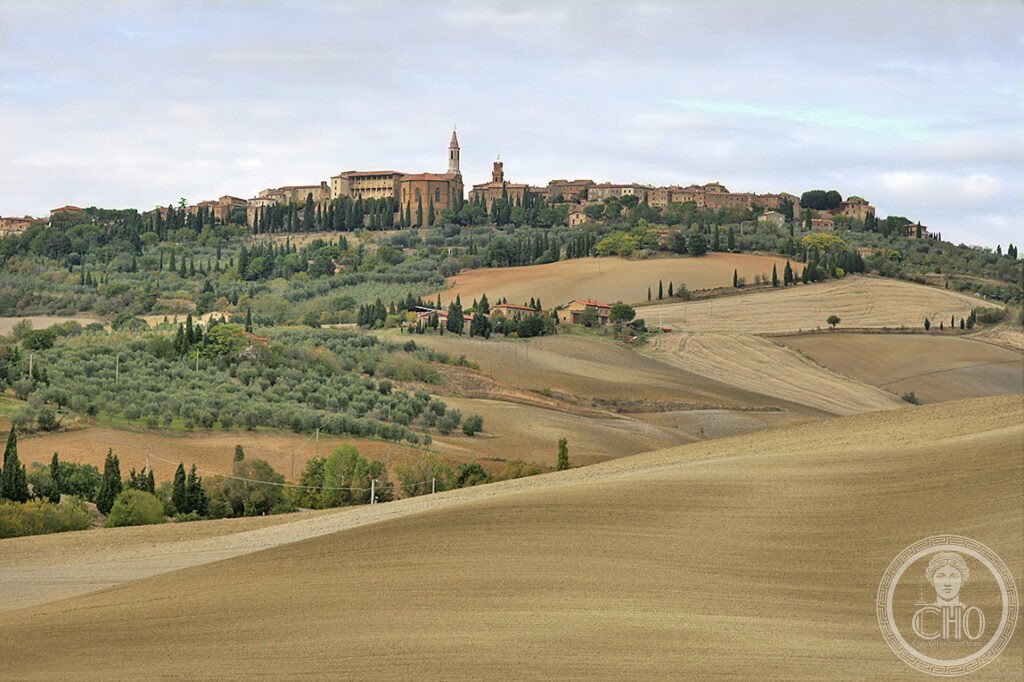
Pienza (province of Siena, Toscana) is a UNESCO World Heritage Site inscribed in 1996 (ref. 789) as “Historic Centre of Pienza.” The inscription covers the planned Renaissance centre of the town — the Piazza Pio II (the central square with four principal buildings on its four sides, the only surviving 15th-century example of a planned civic space in Italy), the Cathedral of Santa Maria Assunta (1459-1462), the Palazzo Piccolomini (the Pope’s private palace, now a museum), the Palazzo Vescovile (the bishop’s palace), and the Palazzo Comunale (the municipal palace). Pienza is also located at the heart of the Val d’Orcia UNESCO Landscape (separately inscribed in 2004, ref. 1026) — the agricultural and scenic landscape of the valleys of the Orcia and Asso rivers, famous for its rolling wheat fields, cypress avenues, and dramatic hilltop towns.
Key facts
- Enea Silvio Piccolomini (1405-1464): Born in Corsignano (the medieval name of Pienza); humanist scholar, poet, and diplomat before entering the Church; Secretary to the Council of Basel (1432-1444); Bishop of Trieste (1447) then Siena (1450); elected Pope in 1458 as Pius II; his Commentarii (memoirs written in Latin) are the only autobiography of a Renaissance pope and describe his plans for Corsignano in detail, including his conversation with Rossellino about the project; Pius II is unique in having published a formal declaration banning the alteration or demolition of the buildings he had commissioned in Corsignano/Pienza (Bulla di Papa Pio II, 1462) — one of the earliest legal monuments protecting a built heritage
- Bernardo Rossellino (1409-1464): Florentine architect and sculptor; collaborator of Leon Battista Alberti on the renovation of the Palazzo della Cancelleria in Rome; commissioned by Pius II in 1459 to redesign Corsignano; the design of the Pienza project was derived directly from Alberti’s principles (De Re Aedificatoria): the piazza as the symbolic centre of civic life, the cathedral oriented south (away from the canonical east) to maximize the view from the loggia over the Val d’Orcia, the regular facades of the surrounding buildings creating a unified visual framework for the square
- The Cathedral of Santa Maria Assunta (1459-1462): Built in a Gothic interior (hall church, with three equal-height naves — because Pius II wanted interior light equal in all naves, as in the German Gothic churches he had seen during his time in Austria and Germany) combined with a Renaissance exterior facade (classical pilasters, round arch portal, triangular pediment, and horizontal cornices); the combination of Gothic spatial organisation with Renaissance exterior articulation is unique in Italian architecture; the 15th-century Pope Paul II later described it as “more beautiful than any church I have seen”
- UNESCO: 1996, ref. 789
- GPS: 43.0756, 11.6778 — Google Maps
History
The project was conceived by Pius II during his first visit to his hometown after his election as Pope in 1458 — the same year he commissioned the renaming of the village from “Corsignano” to “Pienza” (from Pius, meaning “pious” — a reference to his own papal name). The construction was completed in just three years (June 1459 to June 1462), an extraordinary speed made possible by the concentration of papal resources on a small village site rather than a major city. When the Pope formally inaugurated the cathedral on August 29, 1462, the transformation was already complete: a planned civic square with four major buildings, a network of streets radiating from the piazza, and a new town plan for the houses to be built by the Piccolomini family’s associates.
The project was halted by Pius II’s death in 1464 (at Ancona, waiting for the Crusade he had proclaimed to launch against the Ottoman Turks who had taken Constantinople in 1453 — a Crusade that never materialized). Without the Pope’s patronage, the planned extension of the Pienza project to the whole village was never completed. The village remained as Rossellino had left it in 1462, essentially unchanged: the 1462 bull of Pius II protecting the buildings from alteration proved so effective that the buildings survive today almost exactly as completed, making Pienza the most intact 15th-century planned Italian urban space in existence.
What you see
The Piazza Pio II is the heart of Pienza and the essential thing to see: the four buildings on the four sides of the square (Cathedral on the south, Palazzo Piccolomini on the west, Palazzo Vescovile on the east, Palazzo Comunale on the north) form a spatial composition that reads as a single designed environment — the first time in Italian urban design that a public square was conceived as a unified architectural composition, not as the incidental result of building construction around a pre-existing open space. The loggia at the south end of the cathedral gives a view of the Val d’Orcia that Rossellino specifically oriented the cathedral to create.
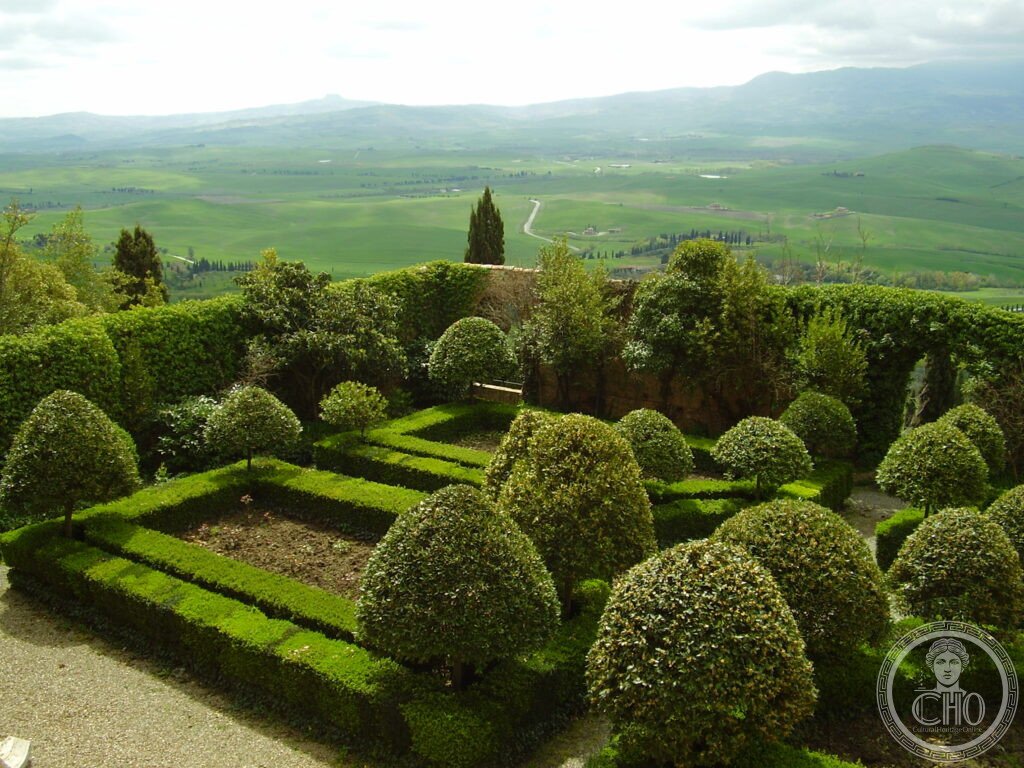
The Palazzo Piccolomini (Via Rossellino 18) is open for guided visits (the state rooms including the Pope’s library and the hanging garden on the south terrace, which looks out directly over the Val d’Orcia — the garden is on three levels, connected by external staircases, an early example of the Italian garden as a designed frame for a landscape view). The Cathedral interior (free entry) contains five altarpieces commissioned by Pius II from the leading Sienese painters of the period (Giovanni di Paolo, Vecchietta, Matteo di Giovanni, Sano di Pietro) — each altarpiece depicting one of the Apostles to whom Pius II was personally devoted, and each in an elaborate carved marble frame by Rossellino.
Gallery
Practical information
- Cathedral: Piazza Pio II; open daily 7:30-12:00 and 14:00-18:00; free entry. The terrace-loggia on the south side (exterior, looking over Val d’Orcia): always accessible from the piazza side.
- Palazzo Piccolomini: Piazza Pio II 2; open Tuesday-Sunday 10:00-18:30 (March-October), 10:00-16:30 (November-February). Guided visits only (every 30 min). Admission ~€7 (reduced ~€5). The hanging garden requires a separate ticket (~€3).
- Museo Diocesano di Arte Sacra: Piazza Pio II 10; open Tuesday-Sunday 10:00-13:00, 14:00-18:00 (March-October). Admission ~€4.50. Contains vestments, illuminated manuscripts, and the “Tesoro del Duomo” (cathedral treasury items including items owned personally by Pius II).
- Duration: 2-3 hours for the complete Pienza historic centre. The town is very small (the entire planned Renaissance area is 200m × 150m); allow 30 additional minutes for a walk around the exterior walls for the Val d’Orcia view.
Getting there
Piazza Pio II, Pienza (SI), Toscana. Pienza has no railway station. By bus: TiemmeToscana buses from Siena (52 km; 1h30) and Montepulciano (15 km; 30 min); limited frequency (3-4 times daily). By car: from Siena, SR2 “Cassia” south then SS146 (52 km, 1h); from Rome, A1 to Chiusi/Chianciano Terme then SS146 (170 km, 2h); from Florence, A1 to Valdarno then SR73 and SS146 (120 km, 1h45). Paid parking at the north entrance of the village (Piazzale delle Logge) and the south entrance (Piazzale del Casello).
Nearby
- Montepulciano — 15 km east; a hilltown famous for Vino Nobile di Montepulciano (the wine that “all other wines bow down before,” according to poet Francesco Redi, 1685); the Palazzo Comunale (a Florentine Renaissance building by Michelozzo, 1440); the Cathedral (unfinished facade, 1592; Taddeo di Bartolo polyptych)
- Montalcino — 25 km west; the hilltop city that produces Brunello di Montalcino (one of Italy’s most celebrated red wines, from Sangiovese grosso grapes aged minimum 4 years in wood); the Fortezza Medicea (1361, now an enoteca); the Museo di Montalcino (archaeological collection from the Etruscan settlement of Murlo)
- Val d’Orcia (UNESCO 2004, ref.1026) — the surrounding landscape of the Orcia and Asso river valleys, inscribed separately as a Cultural Landscape; the famous cypress avenues (along the road from San Quirico d’Orcia to Monticchiello), the white clay hills (crete senesi), and the hilltop towns (Castiglione d’Orcia, Radicofani with its volcanic rock tower)
Sources
- UNESCO: whc.unesco.org/en/list/789
- Wikipedia EN: Pienza
- Mack, Rosamond E.: Pienza: The Creation of a Renaissance City, Cornell University Press, 1987
- Ufficio Turistico di Pienza: pienza.info
Find it on the map
See this place and what’s around it →📷 Become a Cultural Heritage Online photographer
Share your photos of places: they stay published under your name as the author. The more they're seen, the more you get noticed — and soon a contest will reward the most appreciated photos.
Log in or sign up free to add a photo