
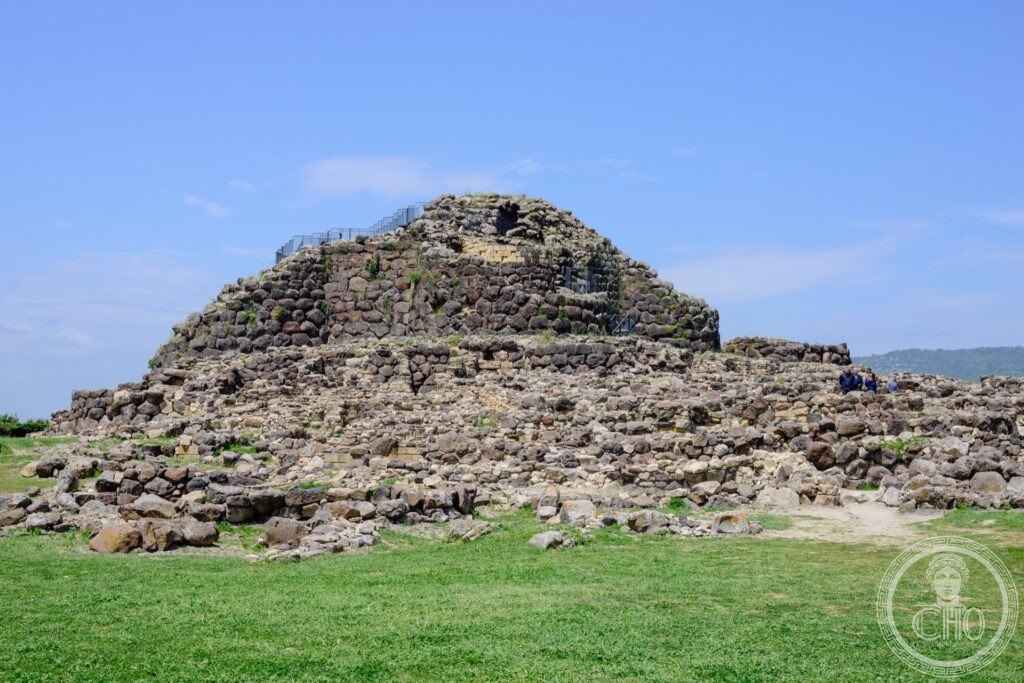
Su Nuraxi di Barumini — the largest and best-preserved nuraghe in Sardinia, built from rough basalt blocks without mortar between 1600 and 900 BCE and surrounded by a village of 200 circular huts — is the masterwork of the Nuragic civilization: a Bronze Age culture unique to Sardinia that built more than 7,000 tower-fortresses across the island between 1800 and 500 BCE, leaving no writing and no external documentary record, and whose purpose, social structure, and religion remain partially unknown.
At a glance
Su Nuraxi di Barumini (province of Medio Campidano/Sud Sardegna, Sardegna; UNESCO 1997, ref. 833) is the most important single monument of the Nuragic civilization — the Bronze and Iron Age culture that was exclusive to Sardinia and produced the nuraghe (a truncated-cone tower structure built from uncut stone without mortar, with corbelled interior vaulting) as its primary architectural form. The UNESCO inscription (1997) recognized the Outstanding Universal Value of Su Nuraxi as a unique typological monument (the nuraghe is a building type without parallel in the ancient world; no identical structure exists anywhere other than Sardinia, and even the closest analogues — the talayots of the Balearic Islands — are generally believed to derive from Sardinian influence rather than independent invention) and as the best-preserved example of the complex nuraghe form (a central tower flanked by 4 subsidiary towers and enclosed by a basalt bastioned wall).
Key facts
- Il nuraghe (1600-900 a.C.): The central tower of Su Nuraxi (ca. 18 m surviving height, originally perhaps 21-23 m) was built in three construction phases: Phase 1 (ca. 1600-1500 BCE, Middle Bronze Age): the central tholos (corbelled stone tower, 15 m high, with an internal chamber at ground level and a corbelled ceiling); Phase 2 (ca. 1300-1200 BCE, Late Bronze Age): the addition of 4 subsidiary towers surrounding the central tower, connected by a curtain wall to form a quadrilobate bastioned compound; Phase 3 (ca. 1200-900 BCE, Final Bronze Age): the outer enclosure wall and the expansion of the village settlement around the compound
- Il villaggio nuragico (XI-IV sec. a.C.): The village of approximately 200 circular huts around the nuraghe compound (founded ca. 1000 BCE, inhabited until the 4th-3rd century BCE, when the Roman conquest of Sardinia ended the Nuragic culture as a living tradition) is the best-documented Nuragic village settlement in Sardinia; the huts show multiple functions (dwellings, storage, a “meeting hut” for assembly, craft workshops) and preserve bronze objects, ceramics, and evidence of cult practices
- La civiltà nuragica: The Nuragic civilization (ca. 1800-300 BCE) left more than 7,000 nuraghi on Sardinia (the highest density of prehistoric tower structures in the Mediterranean — roughly one nuraghe per 3.7 km²); they left no writing; their language is unknown; their religion is partially deduced from the bronze statuettes (bronzetti nuragici) and the “sacred well” sanctuaries (pozzi sacri, of which 40 survive in Sardinia, used for ritual water worship); their relation to external Mediterranean cultures (Phoenicians, who established trading posts in Sardinia from 900 BCE; Mycenaean Greeks, with whom Nuragic bronzes were exchanged) is documented by archaeological finds
- Giovanni Lilliu (1914-2012): The excavation of Su Nuraxi was directed by Giovanni Lilliu, the Sardinian archaeologist who defined the Nuragic chronology and fought for the UNESCO inscription; Lilliu is the central figure of 20th-century Sardinian archaeology; his 1967 book “La civiltà dei Sardi” remains the standard reference
- UNESCO: 1997, rif. 833
- GPS: 39.7021, 8.9897 — Google Maps (Su Nuraxi, Barumini)
History
The Su Nuraxi nuraghe was continuously built and modified from approximately 1600 BCE to 900 BCE; the settlement was inhabited until the Roman conquest of Sardinia (238 BCE — the Romans called it Sardinia et Corsica) and the progressive end of the Nuragic cultural tradition (3rd-2nd century BCE). The site was then abandoned and gradually covered by a landslide and soil accumulation that reached a depth of 4 metres over the village huts; the nuraghe tower remained partially visible above ground level. The systematic excavation by Giovanni Lilliu (1949-1957) recovered the complete plan of the compound and village and established the stratigraphic sequence that defined the chronology of the Nuragic Bronze Age. The site was conserved in situ and is presented as discovered; a small visitor centre displays the bronze finds from the excavation.
What you see
Su Nuraxi is a mandatory guided tour site (the site management requires guides because the structure of the monument makes unsupervised visits dangerous and historically confusing; tours are available in Italian, English, French, German, Spanish, and Sardinian). The 45-minute guided tour (departing every 30-45 min) covers: the outer enclosure wall (basalt blocks, some 2 m long, laid without mortar in 3000-year-old courses that are still stable); the 4 subsidiary towers (entry to the interior of one or two, with the corbelled stone vault visible from inside); the central tower (entry to the ground-floor chamber, with the corbelled “beehive” ceiling intact, the only wooden elements being the guide-installed floor and railing); the village huts (the most recent area, with the “meeting hut” and the storage cells clearly visible). The landscape of the Marmilla region surrounding the site — a rolling agricultural plain of wheat fields and vine rows, with the distinctive flat-topped hills called giare visible in all directions — is visually striking and historically significant (the Giara di Gesturi plateau is famous for the semi-wild ponies that live on it).
Gallery
Practical information
- Su Nuraxi di Barumini: Via Su Nuraxi 13, Barumini (VS), Sardegna; open daily 09:00-18:30 (summer), 09:00-17:00 (winter); admission ~€12 (includes mandatory guided tour), ~€6 (reduced 6-18 years), free under 6; guided tours depart every 30-45 min. Book online at fondazionebarumini.it in peak season (July-August); in shoulder season (May-June, September), walk-ins are usually available. Wear comfortable shoes (uneven basalt ground); the site is fully outdoors with limited shade — bring water and sun protection.
- Fondazione Barumini Sistema Cultura: The Foundation manages Su Nuraxi and two additional Barumini museums: the Casa Zapata (an aristocratic palace built over a 2nd nuraghe complex, with the nuraghe remains visible through glass floors) and the Menhir Museum; the combined ticket (~€15) covers all three.
Getting there
Su Nuraxi di Barumini (VS), Sardegna. GPS 39.7021, 8.9897. By car (essentially required): from Cagliari, SS131 north → exit Sanluri → SP9 to Barumini (60 km, 50 min); from Oristano, SS131 south → SP9 to Barumini (50 km, 45 min). Public transport: ARST buses from Cagliari to Barumini (3-4 daily, 1h10; check arst.sardegna.it for current timetable); from Barumini village, the site is 1 km (20 min walk or taxi). By air: Cagliari Elmas (CAG) airport (70 km); direct flights from mainland Italy and European cities. Sardinia ferry connections from Civitavecchia (Rome), Genova, Livorno, Napoli to Cagliari (Tirrenia, Grimaldi Lines: 14-19 hours).
Nearby
- Cagliari, centro storico — 60 km south; the capital of Sardinia with the Castello quarter (medieval fortifications built by the Pisans, 1305-1350), the Museo Nazionale Archeologico (the most important Nuragic bronze collection in existence: 2,500 bronzetti nuragici from all Sardinian sites), and the Roman amphitheater
- Giara di Gesturi — 10 km north; a flat-topped volcanic basalt plateau (560 m) famous for the semi-wild Giara horses (ponies, Equus caballus giarae, a prehistoric sub-species protected since 1971; 500 individuals; best seen in the early morning at the seasonal ponds called paulis); accessed by 4WD or on foot from Gesturi village
- Necropoli di Pranu Muteddu, Goni — 30 km south-east; a Chalcolithic necropolis (3000-2500 BCE) with 70 rock-cut tombs (domus de janas — “fairy houses”) and 50 menhirs in an open plain, one of the most atmospheric prehistoric sites in Sardinia
Sources
- UNESCO: whc.unesco.org/en/list/833
- Wikipedia EN: Su Nuraxi di Barumini
- Lilliu, Giovanni: La civiltà dei Sardi, Torino: ERI, 1967 (edizione aggiornata: 1988)
- Fondazione Barumini Sistema Cultura: fondazionebarumini.it
Find it on the map
See this place and what’s around it →📷 Become a Cultural Heritage Online photographer
Share your photos of places: they stay published under your name as the author. The more they're seen, the more you get noticed — and soon a contest will reward the most appreciated photos.
Log in or sign up free to add a photoIs this page about you?
This page is read by travellers and heritage enthusiasts who find it on Google. Tell us how you are connected to this place and we will take it from there.