
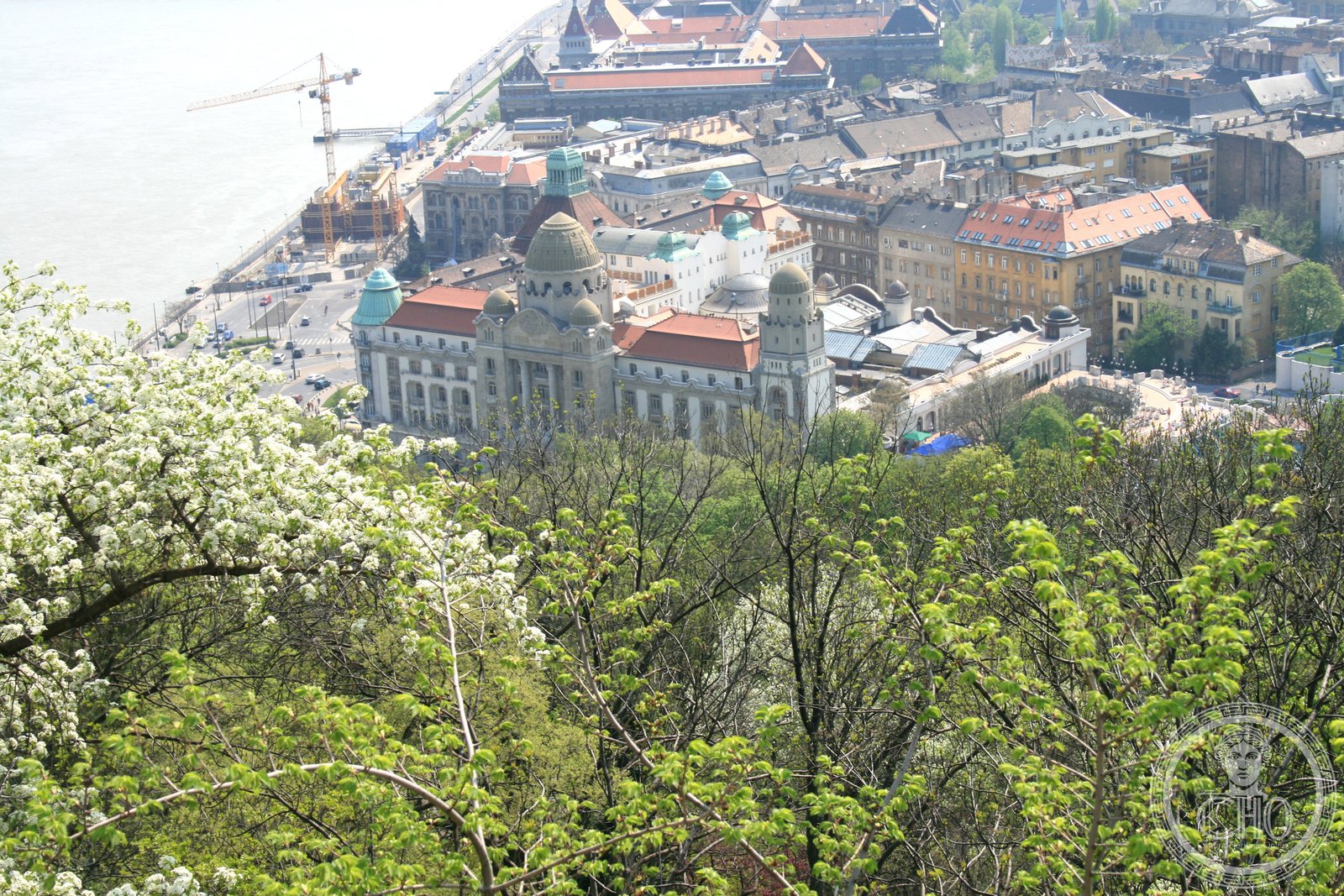
The Gellért is the grandest expression of the Hungarian Secessionist movement — a thermal spa hotel whose mosaic halls, stained-glass ceilings, and open-air wave pool were conceived as a single organic interior.
At a glance
Designed by Ármin Hegedűs, Artúr Sebestyén, and Izidor Stark and completed in 1918, the Hotel Gellért occupies the foot of the hill named after the 11th-century bishop Gerard (Gellért) who was martyred here. The thermal springs beneath the building had been exploited since the Turkish occupation of the 16th century; the Austro-Hungarian commission of 1912 sought to give them a fitting monument. Construction was interrupted by the First World War, delaying the opening by four years. The result is one of the most intact Art Nouveau hotel interiors in Europe: Zsolnay tiles, Tiffany-style glass ceilings, bronze fixtures, and a thermal pool modelled on Roman baths — all within a building that functions simultaneously as a luxury hotel and a public thermal institution.
Key facts
- Built: 1912–1918; architects Ármin Hegedűs, Artúr Sebestyén, Izidor Stark
- Style: Hungarian Secession (Art Nouveau), with Neo-Baroque and Romanesque elements
- Thermal baths: Fed by the Gellért Hill springs, active since the 16th century under Ottoman administration
- Address: Kelenhegyi út 4, 1118 Budapest, Hungary
- GPS: 47.4854, 19.0477
- Status: Operating hotel and public thermal spa; heritage-protected monument
History
The site below the Gellért Hill had hosted thermal baths since the medieval period, expanded significantly during the 150-year Ottoman occupation (1541–1686) when the Turks constructed a series of bath houses fed by the same springs. The Austro-Hungarian city government resolved in 1909 to build a purpose-designed luxury spa hotel that would rival the thermal establishments of Karlovy Vary and Baden-Baden. The architectural competition of 1912 was won by Hegedűs and his collaborators. Construction began immediately but was halted in 1914 with the outbreak of war; the building stood largely complete but unfinished for four years, its interiors fitted out and the hotel finally opened on 25 November 1918 — weeks after the dissolution of the Empire it had been built to celebrate.
Between the wars, the Gellért became Budapest’s leading diplomatic hotel and social centre. The outdoor wave pool, installed in 1927, was the first artificial wave pool in Europe and became an international attraction. The building survived the Second World War with significant structural damage and was restored under Communist administration as a state property, remaining one of the few grand hotels of the era to continue operating more or less continuously.
What you see
The street facade presents a Secession interpretation of Neo-Baroque, with the characteristic Hungarian use of folk-art motifs alongside the Viennese influence of Otto Wagner. Inside, the effect is altogether more exuberant: the central thermal pool hall is covered by a barrel-vaulted glass ceiling supported on iron arcades tiled in Zsolnay ceramic from Pécs — the same manufacturer responsible for the decorative surfaces of the Matthias Church and the Parliament building. The main staircase features bronze balusters and a mosaic ceiling of peacocks, the canonical Secessionist motif of renewal.
Practical information
Hotel and spa accessible separately; spa day tickets available without hotel stay. The thermal baths are divided into indoor halls (year-round) and an outdoor pool (summer). The hotel restaurant occupies the original first-floor dining room.
Find it on the map
See this place and what’s around it →📷 Become a Cultural Heritage Online photographer
Share your photos of places: they stay published under your name as the author. The more they're seen, the more you get noticed — and soon a contest will reward the most appreciated photos.
Log in or sign up free to add a photoIs this page about you?
This page is read by travellers and heritage enthusiasts who find it on Google. Tell us how you are connected to this place and we will take it from there.