
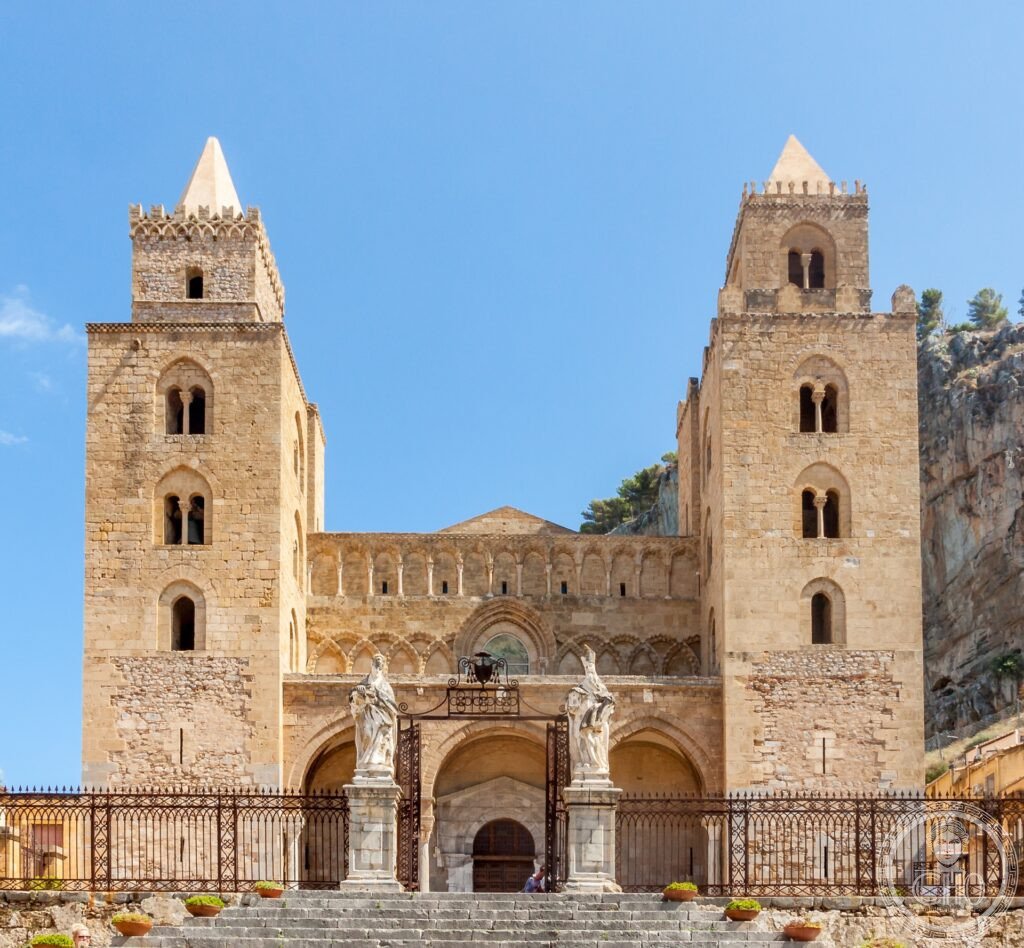
The Cathedral of Cefalù — founded by Roger II of Sicily in 1131 on the site of a Norman victory over a sea storm (according to the foundation legend) and built for the following century with two Romanesque towers over the fishing village beach — contains in its apse the earliest surviving mosaic image of the Christ Pantocrator in the original Norman programme: the gold-ground Byzantine portrait of 1148, painted 40 years before the Pantocrators of Monreale and the Cappella Palatina, is the original from which all other Norman Sicilian Pantocrators descend.
At a glance
The Cathedral of Cefalù (province of Palermo, Sicilia; UNESCO 2015, ref. 1487) is the third component of the serial inscription “Arab-Norman Palermo and the Cathedral Churches of Cefalù and Monreale.” It was founded by Roger II in 1131, four years before his death, as a mausoleum for himself and his successors (the porphyry sarcophagus he had prepared for himself, now in the Palermo Cathedral, was created for Cefalù but removed to Palermo after his death); the building required a century to complete (consecrated 1240), spanning the Norman kingdom, the Hohenstaufen interlude, and the early Angevin period. Its outstanding universal value within the Arab-Norman inscription is the 1148 apse mosaic — the earliest Norman-period mosaic in Sicily in its original state, and the theological prototype for all subsequent royal Norman commissions (Cappella Palatina 1143-1154, Monreale 1172-1189).
Key facts
- Il Cristo Pantocrator del 1148 (abside principale): The Christ Pantocrator mosaic in the central apse of Cefalù Cathedral (commissioned by Roger II in 1148, approximately 5 years after the Cappella Palatina was completed) is the earliest surviving mosaic from the Norman programme in Sicily in its original condition; the Cefalù Pantocrator is notably larger in scale relative to its field than the later Pantocrators of Monreale (1172) and the Cappella Palatina (c.1143); the figure holds a Gospel book open to John 8:12 (“I am the Light of the World”) in both Greek and Latin — the same text as the Monreale Pantocrator; the gold tessera technique is finer than the later Monreale execution
- La Rocca (278 m): The Rocca di Cefalù — the 278 m limestone promontory that towers over the cathedral and the beach — is the geographic feature that defines the Cefalù skyline; the Norman cathedral was deliberately positioned at the foot of the Rocca to create the compositional effect visible from the sea (the two tower facades framed by the rock mass); the Rocca summit preserves Greek-period ruins (a sanctuary of Diana, 4th century BCE), Saracen fortifications, and a Norman tower; the 45-min hike to the summit (marked path from the east side of the cathedral) provides the most complete view of the coast
- Il chiostro medievale (XII sec.): The medieval cloister adjacent to the cathedral (accessible from inside) preserves 26 pairs of columns from the original 12th-century construction; the carved capitals include Romanesque biblical scenes and Arab-Norman geometric interlace ornament; it is smaller and less famous than the Monreale cloister but preserves more of the original 12th-century stonework
- UNESCO: 2015, rif. 1487
- GPS: 38.0399, 14.0229 — Google Maps (Cattedrale di Cefalù)
History
The Cathedral of Cefalù was founded in 1131 by Roger II on the site of his landing after a near-fatal storm at sea — the foundation legend attributes the building to a vow made during the storm (the Norman king promised to build a cathedral to the Virgin if he survived). The location (on the base of the Rocca cliff, in what was then an Arab fishing village called Gephaloidion) was chosen both for its physical drama (the rock backdrop makes the Norman towers visible from 20 km at sea) and for its strategic position on the north coast of Sicily. Roger II died in 1154 without seeing the cathedral complete; the building was finished by subsequent Norman kings (William I, William II), the Hohenstaufen Frederick II (who took custody of Sicily in 1194), and the French Angevins (who completed the facade in the 1240 consecration). The cathedral passed to the Archdiocese of Cefalù in the medieval period and has functioned continuously as the seat of the local bishop to the present day.
What you see
The Cathedral of Cefalù is in the historic centre of Cefalù, on the Piazza del Duomo. The visit (45-90 min) includes: the facade (the two Norman Romanesque towers, 12th century; the medieval carved portal with the Last Judgment; note the Arab “stalactite” carved soffit on the entrance arch); the nave (3 aisles, ancient granite columns with reused Roman capitals; the wooden Norman ceiling of the central nave — painted with geometrical and figurative ornament in the Arab-Norman style, partially preserved above the triumphal arch); the apse (the Pantocrator mosaic of 1148; the Virgin enthroned between archangels; the Apostles; approach along the nave for the best impact of the gold ground); the 12th-century cloister (separate entrance south side). After the cathedral: the Piazza del Duomo (the medieval civic square, with the Lavatoio Medievale — a public washing fountain built over a natural spring still in use in the 13th century) and the beach (300 m from the cathedral — one of the most dramatically situated beaches in Sicily, with the Rocca cliff directly behind it).
Gallery
Practical information
- Cattedrale di Cefalù: Piazza del Duomo, Cefalù (PA); open daily 08:00-13:00 and 15:30-18:00 (winter), 08:00-19:00 (summer); admission ~€3 (includes the apse and the cloister). The Pantocrator mosaic is best lit in the morning (east-facing apse receives direct morning light through the apse windows); the combination of the gold tessera and the natural light at 09:00-11:00 produces a visual effect that afternoon visits cannot replicate. Photography permitted without flash.
- La Rocca: The hiking path to the Rocca summit starts at the Via dei Saraceni (east side of the town, follow signs “Rocca”); trail well-marked; 45 min ascent; open daily 09:00-18:00 (summer), 09:00-16:00 (winter); admission ~€2. Wear suitable footwear (loose limestone rock on the upper section). The view from the summit extends from Cape Orlando to Palermo on a clear day.
Getting there
Cattedrale di Cefalù, Piazza del Duomo, Cefalù (PA), Sicilia. GPS 38.0399, 14.0229. By train: Trenitalia from Palermo Centrale to Cefalù (45-50 min, frequent throughout the day; the Cefalù station is a 10-min walk from the cathedral); from Messina via the north coast line (2h30). By car: A19 (Palermo-Catania) → exit “Cefalù” → SS113 (70 km from Palermo, 50 min); parking in the town is limited and the historic centre is a ZTL — use the parking at the seafront (Lungomare G. Giardina, ~500 m from the cathedral) or the parking at the north entrance to the town (Via Lungomare, free).
Nearby
- Cappella Palatina, Palermo — 70 km west; (CHO card: Cappella Palatina UNESCO 2015); the royal chapel with the Fatimid muqarnas ceiling and Byzantine mosaics — the third component of the Arab-Norman inscription
- Monreale Cathedral — 75 km west; (CHO card: Monreale UNESCO 2015); the cathedral with 6,340 m² of gold mosaic and the 228-column Benedictine cloister
- Riserva Naturale dello Zingaro — 80 km west; the first natural reserve established in Sicily (1981), a 7 km coastal walk through macchia mediterranea between the mountains and the sea (no cars; access on foot from Scopello or San Vito Lo Capo)
Sources
- UNESCO: whc.unesco.org/en/list/1487
- Wikipedia EN: Cefalù Cathedral
- Demus, Otto: The Mosaics of Norman Sicily, London: Routledge, 1950
- Fondazione Federico II: federicosecondo.org
Find it on the map
See this place and what’s around it →📷 Become a Cultural Heritage Online photographer
Share your photos of places: they stay published under your name as the author. The more they're seen, the more you get noticed — and soon a contest will reward the most appreciated photos.
Log in or sign up free to add a photoIs this page about you?
This page is read by travellers and heritage enthusiasts who find it on Google. Tell us how you are connected to this place and we will take it from there.