
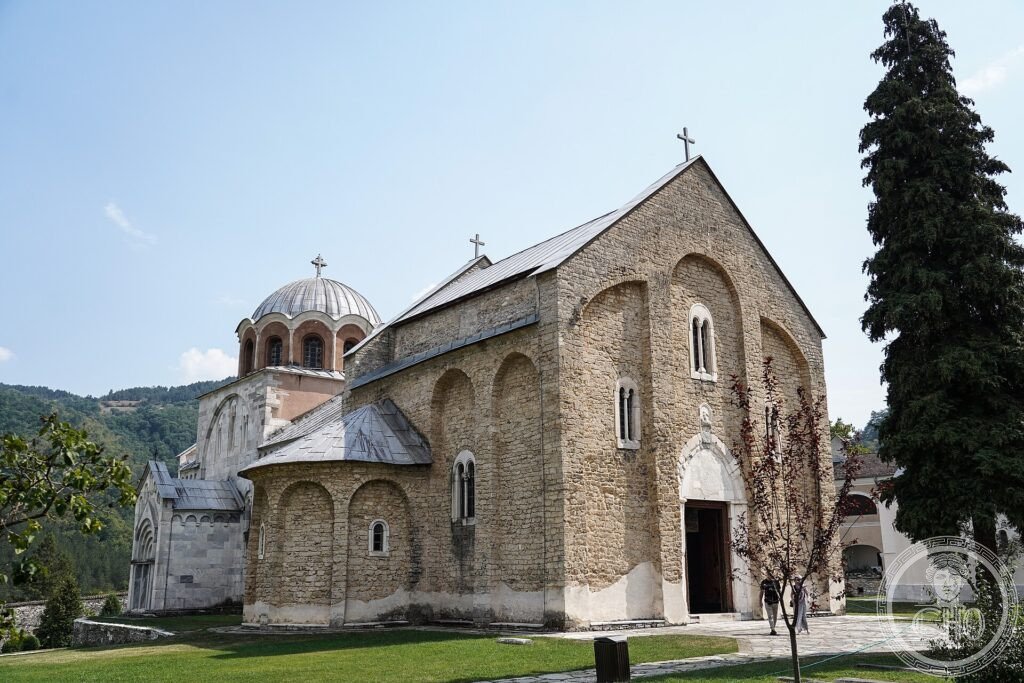
Founded around 1190 by the founder of the Nemanjić dynasty, Studenica is Serbia’s largest and most revered monastery: two white marble churches holding some of the finest Byzantine frescoes in the world. Serbia’s religious and artistic identity took shape here.
At a glance
Studenica, founded around 1190 by Stefan Nemanja, the founder of the medieval Serbian state and its Nemanjić dynasty, is the largest and most revered Serbian Orthodox monastery. Within its walls stand two churches of gleaming white marble, the Church of the Virgin and the Church of the King, holding some of the finest Byzantine frescoes of the 13th and 14th centuries. The monastery became the spiritual and artistic heart of medieval Serbia. It was inscribed by UNESCO in 1986.
Key facts
- UNESCO: World Heritage since 1986 (Studenica Monastery)
- Founded: around 1190 by Stefan Nemanja
- White marble: the churches are built of polished white marble
- Frescoes: outstanding Byzantine wall paintings of the 13th–14th centuries
- Raška school: a model for medieval Serbian architecture
- Royal mausoleum: the resting place of the founder, later St Simeon
History
Stefan Nemanja united the Serbian lands in the 12th century and, late in life, abdicated to become a monk, founding Studenica around 1190 as the family’s monastery and his own burial place. His son St Sava, the first Serbian archbishop, made it the centre of the new Serbian Church and its culture.
The marble Church of the Virgin set the model for the “Raška school” of Serbian architecture, blending Romanesque form with Byzantine decoration. Its frescoes, including a celebrated Crucifixion, and those of the later Church of the King are masterpieces of medieval painting. Through wars and Ottoman rule Studenica remained the symbolic heart of Serbian Orthodoxy.
What you see
Within the round walls stand the white marble churches, the larger Church of the Virgin with its single dome and carved portals, the smaller Church of the King beside it. Inside, the frescoes glow against gold and blue: the monumental Crucifixion at Studenica is among the most famous images of Byzantine art, and the cycles of the Church of the King are equally fine.
The setting among wooded hills above the Studenica river completes the sense of a place apart.
Practical information
- Monastery: active and freely open; modest dress required
- Time needed: 1–2 hours
- Note: reached by a scenic road into the hills
- Setting: in central Serbia, near the town of Kraljevo
Getting there
Studenica is in central Serbia, about 40 km south-west of Kraljevo and some 200 km south of Belgrade. It is reached by road. GPS: 43.4847° N, 20.5328° E.
Nearby
- Žiča Monastery — the medieval coronation church near Kraljevo
- Sopoćani — another UNESCO Serbian monastery with great frescoes
- Kopaonik — Serbia’s main mountain range to the south-east
Sources
- UNESCO World Heritage Centre — “Studenica Monastery” (ref. 389)
- Serbian Orthodox Church — Studenica Monastery
- Encyclopaedia Britannica — Serbian art and architecture
Find it on the map
See this place and what’s around it →📷 Become a Cultural Heritage Online photographer
Share your photos of places: they stay published under your name as the author. The more they're seen, the more you get noticed — and soon a contest will reward the most appreciated photos.
Log in or sign up free to add a photoIs this page about you?
This page is read by travellers and heritage enthusiasts who find it on Google. Tell us how you are connected to this place and we will take it from there.