
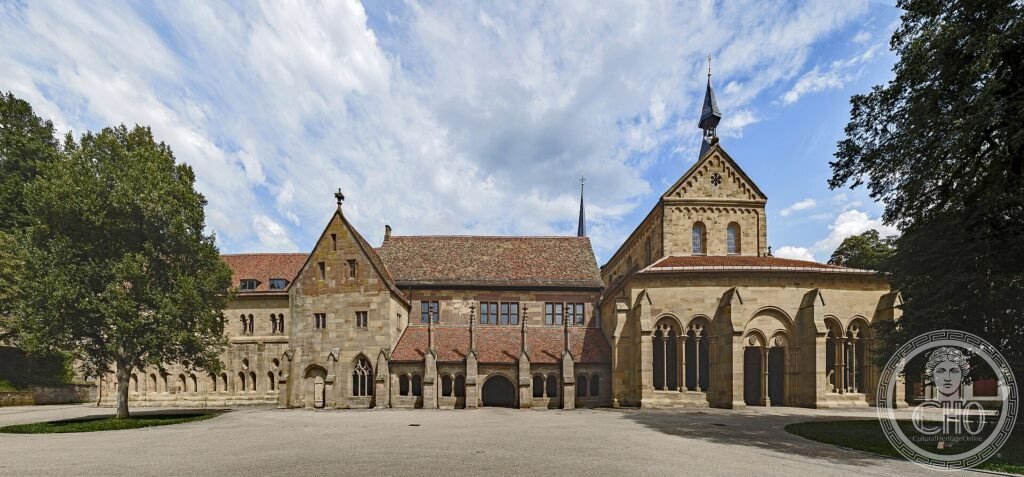
Founded in 1147, Maulbronn is the best-preserved medieval Cistercian monastery in Europe: not only the church but the whole complex — cloisters, refectories, mills, walls, land — has come down almost intact. Here you can see how the monks lived and worked, and here the “Paradise” marks the passage from Romanesque to Gothic.
At a glance
Maulbronn, founded in 1147, is the most complete and best-preserved medieval Cistercian monastery complex north of the Alps. Beyond the church, the whole working world of the monks survives: cloisters, chapter house, refectories, gatehouse, walls, mills and the fields and water-system of the estate. Its church porch, the “Paradies”, is a key witness to the transition from Romanesque to Gothic, a style the Cistercians spread across Europe. It was inscribed by UNESCO in 1993.
Key facts
- UNESCO: World Heritage since 1993 (Maulbronn Monastery Complex)
- Founded: 1147, by Cistercian monks
- Best-preserved: the most complete medieval Cistercian complex in Europe
- The Paradies: the church porch marking the Romanesque-to-Gothic transition
- Working estate: mills, walls, ponds and the monks’ water-management survive
- Later school: a Protestant seminary after the Reformation (pupils included Hölderlin and Hesse)
History
The Cistercians, a reforming monastic order devoted to simplicity and labour, founded Maulbronn in 1147 and built it over the following centuries with their characteristic austere clarity. They cleared land, dug a network of ponds and channels, and ran the estate as a self-sufficient world, leaving an unusually complete record of medieval monastic economy.
After the Reformation the monastery became a Protestant seminary, a role it kept for centuries; among its pupils were the poet Hölderlin and the writer Hermann Hesse, who drew on it in his fiction. The buildings survived intact, preserving a vivid picture of medieval monastic life.
What you see
The walled precinct is entered through a gatehouse into a forecourt of half-timbered and stone buildings. The Romanesque-Gothic church is fronted by the graceful Paradies porch; beyond lie the cloister, the vaulted monks’ refectory, the chapter house and the fountain house. The lay-brothers’ buildings, cellars and mills complete the picture.
Outside the walls, ponds and water-channels recall the Cistercians’ mastery of the landscape.
Practical information
- Monastery: a museum; church and cloister freely accessible, other rooms by ticket
- Time needed: 1.5–2 hours
- Note: the village grew within and around the monastery walls
- Setting: in wooded country between Stuttgart and Karlsruhe
Getting there
Maulbronn is in Baden-Württemberg, between Stuttgart and Karlsruhe in south-western Germany. It is reached by road or by train and bus via Mühlacker. GPS: 48.9956° N, 8.8147° E.
Nearby
- Bruchsal — a Baroque palace to the west
- Stuttgart — the regional capital, about 40 km east
- Kraichgau — gentle wine and orchard country around the monastery
Sources
- UNESCO World Heritage Centre — “Maulbronn Monastery Complex” (ref. 546)
- Staatliche Schlösser und Gärten Baden-Württemberg — official body
- Encyclopaedia Britannica — Cistercians; Maulbronn
Find it on the map
See this place and what’s around it →📷 Become a Cultural Heritage Online photographer
Share your photos of places: they stay published under your name as the author. The more they're seen, the more you get noticed — and soon a contest will reward the most appreciated photos.
Log in or sign up free to add a photoIs this page about you?
This page is read by travellers and heritage enthusiasts who find it on Google. Tell us how you are connected to this place and we will take it from there.