
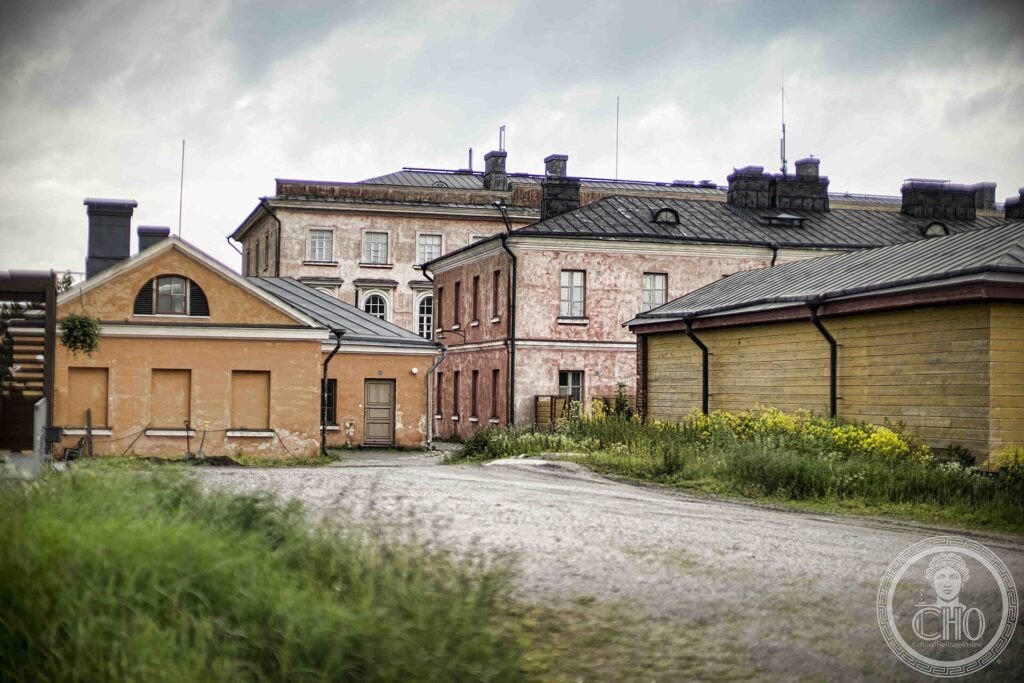
Built by the Swedes in the mid-eighteenth century on a cluster of islands facing Helsinki, Suomenlinna was meant to bar the Baltic to Russia. It changed flag several times — Swedish, Russian, Finnish — and remains one of Europe’s largest examples of maritime military architecture, today an inhabited district of Helsinki.
At a glance
Suomenlinna (“the fortress of Finland”) is one of the great sea fortresses of the world, built from 1748 by Sweden on a chain of islands guarding the approach to Helsinki. Designed against the rising power of Russia, it changed hands as the region’s history turned: Swedish, then Russian after 1808, then Finnish from 1918. Its bastions, walls, dry dock and barracks, adapted over two centuries, make it an exceptional monument of military architecture. It was inscribed by UNESCO in 1991.
Key facts
- UNESCO: World Heritage since 1991 (Fortress of Suomenlinna)
- Begun: 1748 by Sweden, originally named Sveaborg
- Designer: Augustin Ehrensvärd led the construction
- Three flags: Swedish, then Russian (from 1808), then Finnish (from 1918)
- Across islands: bastions, walls and a dry dock spanning several islands
- Living district: still an inhabited part of Helsinki, reached by ferry
History
In the 18th century Sweden, alarmed by Russian expansion, began in 1748 a massive fortress on the islands off Helsinki, then a Swedish town. Augustin Ehrensvärd directed the work, raising bastions, a naval dockyard and quarters for thousands of soldiers, a project so costly it shaped the whole region. The fortress was named Sveaborg, “the fortress of the Swedes”.
In 1808 it surrendered to Russia, which held it for over a century and added its own buildings; the Crimean War brought a British-French bombardment. When Finland gained independence in 1917–18 the fortress became Finnish and was renamed Suomenlinna. Demilitarised in the 20th century, it became a residential district and museum island.
What you see
Ferries cross from Helsinki to the islands, where paths lead among grass-topped bastions, tunnels and gun emplacements looking out to sea. The King’s Gate, the great dry dock (still in use), barracks in brick and timber, and Ehrensvärd’s tomb tell the fortress’s story across two centuries.
Museums, cafés and the homes of residents share the islands, which double as a popular Helsinki retreat.
Practical information
- Access: by public ferry from Helsinki market square, year-round
- Grounds: freely walkable; museums charge entry
- Time needed: half a day
- Note: a working residential district — respect the homes
Getting there
Suomenlinna lies on islands a short ferry ride from central Helsinki, the capital of Finland. Public ferries run from the Market Square (Kauppatori). GPS: 60.1454° N, 24.9881° E.
Nearby
- Helsinki — the capital, with its neoclassical centre and harbour
- Helsinki archipelago — the islands and waters of the Gulf of Finland
- Market Square — the waterfront square where the ferries depart
Sources
- UNESCO World Heritage Centre — “Fortress of Suomenlinna” (ref. 583)
- Governing Body of Suomenlinna — official authority
- Encyclopaedia Britannica — Suomenlinna; Helsinki
Find it on the map
See this place and what’s around it →Events here — now on & upcoming
- Wild Blue and Eternity in the Garden — two exhibitions at HAA Gallery, Suomenlinna, Helsinki, until 18 October 202625 Sep 2026 — 18 Oct 2026See the event →
📷 Become a Cultural Heritage Online photographer
Share your photos of places: they stay published under your name as the author. The more they're seen, the more you get noticed — and soon a contest will reward the most appreciated photos.
Log in or sign up free to add a photoIs this page about you?
This page is read by travellers and heritage enthusiasts who find it on Google. Tell us how you are connected to this place and we will take it from there.