
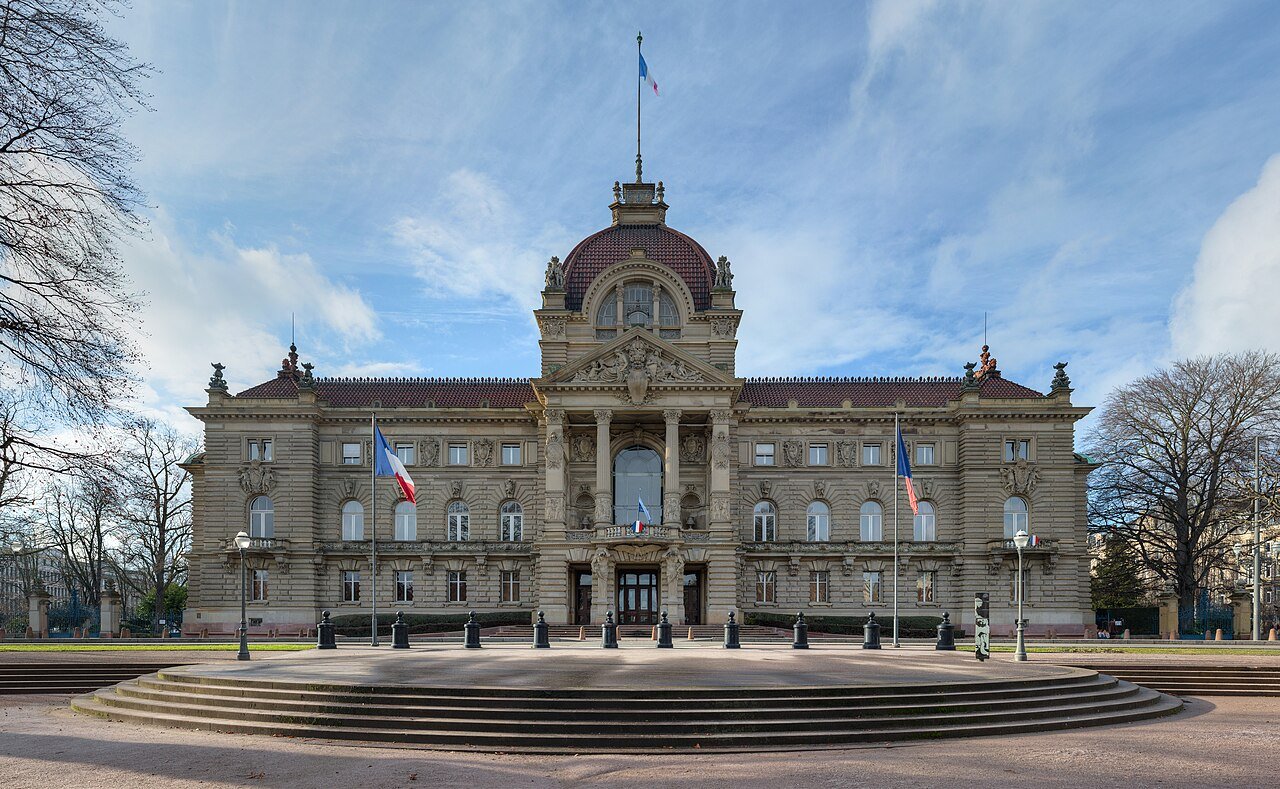
After 1871 the German Empire laid a vast new city beside medieval Strasbourg. Its boulevards carry monumental imperial palaces and, soon after, a generation of Jugendstil facades.
At a glance
The Neustadt — the “German New Town” — is the quarter Strasbourg gained during the Reichsland period, the years from 1871 to 1918 when Alsace-Lorraine was annexed to the German Empire after the Franco-Prussian War. Planned as a new administrative and cultural centre to rival the old Grande-Île, it spreads north and east of the historic core in broad axial avenues lined with ministries, university buildings, churches and apartment blocks. The earlier monuments speak in Wilhelminian revival styles — neo-Renaissance, neo-Romanesque, neo-Gothic — while the turn of the century brought Jugendstil, the German strand of Art Nouveau, to the streets and apartment facades. In 2017 UNESCO extended the existing World Heritage listing of the Grande-Île to include the Neustadt, recognising the two as a single, continuous urban achievement.
Key facts
- Country: France
- Key period: 1871–1918 (German imperial Neustadt)
- UNESCO: “Strasbourg, Grande-Île and Neustadt” — Neustadt inscribed 2017 as an extension of the existing site
- Essential sites: Place de la République, Palais du Rhin, National and University Library, Théâtre national, the Maison Égyptienne and Jugendstil facades across the quarter
- Styles: Wilhelminian historicist revivals, then Jugendstil / Art Nouveau
History
Strasbourg passed to the German Empire in 1871 under the Treaty of Frankfurt, becoming the capital of the new Reichsland of Alsace-Lorraine. The medieval city on its island in the Ill could not hold the administration, garrison and population the empire intended, so engineers and architects drew up an entirely new quarter to the north and east. The plan was deliberately monumental: long straight avenues, formal squares, and a hierarchy of public buildings meant to assert German cultural authority on the Rhine frontier.
The set-piece is the Place de la République, laid out as the Kaiserplatz. Around it rose the Palais du Rhin, the imperial palace begun in 1884 to designs by Hermann Eggert (1844–1920) and finished in 1889, a square neo-Renaissance pile loosely echoing the Palazzo Pitti in Florence. Facing it stand the National and University Library, the former Alsace-Lorraine parliament that is now the Théâtre national, and further administrative palaces, all classified today as monuments historiques. The university quarter, with its grand Palais Universitaire, observatory and museums, extended the same ambition into learning.
As the century turned, taste shifted from historicist revival to Jugendstil. Architects working in the Neustadt and across the city gave apartment blocks sinuous ironwork, floral stucco, bow windows and ceramic decoration — the German cousin of the Art Nouveau then flowering in nearby Nancy and in Brussels and Paris. When France recovered Alsace in 1918 the quarter survived intact, and in 2017 UNESCO acknowledged it as an exceptional, well-preserved expression of late nineteenth- and early twentieth-century European urbanism.
What you see
Walk out from the Grande-Île and the city changes register. The streets widen, the building lines straighten, and the scale grows imperial. The Place de la République is the place to begin: the domed Palais du Rhin anchors one side, the columned library and the former parliament close the others, and a planted central garden softens the granite. From here the avenue de la Liberté and the avenue des Vosges run as monumental spines through the quarter.
Away from the squares the pleasure is the apartment facades. Look up along streets such as the rue du Général de Castelnau and around the university quarter for Jugendstil detail — curved balconies, floral and figural stucco, leaded glass and decorative brick and ceramic. The Maison Égyptienne is the quarter’s most photographed eccentricity, an early twentieth-century facade carrying Egyptian-revival motifs that sit playfully among its Art Nouveau neighbours. Much is best read on foot, slowly, with eyes raised above shop level.
Practical information
- The Neustadt is a living quarter, not a fenced site — facades are viewed freely from the street at any hour.
- The Palais du Rhin houses regional cultural offices (DRAC Grand Est); interiors are not generally open, but the exterior and Place de la République are the draw.
- The National and University Library reading rooms and the university museums keep their own opening hours; check before visiting.
- Allow a half-day on foot to link the Place de la République, the university quarter and the surrounding Jugendstil streets.
- Combine with the Grande-Île and cathedral, a short walk south, for the full UNESCO ensemble.
Getting there
Strasbourg is exceptionally easy to reach. TGV trains link Paris to Strasbourg in under two hours, arriving at the historic Gare de Strasbourg on the Neustadt’s western edge. Strasbourg Airport (SXB) lies southwest of the city, connected to the centre by a short shuttle-train link. Within the city the tram network reaches the quarter directly — the République stop sits on the Place de la République itself — and the whole Neustadt is comfortably walkable from the station and the Grande-Île.
Related in CHO
- Nancy — The École de Nancy and French Art Nouveau
- Paris — Belle Époque, Art Nouveau & Modernism
- Brussels — Victor Horta and Art Nouveau Architecture
Sources

Find it on the map
See this place and what’s around it →Record researched and written by Luigi De Marchi for Cultural Heritage Online, 2026.
📷 Become a Cultural Heritage Online photographer
Share your photos of places: they stay published under your name as the author. The more they're seen, the more you get noticed — and soon a contest will reward the most appreciated photos.
Log in or sign up free to add a photo