
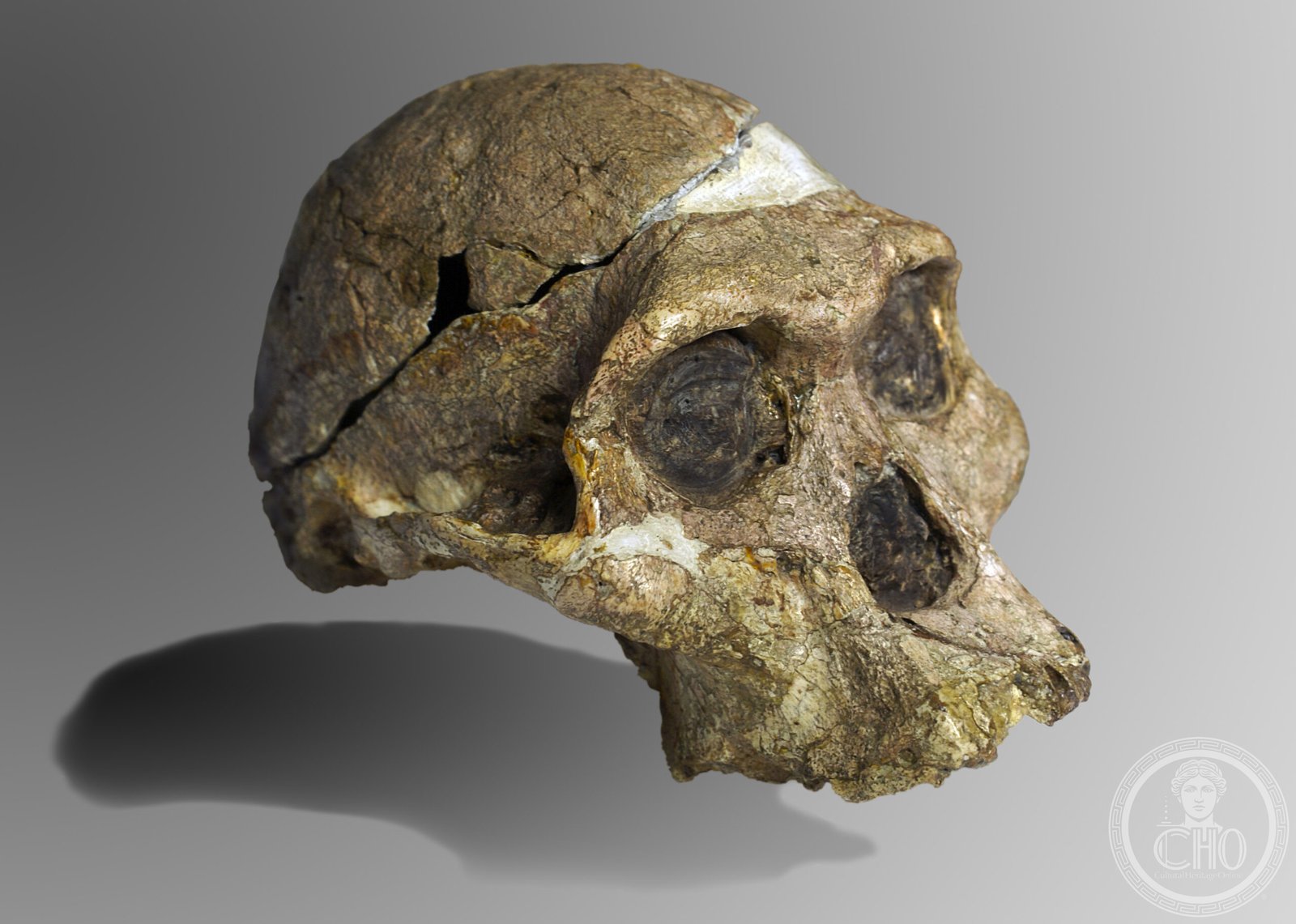

Sterkfontein is the most prolific Australopithecus site in the world — a complex of limestone caves 50 kilometres northwest of Johannesburg that has yielded more than 500 hominid fossils since 1936, more than any other site in Africa. Here, in the limestone labyrinth of the Cradle of Humankind, palaeontologists have retrieved one of the most complete records of early human evolution ever assembled.
The Cave System
The Sterkfontein Caves are a complex of dolomitic limestone caverns formed by the dissolution of ancient rock by slightly acidic groundwater over millions of years. The cave system reaches six levels, with the deeper chambers containing the most significant fossil deposits. The geological setting was critical: the caves acted as natural traps — animals, and hominids, fell or were dragged into the openings by predators, their bones preserved in the cave sediments below. Stalagmites and stalactites of considerable beauty still form in the deeper chambers, making the site visually striking as well as scientifically priceless. Guided tours take visitors through the electrically lit cave systems daily.
Mrs Ples: The Most Famous Skull
The most celebrated find from Sterkfontein is “Mrs Ples” (catalogue number Sts 5) — a nearly complete Australopithecus africanus skull discovered in 1947 by the South African palaeontologist Robert Broom and his assistant John T. Robinson. Dated to approximately 2.5 million years ago, it was the first mature adult Australopithecus ever recovered, providing for the first time a clear picture of what an adult Australopithecus face actually looked like. The nickname “Mrs Ples” derived from the species name Plesianthropus transvaalensis — a name Broom initially gave the specimen before it was reclassified as A. africanus. Decades of debate about whether “Mrs Ples” was male or female were partially resolved by a 2003 study suggesting the individual was actually male, but the name has stuck.
Little Foot: The Oldest Skeleton
“Little Foot” (catalogue number StW 573) is the most extraordinary specimen from Sterkfontein and arguably from anywhere in the world. The skeleton was first discovered in 1994 by Ronald Clarke, who identified four small foot bones in a box of fossils from the cave. Realising they formed a coherent individual, Clarke and his team searched the cave and found the rest of the skeleton still embedded in ancient breccia — and it took more than two decades to excavate it fully. Little Foot is a remarkably complete skeleton (approximately 90% complete), significantly more complete than the famous “Lucy” (Australopithecus afarensis). Most critically, dating studies — the most recent in 2022 using cosmogenic nuclide methods — place Little Foot at approximately 3.4 million years ago, making it one of the oldest known hominid skeletons in existence and older than Lucy by roughly 200,000 years.
More Than 500 Fossils: The Scale of Discovery
Sterkfontein has produced more than 500 hominid fossils since systematic excavation began in 1936 with the work of Robert Broom. These include specimens from multiple hominid species — primarily Australopithecus africanus but also Homo habilis (making Sterkfontein one of the few sites where both genus and species are represented) and later Homo erectus. Stone tools have also been recovered, demonstrating that the caves or their environs were used by hominids across a vast span of time. The sheer volume of material from a single site makes Sterkfontein unique in the global palaeontological record.
UNESCO Cradle of Humankind
Sterkfontein is the centrepiece of the Fossil Hominid Sites of South Africa — a UNESCO World Heritage Site inscribed in 1999 under the name “Cradle of Humankind.” The World Heritage property covers approximately 47,000 hectares in Gauteng Province and includes not only Sterkfontein but also Swartkrans, Kromdraai, Coopers Cave, and other cave systems in the dolomitic hills of the Blaaubank River valley. Together, this cluster of sites constitutes the richest hominid fossil region on Earth. The name “Cradle of Humankind” reflects the understanding that Africa — and specifically this corner of South Africa — is where much of human evolutionary history played out.
The Maropeng Visitor Centre
The Maropeng Visitor Centre — “Maropeng” meaning “returning to the place of origin” in Setswana — is the official visitor centre for the Cradle of Humankind World Heritage Site, located 6 kilometres from the Sterkfontein Caves. Its building, a striking tumulus-shaped structure designed to evoke a prehistoric mound, houses a full permanent exhibition on human evolution, including original fossil casts, interactive displays on DNA and the dispersal of modern humans, and a remarkable boat ride through a simulated primordial world. Together, the caves and the visitor centre form a comprehensive experience of palaeontological science.
Visiting Sterkfontein
The Sterkfontein Caves are open to the public via guided tours, departing regularly from the site entrance 50 kilometres northwest of central Johannesburg. Tours descend into the illuminated cave chambers and pass through the excavation sites, with guides explaining the stratigraphic layers and the significance of each major find. A small on-site museum displays replica fossils and excavation tools. The caves maintain a constant temperature of approximately 18°C year-round — cool and humid — so a light layer is advisable. Little Foot is not currently on public display (it remains in laboratory study at Wits University), but casts of Mrs Ples and other key specimens are visible.
Scientific Legacy and Ongoing Research
Excavation at Sterkfontein continues to the present day under the supervision of the University of the Witwatersrand. The site is not a closed chapter of history but an active research frontier. New specimens are still being recovered from the breccia matrix, and advances in dating technology continue to revise our understanding of the chronology. Sterkfontein’s contribution to human knowledge is simple to state and vast in implication: it is where the deep prehistory of our species became legible, where fossil after fossil gave us faces and dates and evolutionary context that transformed speculation into science.
Find it on the map
See this place and what’s around it →📷 Become a Cultural Heritage Online photographer
Share your photos of places: they stay published under your name as the author. The more they're seen, the more you get noticed — and soon a contest will reward the most appreciated photos.
Log in or sign up free to add a photo