
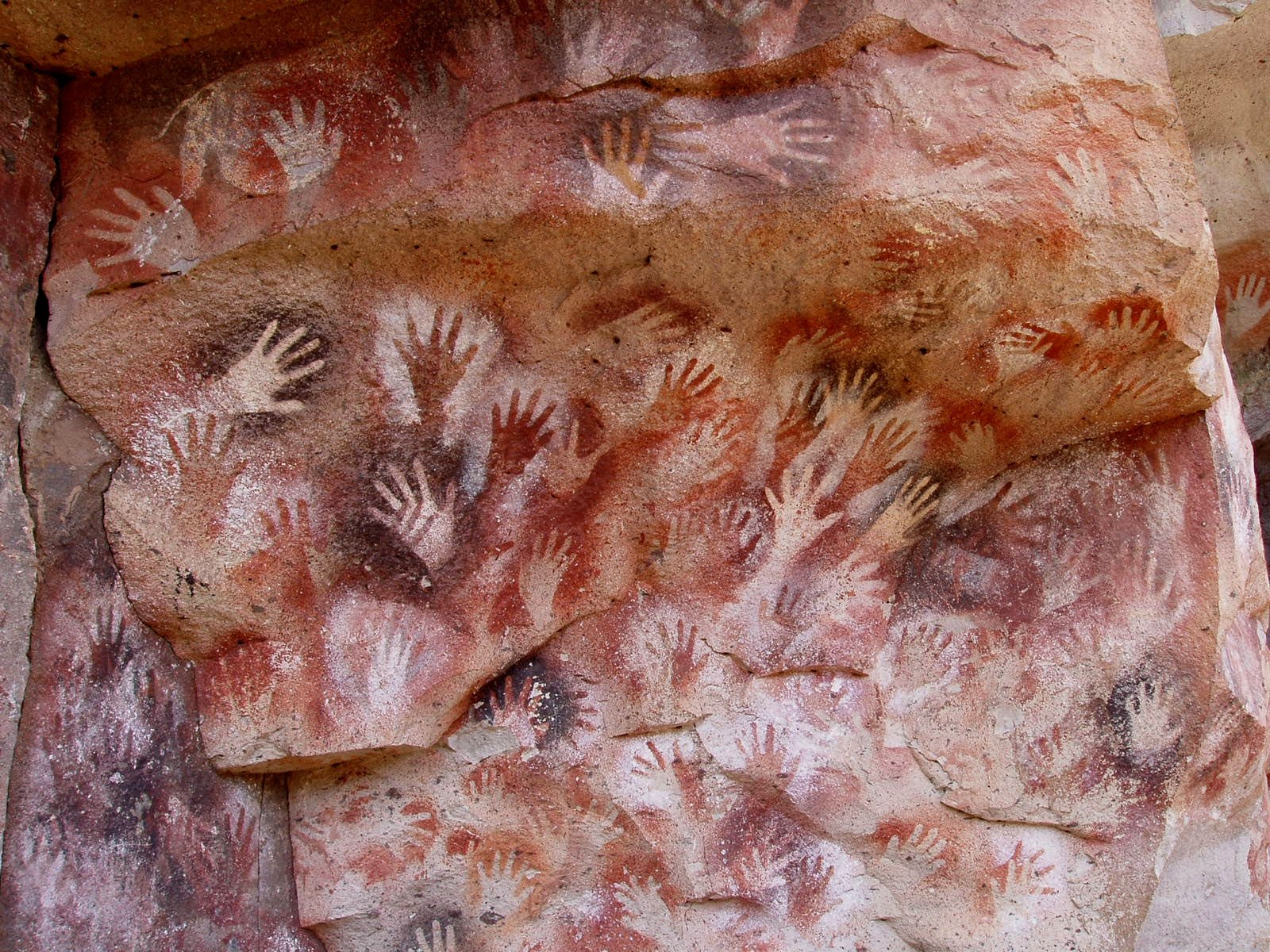
Deep in the canyon of the Rio Pinturas in Patagonia, Argentina, a single rock wall holds approximately 2,000 hand stencils spanning nearly 9,000 years of continuous artistic tradition, from around 9000 BC to 700 BC. Cueva de las Manos (Cave of Hands) is a UNESCO World Heritage Site where the distance between the oldest and the newest mark on the wall is greater than the entire span of recorded history.
The Wall of Hands
The dominant image at Cueva de las Manos is the negative hand stencil: an artist pressed their hand to the rock wall, then blew ochre paste through a hollow bone — creating a silhouette of the hand in color against the stone. The result, multiplied across approximately 2,000 individual prints overlapping in dense palimpsest layers, is one of the most arresting sights in prehistoric art worldwide.
The hands are predominantly left hands. The practical explanation is elegant: the artist held the blowing tube in their dominant right hand while pressing the left to the wall. Over centuries and millennia, layer accumulated upon layer — the oldest stencils buried beneath the most recent, creating a visual archaeology where color and position indicate age.
The pigments — red and orange ochre, black from manganese oxide, white from kaolin or lime, purple — have survived in the sheltered overhang of the canyon with extraordinary fidelity across thousands of years.
Nine Thousand Years of Continuous Tradition
What sets Cueva de las Manos apart from other prehistoric painted caves is not individual image quality — it is duration. The earliest datable stencils have been placed at approximately 9000 BC; the most recent at around 700 BC. Between those two dates lies 8,300 years — more than twice the distance from ancient Egypt’s first dynasty to today.
For nearly a hundred centuries, successive human groups returned to the same cliff face and made the same gesture: pressing a hand to stone, blowing pigment, leaving a mark. The earliest makers are associated with the ancestors of the Tehuelche people — the indigenous hunter-gatherers who populated Patagonia for thousands of years before European contact.
The Hunting Panels
Interspersed among the hand stencils are dynamic hunting scenes: groups of guanacos (the wild camelid native to Patagonia) being surrounded and pursued by human hunters armed with boleadoras — the weighted rope weapon that could tangle an animal’s legs at a distance. These scenes are rendered with a narrative energy absent from the hand stencils: figures in motion, animals running, the spatial logic of an encirclement hunt.
Geometric patterns also appear throughout the cave: grids, zigzags, nested rectangles, and abstract forms that may represent territorial markers, cosmological symbols, or elements of an iconographic system whose key is lost.
The Canyon Setting
Cueva de las Manos sits within the Canon del Rio Pinturas — a dramatic canyon carved by the Pinturas River into the Patagonian plateau. The canyon walls rise 270 metres on both sides; the river runs at the base. The painted shelter is a large overhang facing roughly north to catch maximum daylight.
The surrounding landscape is quintessential Patagonia: flat-topped mesa tablelands, sparse Andean steppe vegetation, and the vast treeless horizon that makes distance and solitude palpable. The area falls within Santa Cruz Province — the southernmost and least-populated province of continental Argentina.
Discovery and UNESCO Recognition
The cave was first documented scientifically by Argentine archaeologist Francisco Moreno in 1876. Systematic archaeological study began in the 1960s and 1970s under Carlos Gradin, who established the stratigraphic sequence and the radiocarbon chronology placing the oldest stencils at approximately 9000 BC.
UNESCO inscribed Cueva de las Manos on the World Heritage List in 1999, citing the exceptional quality and concentration of the prehistoric art. The inscription includes not only the cave itself but the broader Pinturas River canyon, recognizing that the archaeological value is inseparable from the landscape that created and preserved it.
Visitor Information
Cueva de las Manos is reached from the town of Perito Moreno in Santa Cruz Province, approximately 163 km to the north via Provincial Route 97 (partially unpaved). The journey takes roughly 2.5 to 3 hours by vehicle. The standard visit includes a guided walk along a boardwalk path below the main painted panels. Self-guided visits are not permitted inside the painted shelter. Best visiting season: October through March (Southern Hemisphere spring and summer).
Related Places
Cueva de las Manos shares Patagonia with the Perito Moreno Glacier in Los Glaciares National Park — approximately 600 km to the southwest and another UNESCO World Heritage Site. In South America’s broader prehistoric art landscape, the closest comparable site is Serra da Capivara National Park in northeastern Brazil, with extensive rock paintings dating to approximately 25,000 BC.
Find it on the map
See this place and what’s around it →📷 Become a Cultural Heritage Online photographer
Share your photos of places: they stay published under your name as the author. The more they're seen, the more you get noticed — and soon a contest will reward the most appreciated photos.
Log in or sign up free to add a photo