
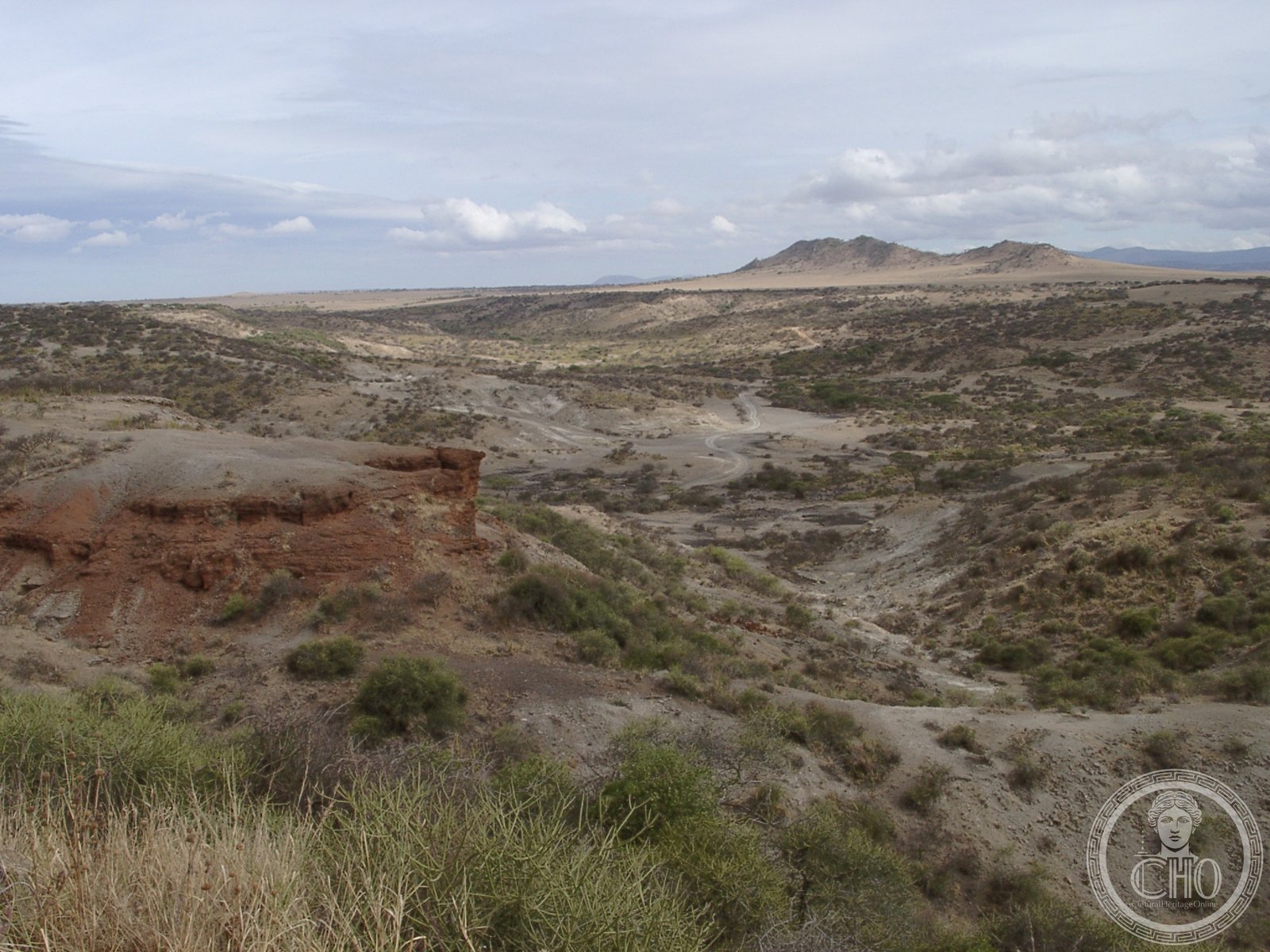
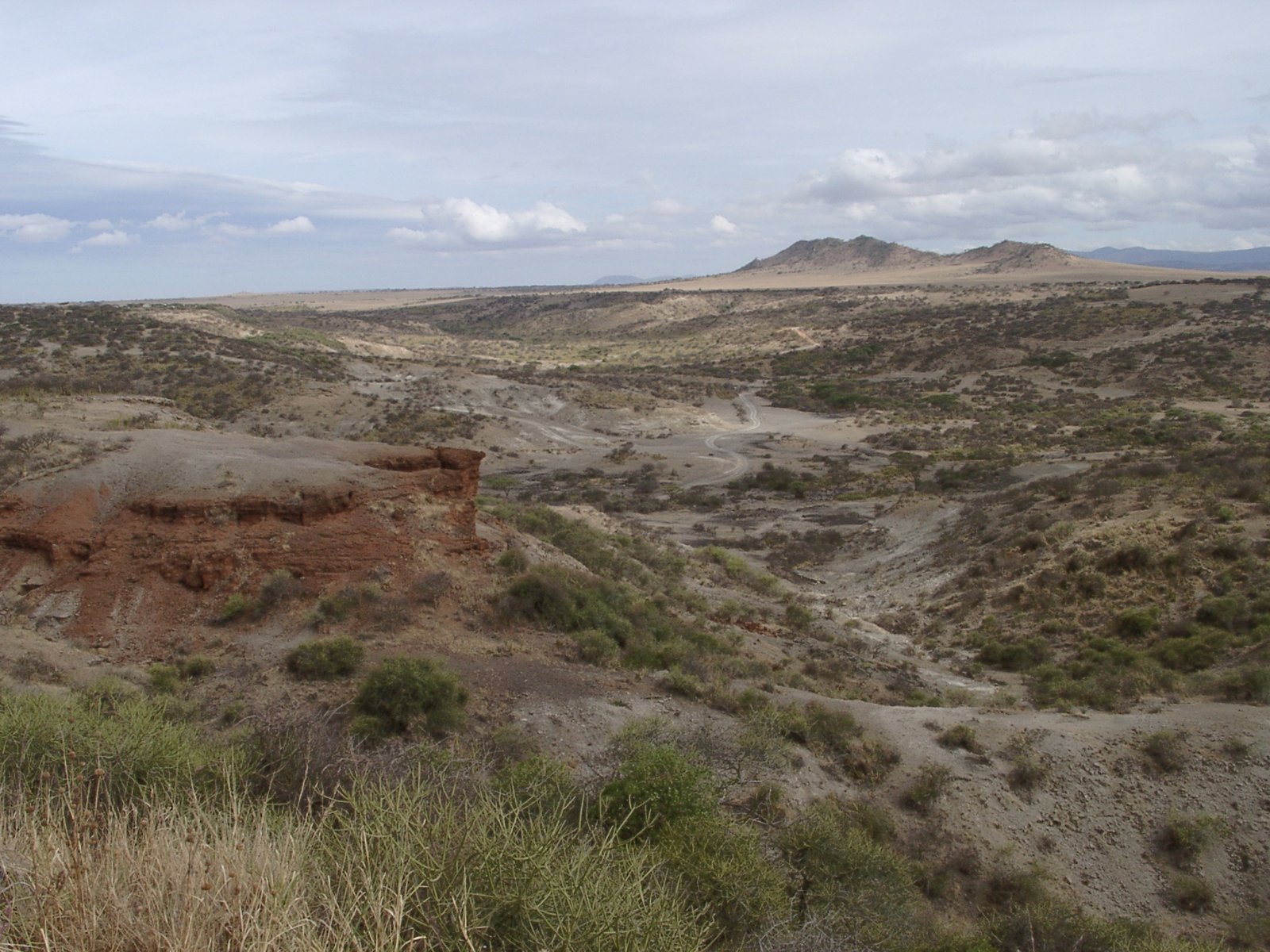
A steep-sided ravine cutting through the eastern Serengeti, Olduvai Gorge is the single most important site in the study of human origins. In its walls — laid bare by volcanic upheaval and millennia of erosion — nearly two million years of human evolution lie exposed in geological strata that read like the pages of a book. No other location on Earth has yielded such a complete, sequential record of our ancestral lineage.
The Gorge Itself
Olduvai — correctly spelled Oldupai since 2005, after the Maasai word for the wild sisal plant that grows abundantly here — is approximately 48 kilometres long and 90 metres deep. It was formed by a combination of volcanic activity and the tectonic forces of the Great Rift Valley, which split the African continent and created a natural cross-section through layers of ancient sediment. Each stratum, colour-coded by its mineral composition, corresponds to a specific geological epoch. The gorge sits within the Ngorongoro Conservation Area in northern Tanzania, part of the broader East African Rift System. Its geological sequence is divided into five main beds (Beds I through V, plus the Masek and Ndutu Beds), each corresponding to distinct climatic and environmental phases.
The Leakeys and the Discovery of Human Origins
The gorge was first brought to scientific attention by the German entomologist Wilhelm Kattwinkel in 1911. But it was Louis and Mary Leakey who transformed Olduvai into the world’s foremost laboratory of human prehistory, beginning excavations in 1931. In 1959, Mary Leakey found the first skull of Paranthropus boisei — nicknamed “Nutcracker Man” for its massive molars — dated to 1.75 million years ago, the oldest hominid skull found at that time. The following year, their son Jonathan discovered the first skull of Homo habilis (“handy man”), also dated to 1.75 million years: the first member of the genus Homo ever identified, with a cranial capacity significantly larger than the australopithecines and consistently associated with Oldowan stone tools — the oldest recognizable technology produced by the human lineage.
The Fossil Sequence: An Unparalleled Record
What makes Olduvai unique is not any single discovery but the stratigraphic sequence as a whole. The gorge contains evidence of multiple hominid species coexisting and succeeding one another across time: Australopithecus, Paranthropus boisei, Homo habilis, Homo erectus, and anatomically modern humans are all represented in successive geological layers. Nowhere else on Earth does such a complete, legible record exist within a single site. The Oldowan tool industry — flakes knapped from river cobbles to create cutting edges — appears at the gorge’s lowest levels, approximately 1.9 million years ago, representing the first recognizable human technology. Above it lie Acheulean handaxes, then Later Stone Age assemblages, then evidence of the first modern humans — a compressed library of innovation across two million years.
Volcanic Preservation: Why the Fossils Survive
Olduvai’s extraordinary fossil record owes its survival to volcanic events. Eruptions from the nearby Ngorongoro Crater complex periodically buried the landscape in ash, sealing and preserving the bones and tools of whoever had been living in the area. Bed I, the deepest and oldest layer, preserves evidence of a shallow alkaline lake that attracted animals and hominids alike to its shores — a productive environment that concentrated life, and death, in one place. As the lake dried and the land changed, successive populations left their traces in successive layers, each sealed by the next eruption. The result is a geological archive of human life that has no parallel anywhere on the planet.
UNESCO World Heritage Status
Olduvai Gorge is part of the Ngorongoro Conservation Area, inscribed as a UNESCO World Heritage Site in 1979 and extended in 2010. The conservation area covers 8,292 square kilometres and encompasses the Ngorongoro Crater — the world’s largest intact volcanic caldera — alongside vast tracts of open savanna, making it one of the most ecologically and archaeologically significant landscapes in Africa. The dual mandate of wildlife conservation and archaeological protection presents ongoing management challenges: the Maasai people who inhabit the area have lived alongside these ancient sites for centuries, and their traditional pastoralism continues within view of the gorge walls.
The On-Site Museum
A small but carefully curated museum at the gorge rim displays high-quality replicas of the most important fossil finds, including casts of the Paranthropus boisei skull (“Nutcracker Man”) and the Homo habilis specimen. Original fossils are held at the National Museum of Tanzania in Dar es Salaam and at the Oldupai Museum, which opened in 2019 near the gorge as a purpose-built facility. Signage along the gorge rim explains the geological sequence in accessible terms. Guided descents into the gorge — led by Tanzanian archaeologists and trained naturalists — offer closer views of the fossil-bearing strata, though collecting or touching fossils is strictly prohibited.
Visiting Olduvai Gorge
The gorge is located approximately 45 kilometres west of the Ngorongoro Crater rim, off the road connecting Ngorongoro to the Serengeti. Most visitors combine it with a Ngorongoro safari circuit. Entrance fees support both the museum and ongoing conservation efforts. The site is open daily; guided walks descend into the gorge at scheduled times. Photography from the rim is freely permitted. The surrounding landscape — flat-topped acacia, red volcanic soil, sweeping views toward the Serengeti plains — connects viscerally to the ancient world preserved underfoot.
Scientific and Cultural Legacy
Olduvai Gorge occupies a position in human self-understanding that few physical places can claim. The gorge did not merely yield important fossils; it fundamentally reshaped what human beings understood about their own origins — shifting the hypothetical cradle of humanity from Asia to Africa, and pushing the timeline of human evolution back by millions of years. Mary Leakey continued working in the region until 1983; her final major discovery, the Laetoli footprints preserved 45 kilometres south of Olduvai, confirmed that bipedalism preceded the expansion of the brain — another paradigm-shifting finding from the Tanzanian strata. The phrase “Out of Africa,” now central to every account of human prehistory, owes its empirical foundation in large part to what was found here.
Find it on the map
See this place and what’s around it →📷 Become a Cultural Heritage Online photographer
Share your photos of places: they stay published under your name as the author. The more they're seen, the more you get noticed — and soon a contest will reward the most appreciated photos.
Log in or sign up free to add a photo