
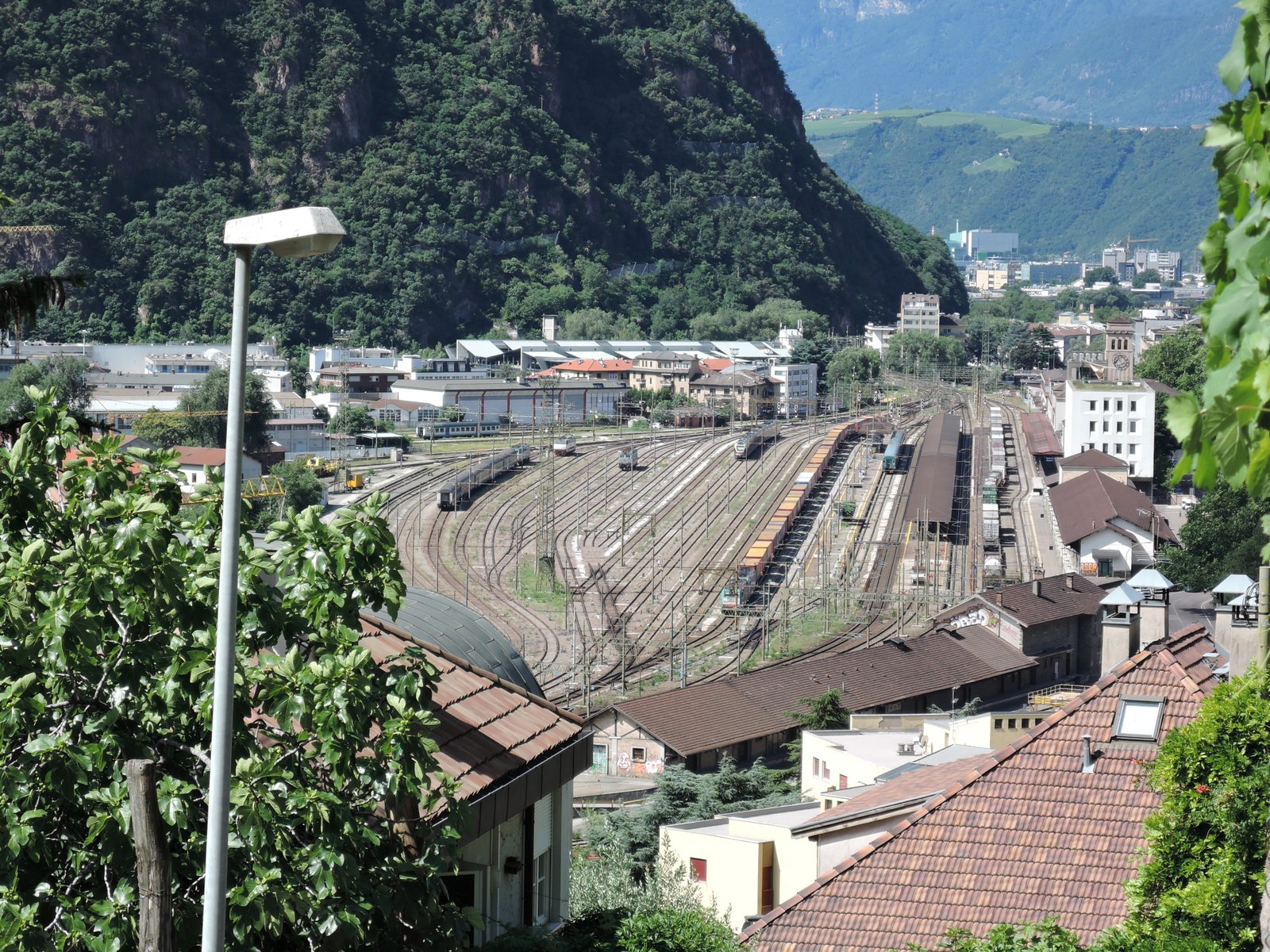
Built between 1927 and 1929 by Angiolo Mazzoni, chief architect of the Italian State Railways, this station was the first large-scale statement of fascist authority in a city the regime had held for less than a decade.
At a glance
The Bolzano railway station sits at Piazza della Stazione 1 at the southern edge of the city centre. Mazzoni — who rebuilt stations from Agrigento to the Alps — gave Bolzano a monumental facade of eight pilasters, a prominent clock tower, and two niches housing allegorical sculptures by Austrian artist Franz Ehrenhöfer. The building opened in 1929 and remains largely unchanged. It processes roughly 5.5 million passenger movements annually, making it one of the busiest stations in the northeast.
Key facts
- Address: Piazza della Stazione 1 / Bahnhofplatz 1, 39100 Bolzano
- Coordinates: 46.4967°N, 11.3583°E (Google Maps)
- Built: 1927–1929 (reconstruction of an 1859 original)
- Architect: Angiolo Mazzoni (1894–1979), Ufficio Speciale per le Costruzioni delle Ferrovie dello Stato
- Style: Fascist rationalism with monumental classicist elements
- Sculptures: Franz Ehrenhöfer — electricity and steam (niches), River Adige allegory (clock tower), St Christopher fountain
- Current use: Active passenger station (RFI / Trenitalia / Eurocity services to Innsbruck, Verona, Munich)
History
The first station at Bolzano opened on 16 May 1859, when the Brenner Railway extended south from Innsbruck. That original building was Austrian in character, functional, and modest. After the 1919 Treaty of Saint-Germain-en-Laye transferred the region from Austria to Italy, Bolzano became a border city overnight — and a symbolic problem for Rome. The German-speaking population, which comprised the clear majority, had not been consulted. Mussolini’s government understood that control of a city’s infrastructure projected authority as effectively as any monument.
In 1927 the fascist government tasked Angiolo Mazzoni — already responsible for dozens of post offices and stations across Italy — with rebuilding the Bolzano station in a manner appropriate to the new political reality. Work began that year and the rebuilt station was inaugurated in 1929. The design retained the station’s functional role while replacing its architectural character entirely: gone was the Austrian vernacular, replaced by a monumental facade that quoted imperial Rome in the compressed vocabulary of Italian rationalism. Ehrenhöfer’s sculptures — he was Austrian, a detail rarely mentioned in official accounts — depicted electricity and steam, the productive forces of the modern state, flanking the main entrance.
During the period of forced Italianisation (1923–1939), the station was the point of arrival for thousands of Italian workers and civil servants brought in by the regime to change the demographic balance of the city. It was also the point of departure, in September 1943, when German forces occupied South Tyrol after Italy’s armistice with the Allies, and again in 1945 when they withdrew. The Optionszwang of 1939 — the forced choice offered to German speakers to either accept Italian citizenship fully or emigrate to the Reich — passed through this station in the form of families carrying their belongings south.
What you see
The main facade faces Piazza della Stazione across a wide forecourt. Eight pilasters in pale stone divide the frontage into bays, rising to a shallow cornice. The central bay is slightly taller than the flanking ones, with the clock tower rising from behind the roofline. Two deep niches on either side of the main entrance hold Ehrenhöfer’s larger-than-life allegorical figures: electricity on the left (female, with a lightning bolt), steam on the right (male, with a locomotive wheel). The surfaces are flat and the ornamentation controlled — this is not the baroque fascism of the EUR in Rome but the pragmatic, stripped classicism that Mazzoni applied throughout the state railway network.
Above the entrance to the clock tower, Ehrenhöfer carved an allegory of the River Adige — the river that defines Bolzano’s valley and, in regime mythology, the natural boundary between Italian and German worlds. Inside the station, a fountain dedicated to St Christopher (patron of travellers) occupies a corner of the main hall. The masks Ehrenhöfer placed on the cornices throughout the complex are easy to miss; look up along the roofline as you move between platforms.
Cultural significance
For the German-speaking Südtiroler, Mazzoni’s station was the physical embodiment of Italian annexation: every traveller arriving from the north passed through a building that announced, in stone and plaster, that this was now Italian territory. The choice of Austrian sculptor Ehrenhöfer to make the statues suggests a more complicated negotiation than the official record admits — one of the few moments where local artistic talent was incorporated into the regime’s building programme rather than replaced by Italian practitioners. Today the station functions as a bilingual space, with announcements and signage in both Italian and German, a practical reality of the 1972 Second Statute of Autonomy. The building itself has been neither renovated nor contextualised: it stands as Mazzoni left it, functioning daily, its political origins visible to anyone who looks at the pilasters and knows what they represent.
Practical information
- Access: The exterior and main hall are publicly accessible at all hours; no admission charge
- Train services: Trenitalia intercity services to Verona, Trento; Eurocity to Innsbruck and Munich; regional services throughout South Tyrol
- Time needed: 15–20 minutes to examine the facade, niches, clock tower detail, and St Christopher fountain
Getting there
The station is a 15-minute walk south from Piazza Walther, the historic centre. From the Monumento alla Vittoria (this itinerary’s first stop), walk east along Via del Brennero, then south on Via Garibaldi to Piazza della Stazione — roughly 1.2 kilometres. Bolzano is compact and flat; the walk is direct and takes about 15 minutes.
Nearby
- Piazza della Stazione / Bahnhofplatz — the wide forecourt in front of the station is itself a fascist-era urban intervention
- Via Garibaldi — main axis between the station and Piazza Walther, lined with 1930s commercial architecture
- The Casa del Fascio (Palazzo degli Uffici Finanziari) is a 10-minute walk northwest — the next stop on this itinerary
Sources
Find it on the map
See this place and what’s around it →📷 Become a Cultural Heritage Online photographer
Share your photos of places: they stay published under your name as the author. The more they're seen, the more you get noticed — and soon a contest will reward the most appreciated photos.
Log in or sign up free to add a photoIs this page about you?
This page is read by travellers and heritage enthusiasts who find it on Google. Tell us how you are connected to this place and we will take it from there.