

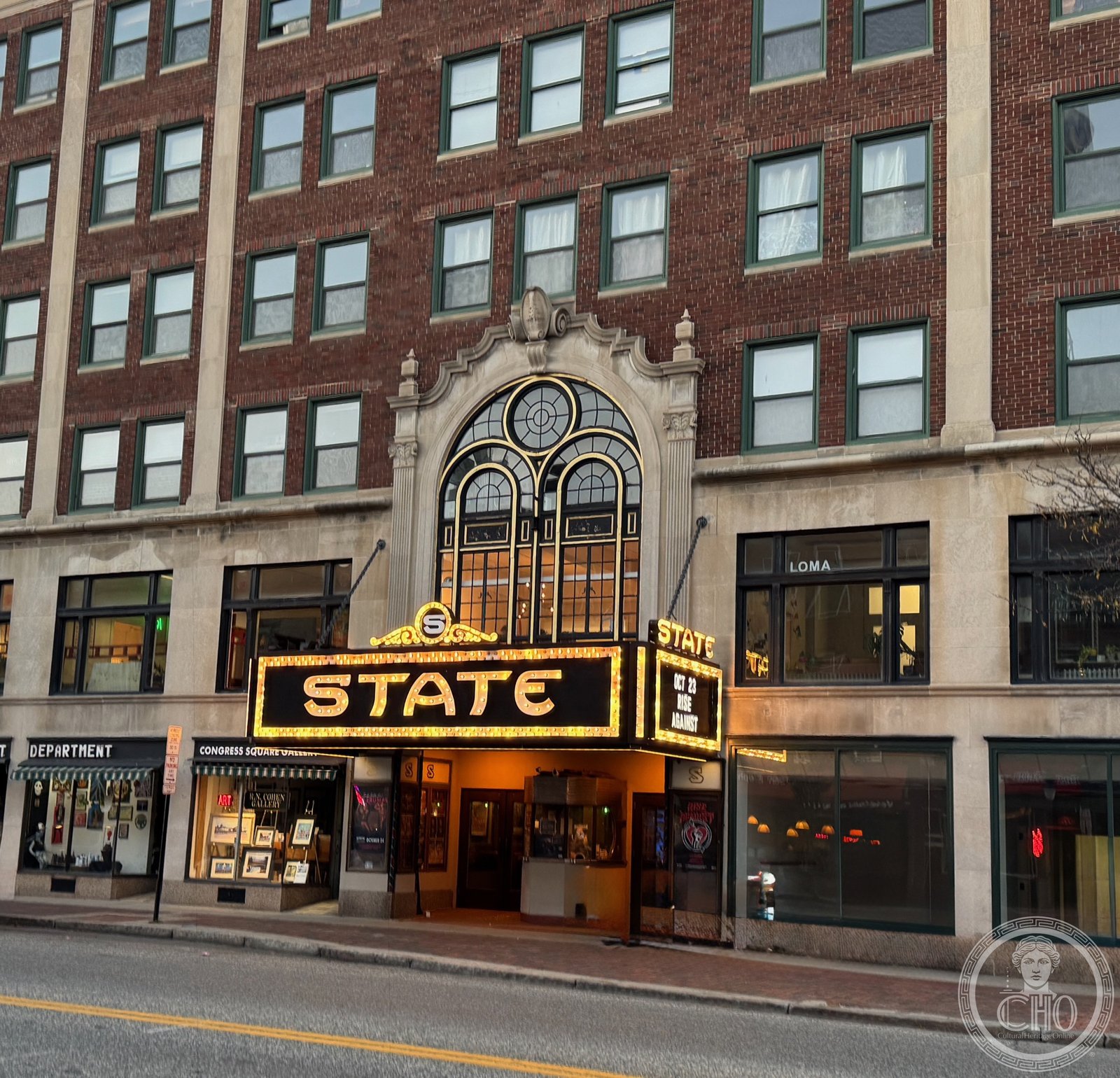
On Congress Street in the heart of Portland, the State Theatre has been the Art Deco landmark of Maine’s largest city since it opened in 1929 — a movie palace built at the height of the theatrical golden age that has survived the decline of the single-screen cinema, found new life as a concert venue, and stands today as the most architecturally significant entertainment building in northern New England.
At a glance
The State Theatre at 609 Congress Street is the defining historic entertainment venue of Portland, Maine, and the finest Art Deco building surviving in the state. Opened in 1929 in the final years before the Depression transformed American movie palace construction, it brought the full vocabulary of the Art Deco style to Congress Street — the main commercial artery of New England’s northernmost major city. With a seating capacity of approximately 1,900, it served Portland audiences as a cinema through the golden age of movies before closing and reopening in various configurations. Restored and reopened as a music venue, it now hosts concerts that serve Portland’s active arts community and the audiences of coastal Maine, its Art Deco facade on Congress Street as compelling as it was when the theater first opened.
Key facts
- Address: 609 Congress Street, Portland, ME 04101.
- Opened: 1929.
- Style: Art Deco.
- Capacity: approximately 1,900.
- Current use: Active concert venue.
- Designation: National Register of Historic Places.
History
Portland in 1929 was the commercial and cultural hub of a Maine whose economy was built on fishing, maritime trade, timber, and the summer tourism industry that had developed along the Maine coast since the nineteenth century. The city occupies a peninsula at the southern end of Casco Bay, its downtown concentrated on Munjoy Hill and the Western Promenade heights above a working waterfront. Congress Street was the main commercial street, lined with banks, department stores, hotels, and entertainment venues that served both the Portland population and the tourists passing through.
The State Theatre was built at the peak of the movie palace era, when the national theater chains were investing heavily in grand downtown entertainment venues — buildings designed to make the cinema experience feel like an occasion, to compete with legitimate theater on architectural terms, and to establish the movies as a cultural institution worthy of the finest buildings a city could provide. The Art Deco style, which had reached American commercial architecture from the 1925 Paris Exposition Internationale des Arts Décoratifs, was the natural choice for a theater that wanted to signal modernity and sophistication.
Portland’s distance from the major American theatrical circuits and its relatively small population gave the State Theatre a regional importance that goes beyond what its size might suggest. As the largest and most architecturally ambitious movie palace in Maine, it served as the primary destination for first-run films and theatrical events in a state that had no comparable venue outside of it. The theater’s conversion to a live music venue has maintained this regional importance into the present: for audiences across coastal Maine, a show at the State Theatre remains an event, a reason to come into the city.
What you see
The Congress Street facade delivers the State Theatre’s Art Deco credentials with characteristic economy: a composition of vertical pilasters, ornamental panels, and geometric detailing that establishes the building’s identity on a street with a diverse architectural character. The marquee, projecting over the Congress Street sidewalk, continues to announce the theater’s programming as it has since 1929, giving the building an active presence on the street rather than the muted dignity of a landmark no longer in use.
The interior has been adapted for live concert performance while retaining the essential spatial qualities of the original theater design. The floor plan — an orchestra level with balcony above — provides the varied sight lines and acoustic environment that works for the range of musical programming the State Theatre presents. The Art Deco decorative elements that survive from the original construction give the room its historical character; the technical equipment that serves contemporary sound reinforcement is discreetly integrated.
Practical information
- Events: Active concert venue; national touring acts, local Portland performers; check statetheatreportland.com for schedule.
- Arts District: The State Theatre anchors the Congress Street arts district, surrounded by galleries, restaurants, and other cultural venues that have developed around Portland’s active arts community.
- Parking: Street parking on Congress Street and surrounding blocks; several garages within a short walk; Portland is a walkable city.
Getting there
Portland is Maine’s largest city and commercial hub, on the coast 100 miles north of Boston via Interstate 95. Portland International Jetport (PWM) is 3 miles west. Amtrak’s Downeaster train runs between Boston’s North Station and Brunswick, ME, with a stop at Portland’s Transportation Center on Thompson’s Point, about a mile from the State Theatre. The theater is in the heart of Portland’s peninsular downtown, walkable from most hotels.
Nearby
- Portland Museum of Art (1983) — the major art museum of Maine, designed by I.M. Pei and partners in a building that references the red brick warehouse architecture of Portland while housing significant collections of American art including important holdings of Winslow Homer and Andrew Wyeth; two blocks from the State Theatre on Congress Street.
- Victoria Mansion (1858–1860) — the Italianate villa at 109 Danforth Street, considered the finest surviving antebellum interior in the United States; its rooms retain their extraordinary 1860s painted and carved decoration, a document of American taste at its pre-Civil War peak.
- Portland Observatory (1807) — the last surviving maritime signal tower in the United States, on Munjoy Hill overlooking Casco Bay; built to allow ships’ owners to identify their vessels before they docked, it now serves as a museum and observation platform with views across the bay.
- Portland Old Port — the renovated nineteenth-century warehouse district on the waterfront, now the commercial heart of Portland’s restaurant and retail scene; the brick buildings along Exchange, Fore, and Commercial Streets give the Old Port its distinctive New England commercial character.
Sources
- National Register of Historic Places, State Theatre Portland nomination.
- Maine Historic Preservation Commission records.
- Portland Press Herald archives — State Theatre history.
- Greater Portland Landmarks documentation.
- Maine Arts Commission institutional history.
Find it on the map
See this place and what’s around it →Record researched and written by Luigi De Marchi for Cultural Heritage Online, 2026.
📷 Become a Cultural Heritage Online photographer
Share your photos of places: they stay published under your name as the author. The more they're seen, the more you get noticed — and soon a contest will reward the most appreciated photos.
Log in or sign up free to add a photoIs this page about you?
This page is read by travellers and heritage enthusiasts who find it on Google. Tell us how you are connected to this place and we will take it from there.