
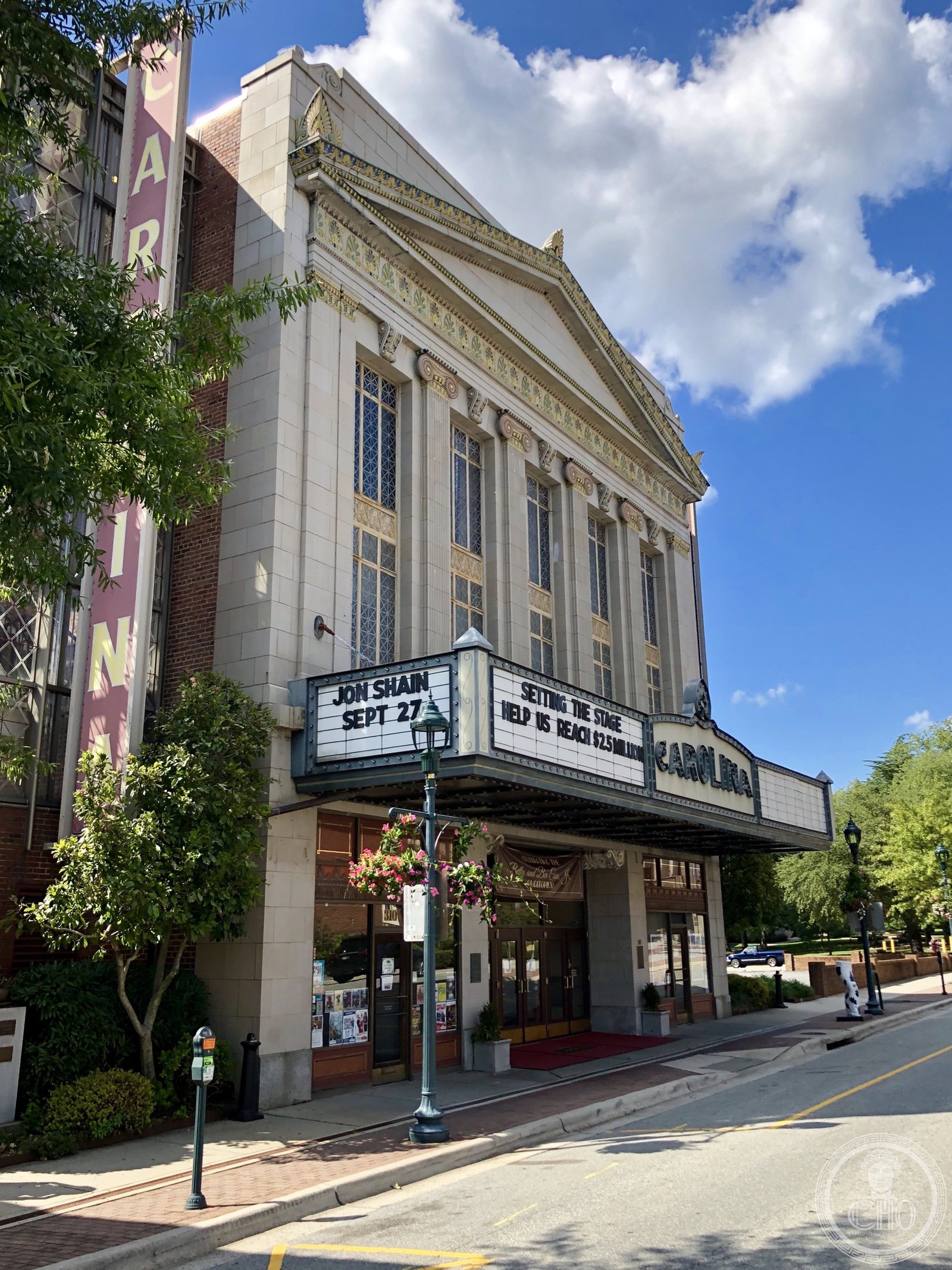
On South Greene Street in downtown Greensboro, the Carolina Theatre has been the cultural centerpiece of the Piedmont Triad’s largest city since 1927 — an Art Deco movie palace that survived the decline of downtown cinema, reinvented itself as a publicly owned performing arts center, and now serves a city whose history includes some of the most pivotal moments of the American civil rights movement.
At a glance
The Carolina Theatre at 310 South Greene Street is the finest surviving Art Deco theater in North Carolina’s Piedmont Triad and one of the most beautifully maintained historic theaters in the American South. Opened in 1927 as the region’s premier movie palace, it brought the full vocabulary of the Art Deco idiom to downtown Greensboro — elaborate ornamental facade, grand lobby, and richly detailed auditorium — in a building that announced Greensboro’s ambition as the leading commercial city of the North Carolina Piedmont. Owned by Greensboro since the 1970s and operated as a nonprofit performing arts center, it has served the community with concerts, theatrical productions, film programming, and community events, its restored interior as impressive today as it was at the building’s 1927 opening.
Key facts
- Address: 310 South Greene Street, Greensboro, NC 27401
- Opened: 1927
- Style: Art Deco
- Ownership: City of Greensboro (owned since the 1970s)
- Current use: Active performing arts center; concerts, film, theatrical productions
- Designation: National Register of Historic Places
History
Greensboro in 1927 was the industrial and commercial hub of North Carolina’s Piedmont region — the textile manufacturing district that had made the Piedmont the economic engine of the New South. The city’s prosperity was built on cotton mills, insurance companies, and the rail connections that served both. Elm Street and the surrounding downtown commercial district concentrated the wealth generated by the Piedmont economy in a succession of retail stores, office buildings, and entertainment venues.
The Carolina Theatre was the peak expression of downtown Greensboro’s commercial ambition: a movie palace designed to compete with the finest theaters in larger cities, bringing the Art Deco style and the full cinematic experience of the 1920s to a growing industrial city. The building’s ornate facade and interior were designed to make going to the cinema feel like an occasion — an event that reflected well on the city and on the audiences who attended.
The theater served Greensboro through the great decades of American cinema and into the era of television and suburban development. When downtown retail and entertainment began to decline in the 1960s, the Carolina was vulnerable to the pattern of closure and demolition that eliminated so many American movie palaces. But Greensboro chose a different path: the city acquired the theater in the 1970s, committed to its preservation, and repositioned it as a publicly owned cultural asset. The subsequent restoration and the transformation of the theater into a community performing arts center have made the Carolina Theatre one of the success stories of historic theater preservation in the South.
Greensboro’s place in American history was secured on February 1, 1960, when four Black college students from North Carolina A&T sat down at the whites-only Woolworth lunch counter on South Elm Street and refused to leave. The Greensboro sit-ins that followed became one of the defining events of the civil rights movement, inspiring similar protests across the South and demonstrating the power of nonviolent direct action.
What you see
The South Greene Street facade presents the Carolina Theatre’s Art Deco identity with full commitment: a terra cotta composition with geometric ornamental panels, vertical emphasis, and decorative detailing that establishes the building as the most architecturally ambitious on its block. The entrance canopy and restored marquee give the building a theatrical presence on the street that has changed relatively little in nearly a century.
The main auditorium interior is the theater’s defining experience: an elaborately ornamented room with tiered balconies, decorative plasterwork, and the proscenium stage configuration that served silent films, sound cinema, and live performance across the building’s history. The restoration has preserved and renewed the Art Deco decorative program while adapting the technical infrastructure for contemporary use.
Practical information
- Events: Concerts, theatrical productions, film series, community events; check carolinatheatre.com for schedule
- Downtown Greensboro: The Carolina Theatre is in the South Elm Street entertainment district, surrounded by restaurants and bars that have developed around the restored downtown
- Parking: Public parking garages available within two blocks; the center city is walkable
Getting there
Greensboro is the largest city in North Carolina’s Piedmont Triad (with Winston-Salem and High Point), at the intersection of Interstate 40 and Interstate 85, roughly midway between Charlotte (90 miles west) and Raleigh (80 miles east). Piedmont Triad International Airport (GSO) is 12 miles west. Amtrak’s Carolinian and Piedmont trains connect Greensboro to Charlotte, Raleigh, and New York; the train station is about a mile from the Carolina Theatre.
Nearby
- International Civil Rights Center and Museum — the civil rights museum located in the former Woolworth building at 134 South Elm Street, where the February 1, 1960 sit-in began; the original lunch counter is preserved inside; the museum documents the Greensboro sit-ins and their role in the civil rights movement
- Greensboro History Museum — the city history museum covering Greensboro from its founding through the twentieth century, including significant material on the civil rights era; in the downtown core
- Blandwood Mansion (1844) — the Italianate villa of Governor John Motley Morehead, an early example of the architectural influence of Andrew Jackson Downing in the American South; a National Historic Landmark in the Greensboro historic center
- Guilford Courthouse National Military Park — the site of the 1781 Battle of Guilford Courthouse, a pivotal engagement of the American Revolutionary War in which Nathanael Greene’s Continental Army inflicted severe losses on Cornwallis’s British forces; six miles northwest of downtown
Sources
- National Register of Historic Places, Carolina Theatre nomination
- Carolina Theatre, institutional history
- Greensboro Historical Museum records
- North Carolina State Historic Preservation Office architectural survey
- News & Record archives — Carolina Theatre history
Find it on the map
See this place and what’s around it →Record researched and written by Luigi De Marchi for Cultural Heritage Online, 2026.
📷 Become a Cultural Heritage Online photographer
Share your photos of places: they stay published under your name as the author. The more they're seen, the more you get noticed — and soon a contest will reward the most appreciated photos.
Log in or sign up free to add a photoIs this page about you?
This page is read by travellers and heritage enthusiasts who find it on Google. Tell us how you are connected to this place and we will take it from there.