
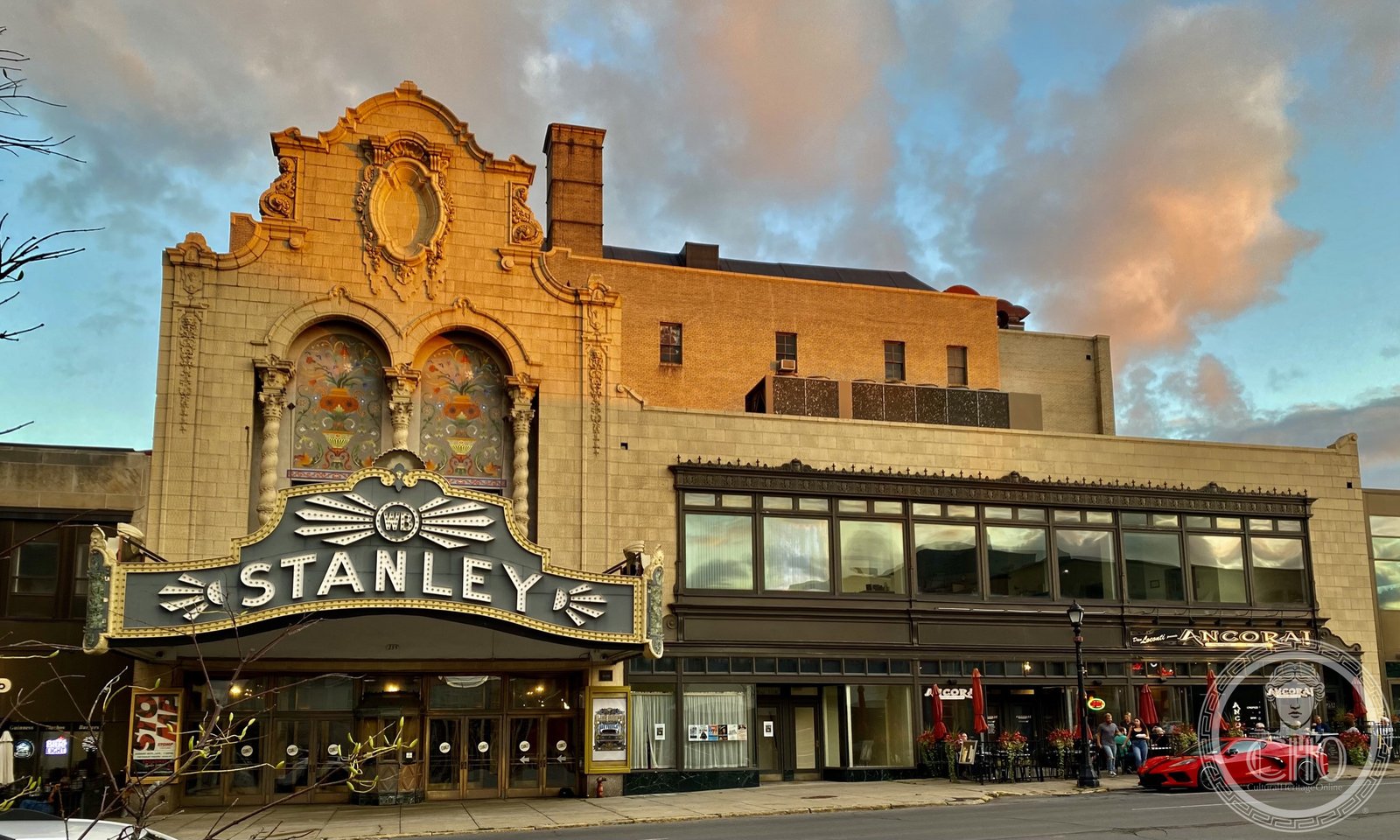
The Stanley Theater opened in 1928 on Genesee Street in Utica as one of the grandest atmospheric picture palaces in upstate New York, its Baroque-influenced interior designed by Thomas Lamb creating a theatrical environment that has been carefully preserved through decades of community stewardship.
At a glance
Utica’s Stanley Theater is the work of Thomas W. Lamb, one of the most prolific theater architects in American history, whose commissions included major movie palaces in New York, Brooklyn, and cities across the United States. The Stanley opened in 1928 as a first-run film palace for the Warner Bros. circuit, seating over 2,900 patrons in an elaborately decorated interior that drew on Spanish and Italian Baroque architectural sources. The theater is now the home of the Landmark Theatre, a nonprofit organization that has preserved and restored the Stanley and presents live performances, concerts, and community events.
Key facts
- Address: 259 Genesee Street, Utica, NY 13501
- Opened: 1928
- Architect: Thomas W. Lamb (1871–1942)
- Style: Spanish/Italian Baroque atmospheric
- Seating: approximately 2,900
- Listed: National Register of Historic Places
- Current operator: Landmark Theatre, Utica
History
Utica occupies a strategic position in the Mohawk Valley of central New York, the natural corridor through the Appalachian plateau that became the Erie Canal route and then the New York Central Railroad main line connecting the Hudson Valley with the Great Lakes. The city prospered through the nineteenth century on textiles, manufacturing, and its role as a regional commercial center, then faced the same industrial decline that affected most upstate New York cities in the mid-twentieth century.
The Stanley opened in the city’s last prosperous decade, commissioned by the Stanley Company of America (later acquired by Warner Bros.) as a showcase movie palace for upstate New York. Thomas Lamb’s design drew on the atmospheric theater concept that had been popularized by architect John Eberson: rather than a conventional theater interior, Lamb created a space that suggested an outdoor courtyard under a night sky, with the ceiling painted blue and hung with twinkling lights, the walls ornamented with Baroque sculptural forms suggesting a Spanish colonial garden.
The Warner Bros. circuit showed films at the Stanley through the 1960s before declining attendance led to closure. The Landmark Theatre was formed in the 1970s to save the building, and has operated the theater ever since, combining film programming with live performances. The restoration of the Stanley has been one of Utica’s most sustained community heritage projects, a counterpoint to the economic difficulties the city has faced since deindustrialization.
What you see
The Stanley’s Genesee Street facade presents an elaborate ornamental composition characteristic of Thomas Lamb’s work: heavily articulated masonry, arched windows with decorative surrounds, and a vertical tower that marks the theater’s presence on the street. Lamb designed theater exteriors to signal grandeur and invitation simultaneously, and the Stanley reads from a block away as a building of special status.
The interior is what the Stanley is most celebrated for: Thomas Lamb’s atmospheric scheme covers the walls in Baroque sculptural ornament — twisted columns, cartouches, garlands, and heraldic devices — while the ceiling simulates an outdoor sky with deep blue paint and fiber-optic starfield effects. The theatrical effect of this interior on a first-time visitor is substantial: the space feels expansive, ornate, and utterly unlike a contemporary venue, a survivor from an era when going to the movies was an occasion requiring a palace.
Practical information
- Access: 259 Genesee Street, downtown Utica
- Hours: Box office open for scheduled events; check the Landmark Theatre website
- Best for: Atmospheric theater architecture, Thomas Lamb architecture, Mohawk Valley heritage
- Tip: The Landmark Theatre’s restoration tours (when available) give access to the backstage and technical spaces that the standard audience experience does not include
Getting there
Utica is located on I-90 (New York State Thruway) approximately 100 miles west of Albany and 50 miles east of Syracuse. Amtrak’s Lake Shore Limited (New York City to Chicago) stops at Utica, with the station approximately 10 minutes on foot from the Stanley. The nearest major airport is Syracuse Hancock International Airport (SYR), approximately 50 miles west. Genesee Street is downtown Utica’s commercial main street, and the Stanley is on the eastern section of the street.
Nearby
- Munson-Williams-Proctor Arts Institute — a major regional art museum designed by Philip Johnson (1960), with a collection spanning the Hudson River School through contemporary art
- Erie Canal Museum, Syracuse — 50 miles west, the definitive museum of the Erie Canal that connected Utica’s economy to the Great Lakes in the nineteenth century
- Adirondack Park — approximately 50 miles north, one of the largest protected areas in the contiguous United States, with hiking, canoeing, and wilderness access from the Fulton Chain of Lakes
- National Baseball Hall of Fame, Cooperstown — approximately 35 miles south via Route 28, in the village at the foot of Otsego Lake
Sources
- Landmark Theatre, Utica — official history, restoration documentation
- National Register of Historic Places — Stanley Theater, Utica, New York
- Lamb, Thomas W. — theater design bibliography and commissioned works documentation
Find it on the map
See this place and what’s around it →Record researched and written by Luigi De Marchi for Cultural Heritage Online, 2026.
📷 Become a Cultural Heritage Online photographer
Share your photos of places: they stay published under your name as the author. The more they're seen, the more you get noticed — and soon a contest will reward the most appreciated photos.
Log in or sign up free to add a photoIs this page about you?
This page is read by travellers and heritage enthusiasts who find it on Google. Tell us how you are connected to this place and we will take it from there.