
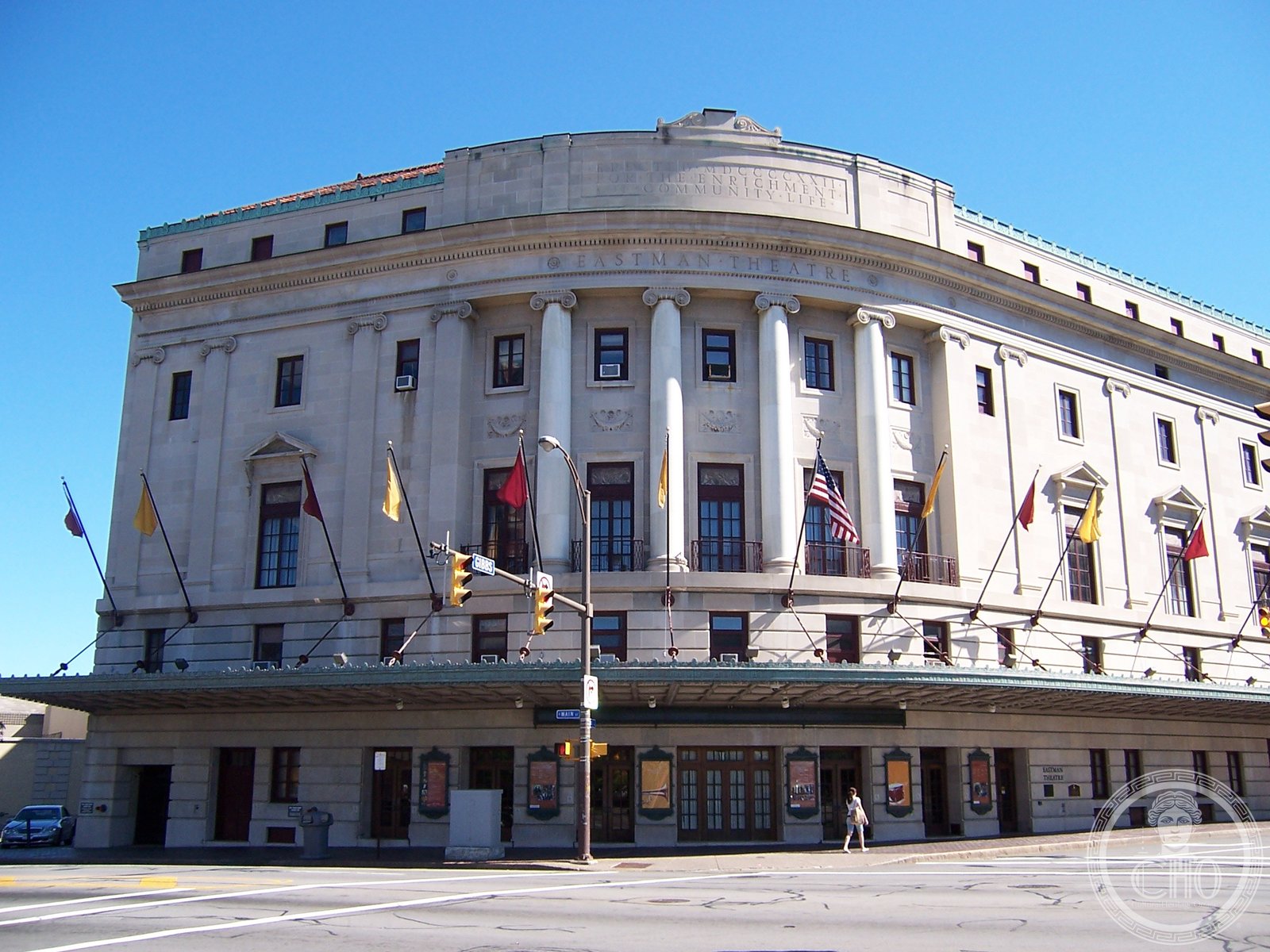
The Eastman Theatre opened in 1922 as the concert hall of the Eastman School of Music, founded by George Eastman whose Kodak camera empire transformed Rochester into one of the great industrial cities of upstate New York and made him one of the most consequential philanthropists of the twentieth century.
At a glance
George Eastman gave Rochester two of its defining cultural institutions in the early 1920s: the Eastman School of Music, established in 1921 as part of the University of Rochester, and the Eastman Theatre, opened a year later as the school’s concert hall and a public cinema presenting films and live performances. Eastman commissioned architects Gordon and Kaelber to design a facility that would match the ambition of the School: a 3,000-seat auditorium whose Beaux-Arts / Neoclassical interior established the standard for performing arts venues in upstate New York. The theater today remains the home venue of the Rochester Philharmonic Orchestra.
Key facts
- Address: 60 Gibbs Street, Rochester, NY 14604
- Opened: 1922
- Architect: Gordon and Kaelber
- Funded by: George Eastman (1854–1932), founder of Eastman Kodak
- Capacity: approximately 3,000 seats
- Listed: National Register of Historic Places
- Current resident: Rochester Philharmonic Orchestra
History
George Eastman’s career traced the arc of American industrial transformation in the late nineteenth and early twentieth centuries. Born in 1854 in Waterville, New York, Eastman developed the flexible photographic film and the Kodak camera that democratized photography, turning an activity previously limited to professionals with cumbersome plate equipment into something anyone could do. By 1900 the Eastman Kodak Company, headquartered in Rochester, was the dominant force in consumer photography worldwide, and Eastman had become extraordinarily wealthy.
Eastman’s philanthropic legacy was unusually strategic. He gave massively to the University of Rochester, to the Massachusetts Institute of Technology, and to Tuskegee and Hampton Institutes (early supporters of African American education). His most ambitious local project was the Eastman School of Music, established in 1921 at the University of Rochester, which he conceived as a professional conservatory capable of rivaling the great European schools. The Eastman Theatre was built simultaneously as the School’s performance venue and as a community cinema, presenting films on a commercial basis to help support the School’s operating costs.
After Eastman’s death in 1932, the theater passed through various operational arrangements before settling into its current role as the primary concert venue of the Rochester Philharmonic Orchestra and the home stage for Eastman School performances. The interior has been restored and updated while preserving the essential character of Gordon and Kaelber’s 1922 design.
What you see
The Eastman Theatre’s Main Street facade presents a formal Neoclassical composition: a piano nobile of tall arched windows rising above a rusticated base, with a central bay distinguished by a decorative surround that signals the primary entrance. The scale is substantial without being monumental, calibrated to a major downtown commercial street rather than a grand civic plaza. Gordon and Kaelber’s design places the theater in the tradition of Beaux-Arts civic architecture that defined American public building at the turn of the twentieth century.
The auditorium interior is the building’s greatest achievement: a deep horseshoe form with tiered balconies, elaborate plasterwork on the ceiling and walls, and the proportions of a European opera house transplanted to upstate New York. The acoustic performance of the space has been refined through successive renovations, and the Rochester Philharmonic’s relationship with the hall has shaped both the orchestra’s programming and the theater’s reputation as a first-class concert venue.
Practical information
- Access: 60 Gibbs Street, downtown Rochester, adjacent to the Eastman School of Music campus
- Hours: Box office and tours by appointment; performance schedule on the Eastman Theatre and Rochester Philharmonic websites
- Best for: Classical music, architectural heritage, George Eastman history
- Tip: The George Eastman Museum, on East Avenue, is Rochester’s other major Eastman legacy: a museum of photography and cinema in Eastman’s restored Colonial Revival mansion, with the world’s largest archive of photographic and film holdings
Getting there
Rochester is located on Lake Ontario at the junction of I-490 and I-390 in upstate New York, approximately 80 miles east of Buffalo and 90 miles west of Syracuse. The Greater Rochester International Airport (ROC) is approximately 5 miles south of downtown. Amtrak’s Lake Shore Limited (New York City to Chicago) and Empire Service (New York City to Buffalo) stop at Rochester. The Eastman Theatre is on Gibbs Street, which runs parallel to Main Street in the heart of downtown Rochester, adjacent to the Eastman School of Music campus.
Nearby
- George Eastman Museum — on East Avenue, the photography and cinema museum in George Eastman’s restored 1905 mansion, with the world’s largest photographic archive
- Memorial Art Gallery — the University of Rochester’s art museum, with a broad collection from ancient to contemporary
- Strong National Museum of Play — on Manhattan Square, one of the largest museums in the United States focused on the history and culture of play
- Erie Canal, Rochester section — the historic Genesee Valley section of the canal passes through Rochester; the Canal Society of New York State and the Erie Canalway National Heritage Corridor provide resources for heritage exploration
Sources
- Eastman School of Music — official history and George Eastman documentation
- Rochester Philharmonic Orchestra — Eastman Theatre venue history
- National Register of Historic Places — Eastman Theatre, Rochester, New York
Find it on the map
See this place and what’s around it →Record researched and written by Luigi De Marchi for Cultural Heritage Online, 2026.
📷 Become a Cultural Heritage Online photographer
Share your photos of places: they stay published under your name as the author. The more they're seen, the more you get noticed — and soon a contest will reward the most appreciated photos.
Log in or sign up free to add a photoIs this page about you?
This page is read by travellers and heritage enthusiasts who find it on Google. Tell us how you are connected to this place and we will take it from there.