
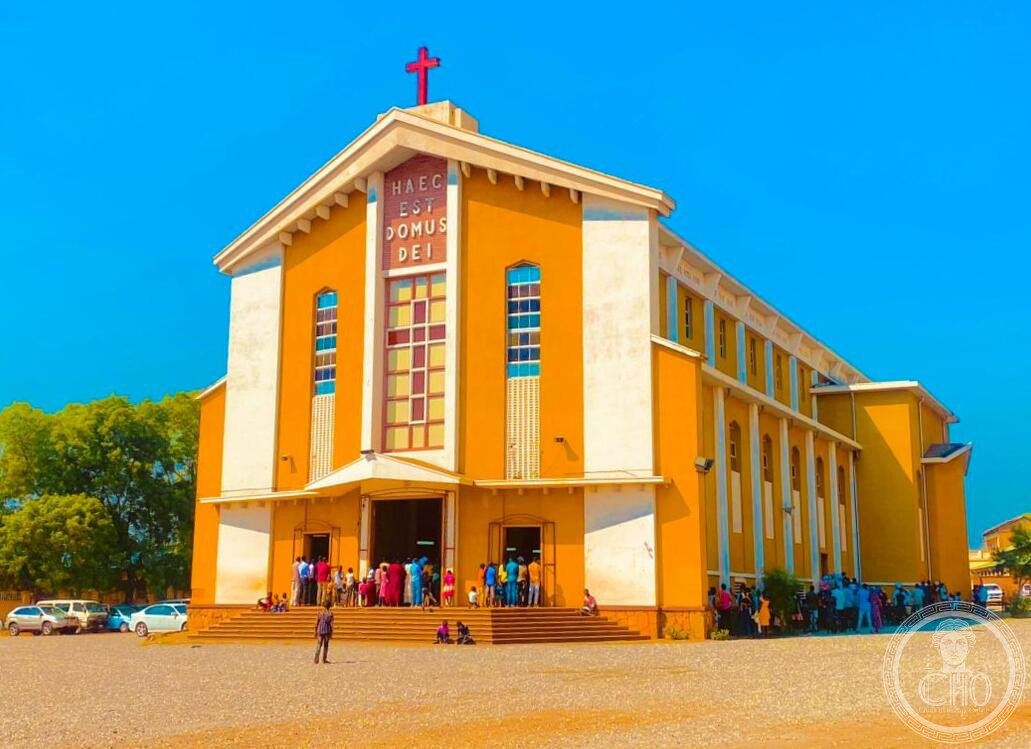
In Juba, the capital of South Sudan, the building of the church of Saint Theresa, in the Kator district, began in 1952. No source documents the name of an architect, nor identifies with certainty who commissioned it, although the Catholic missionary presence in the region, tied to Saint Daniel Comboni and the Comboni missionaries, is well documented from the 19th century onwards. The building was not born a cathedral, but a simple parish church, and took that status only on 12 December 1974, when Pope Paul VI, with the bull «Cum in Sudania», raised the ecclesiastical district to the metropolitan archdiocese of Juba. That district went back to the apostolic prefecture of Bahr el-Gebel, erected on 14 July 1927, which became an apostolic vicariate in 1951 and was renamed the apostolic vicariate of Juba in 1961. During the Sudanese civil wars the government of Khartoum nationalised the mission schools and expelled hundreds of foreign Christian missionaries in 1964, during the first civil war, from 1955 to 1972. The second civil war, from 1983 to 2005, saw the Catholic Church deeply engaged in mediation and peace work, often the only functioning infrastructure across vast areas of the south; the Catholic bishops actively supported the referendum for independence of 2011. During one episode of the civil war, which the sources consulted do not date precisely, about 5,000 people took refuge inside the cathedral of Saint Theresa, which stayed shut for days during violent clashes between rival factions of the national army. A similar episode was repeated during the Juba crisis of December 2013, and in later outbreaks of violence, such as that of July 2016, when thousands of civilians sought refuge in the cathedral together with other churches in the city, with no direct structural damage to the building recorded. From 3 to 5 February 2023 Pope Francis visited South Sudan on an «ecumenical pilgrimage of peace» made together with the Archbishop of Canterbury, Justin Welby, and the Moderator of the Church of Scotland, Iain Greenshields, the first time in Christian history that the leaders of the Catholic, Anglican and Presbyterian churches undertook an ecumenical journey abroad together. On the morning of 4 February 2023 Francis met bishops, priests, deacons, religious and seminarians in the cathedral of Saint Theresa itself, received by Archbishop Stephen Ameyu Martin Mulla, before about a thousand people inside and five thousand more outside, saying in his address that «the first duty is not to be a perfectly organised Church: any company can do that». The present archbishop of Juba is Cardinal Stephen Ameyu Martin Mulla, in office since 12 December 2019 and the first cardinal in the history of South Sudan, created such on 30 September 2023. In the sources consulted there is no record of any formal listing of the cathedral in a cultural heritage register.
About St. Theresa Cathedral
In Juba, the capital of South Sudan, construction of St. Theresa’s Church in the Kator district began in 1952; no source documents an architect’s name or definitively identifies who commissioned it, though Catholic missionary presence in the region, tied to St. Daniel Comboni and the Comboni Missionaries, is well documented from the 19th century onward. The building was not originally a cathedral but a simple parish church, gaining that status only on 12 December 1974, when Pope Paul VI, through the bull “Cum in Sudania,” elevated the ecclesiastical territory to the Metropolitan Archdiocese of Juba — a jurisdiction tracing back to the Apostolic Prefecture of Bahr el-Gebel, erected on 14 July 1927.
Key facts
- 1952: construction of the church begins in Juba’s Kator district.
- 12 December 1974: elevated to cathedral with the creation of the Archdiocese of Juba.
- ~5,000 people reportedly sheltered inside during a civil-war-era army clash, date unconfirmed.
- December 2013 and July 2016: thousands again take refuge in the cathedral during renewed Juba violence.
- 4 February 2023: Pope Francis meets clergy and religious at the cathedral during a historic joint ecumenical visit.
- 30 September 2023: Archbishop Stephen Ameyu Martin Mulla becomes South Sudan’s first-ever cardinal.
History
Built two decades before South Sudan even existed as a distinct ecclesiastical territory, St. Theresa’s Church became a cathedral only in 1974 and has since repeatedly served as a literal sanctuary for thousands of Juba’s civilians during outbreaks of army and factional violence. Its most historic moment came in February 2023, when it hosted the first-ever joint foreign ecumenical visit by a pope, an Archbishop of Canterbury, and a Moderator of the Church of Scotland — a gesture aimed squarely at a nation the Church itself has repeatedly held together as its only functioning institution during decades of war.
What you see
Detailed architectural documentation of the cathedral — its style, materials, and capacity — is not publicly available in any source consulted; visibly, the building carries a clock tower on one side of its façade. What the cathedral lacks in documented architectural pedigree, it makes up for in accumulated historical weight, having sheltered thousands of civilians across multiple episodes of violence since South Sudan’s civil wars began.
Practical information
- Opening hours: generally open daily outside services; check current hours and security conditions before visiting.
- Address: Unity Avenue, Kator, Juba, Central Equatoria State, South Sudan.
Getting there
The cathedral stands on Unity Avenue in Juba’s Kator district. GPS: 4°49′38″N, 31°36′01″E.
Nearby
- Kator district — the central Juba neighborhood surrounding the cathedral.
Sources
- Wikipedia — “St. Theresa Cathedral, Juba” and “Roman Catholic Archdiocese of Juba” (en.wikipedia.org).
- Vatican.va — press bulletin, Pope Francis at St. Theresa Cathedral, 4 February 2023.
- Episcopal News Service — “South Sudan cathedral provides sanctuary as thousands flee Juba violence”
Find it on the map
See this place and what’s around it →📷 Become a Cultural Heritage Online photographer
Share your photos of places: they stay published under your name as the author. The more they're seen, the more you get noticed — and soon a contest will reward the most appreciated photos.
Log in or sign up free to add a photo