
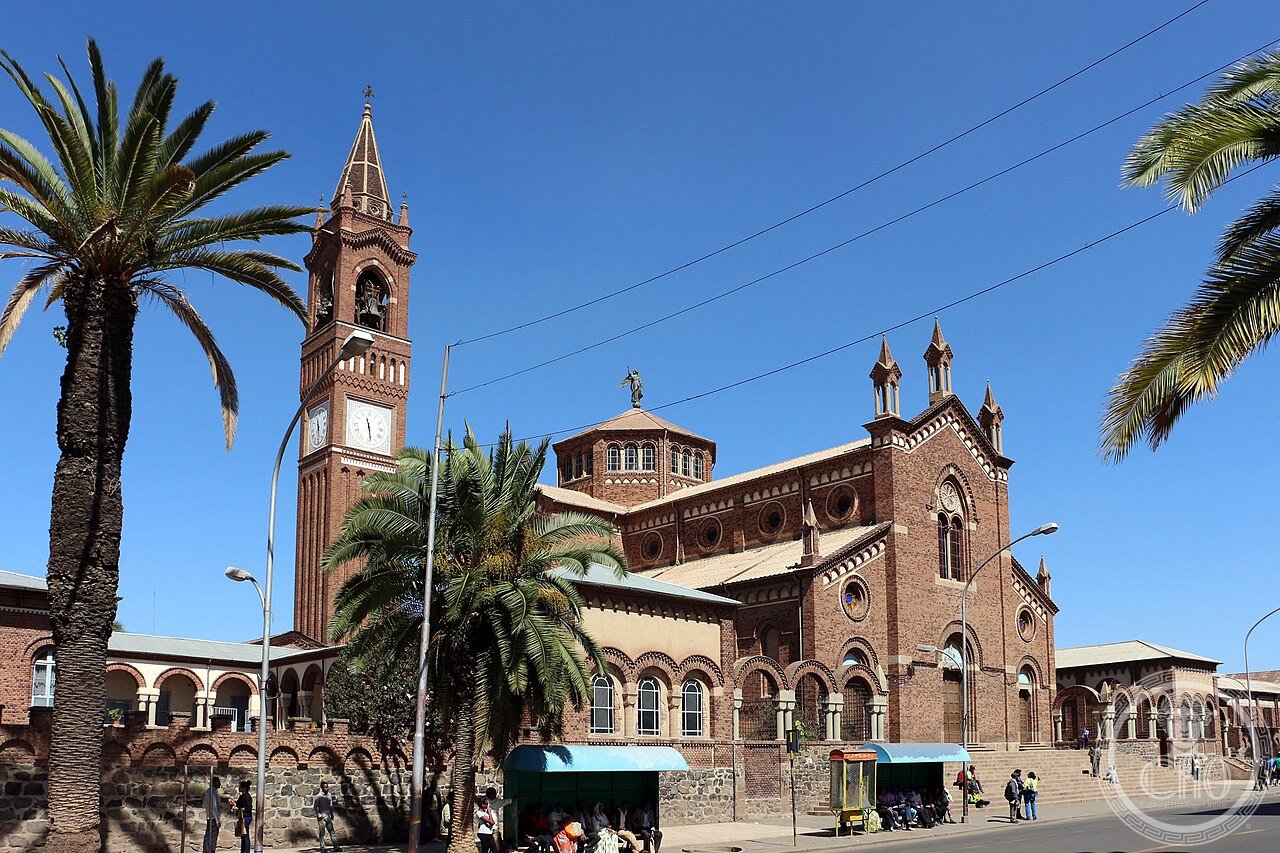
In Asmara, capital of Eritrea, the Church of the Blessed Virgin of the Rosary was built by the Italian colonial authorities for the fast-growing community of Italian settlers. It served as the principal church of the apostolic vicariate of Eritrea. Work began in June 1921 and was completed in September 1923, with the consecration on 14 October of the same year. The design was by the Milanese architect Oreste Scanavini, with the works directed by Mario Mazzetti, of Montese, in the province of Modena. Lombard Romanesque Revival in style, the church has a nave with two side aisles, a transept and three apses, measuring about 40 metres in length, 27 in width and 25 metres in height up to the lantern, which is crowned by a bronze statue commonly identified as the archangel Gabriel, although some sources suggest it may be Michael. The bell tower, about 52 metres tall, was completed according to Wikipedia in 1925, though other sources give 1928, a discrepancy that remains unresolved. According to some tourist sources not cross-checked against primary ones, the eight bells that form an octave were cast from the bronze of Austro-Hungarian cannon captured in the First World War, the largest weighing 3.8 tonnes. An isolated source attributes the altarpiece of the high altar, showing the Assumption of Mary, to the painter Carlo Maratta (1625-1713), and describes it as a gift of King Victor Emmanuel III, a suggestive claim but unverified elsewhere, to be treated with caution. Asmara was nicknamed «Little Rome» during the Italian colonial building boom of the thirties, which led to the inscription of the city on the UNESCO World Heritage List in 2017 as «Asmara: a Modernist African City». The church, which precedes that modernist period (1935-1941) by more than a decade, falls within it as a pre-existing historic building inside the protected urban fabric, without any specific mention in the text of the UNESCO decision, which could not be consulted directly during this research. It was the principal church of the apostolic vicariate of Eritrea from 1923. On 21 December 1995, with the reorganisation of the ecclesiastical circumscription, the status of cathedral passed to the Kidane Mehret Cathedral, of Ethiopian rite, while this building is today technically a parish church of the Eritrean Catholic archeparchy of Asmara, though the inhabitants still commonly call it «the cathedral». The archeparchy was raised from eparchy to metropolitan archeparchy by Pope Francis in January 2015. No pope has ever visited Eritrea.
About the Church of Our Lady of the Rosary
In Asmara, the capital of Eritrea, the Church of Our Lady of the Rosary was built by Italian colonial authorities to serve the rapidly growing Italian settler community and as the principal church of the Apostolic Vicariate of Eritrea; work began in June 1921 and was completed in September 1923, with consecration following on 14 October that year. The design was by Milanese architect Oreste Scanavini, with construction overseen by Mario Mazzetti of Montese, in the province of Modena.
Key facts
- June 1921-September 1923: built by Italian colonial authorities.
- 14 October 1923: consecrated as the principal church of the Apostolic Vicariate of Eritrea.
- ~52-metre bell tower, completed in either 1925 or 1928 depending on the source.
- 2017: falls within the UNESCO-inscribed historic core of “Asmara: A Modernist African City”
- 21 December 1995: loses canonical cathedral status to Kidane Mehret Cathedral, though still popularly called “the cathedral”
- January 2015: the Eritrean Catholic Archeparchy of Asmara elevated to metropolitan status.
History
Built in the early 1920s, over a decade before the modernist architectural boom that made Asmara “Piccola Roma” and later earned it UNESCO World Heritage status, the Church of Our Lady of the Rosary is a historicist Romanesque-revival landmark within a city otherwise celebrated for rationalist and Art Deco design. Its own canonical status has quietly shifted since 1995, when cathedral rank passed to the Eastern-rite Kidane Mehret Cathedral elsewhere in the city — a technical distinction most Asmarinos and visitors continue to overlook, still calling this building simply “the cathedral.”
What you see
A Lombard-Romanesque nave with two side aisles, a transept and three apses rises to a lantern topped by a bronze angel, beside a freestanding bell tower roughly 52 metres tall. Inside, the high altar’s painting of the Assumption of Mary is attributed by one source to the Baroque painter Carlo Maratta, though this attribution remains unverified elsewhere and should be treated as a local tradition rather than a settled fact.
Practical information
- Opening hours: generally open daily outside services; check current hours before visiting.
- Address: central Asmara, Eritrea.
Getting there
The church stands in central Asmara, within easy walking distance of the city’s main historic thoroughfares. GPS: 15°20′12″N, 38°56′16″E.
Nearby
- Central Asmara historic core — the UNESCO-inscribed modernist and colonial-era district surrounding the church.
Sources
- Wikipedia — “Church of Our Lady of the Rosary, Asmara” and “Asmara” (en.wikipedia.org).
- Wikipedia — “Eritrean Catholic Archeparchy of Asmara” (en.wikipedia.org).
- Catholic-Hierarchy.org — Archeparchy of Asmara.
Find it on the map
See this place and what’s around it →
📷 Become a Cultural Heritage Online photographer
Share your photos of places: they stay published under your name as the author. The more they're seen, the more you get noticed — and soon a contest will reward the most appreciated photos.
Log in or sign up free to add a photo