
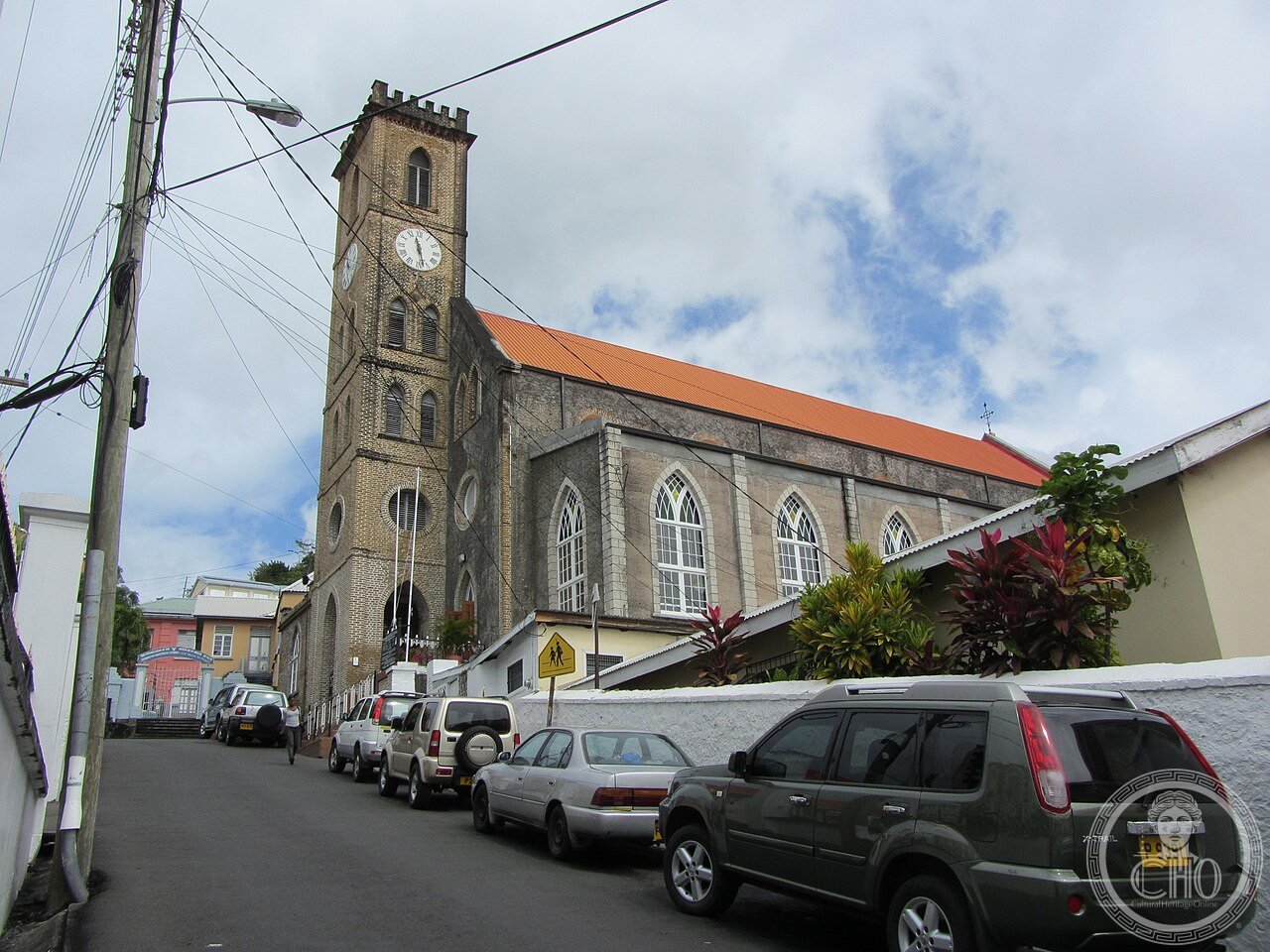
In St. George’s, the capital of Grenada, the first Catholic Mass in the area known as «Lagoon» was celebrated in 1650, and in 1656 a French Dominican friar, Du Tertre, described a small church of reeds and palm leaves. A second church was blessed on 10 September 1690, on the site of today’s Anglican church of St. George’s. A third church, dedicated to St. James, was completed in 1804, with a spire. The Gothic tower dates from 1818, while a new church, begun in 1840 and completed in 1848, was rededicated to St. James in Gothic Revival style. The sources describe the building as «completely finished» in 1884. In 1901 the English Dominicans took over the running of the parish, adding the chapel of the Madonna and that of St Joseph, while later Bishop Justin Field added the chapel of the Blessed Sacrament. This sequence, as reported by the available sources, is neither fully linear nor entirely verified, and no source names a specific architect or a single commissioner. In Gothic Revival style, with pointed-arch windows and doors, high ceilings and large buttresses, the cathedral stands on top of a hill overlooking the harbour, with a tower about 30 metres high whose bells and clock sound every quarter of an hour. Grenada was a French colony from 1649, and for more than a century Catholicism shaped the religious life of the island, for the white settlers and for most of the enslaved population alike. Ceded to Great Britain by the treaty of Paris of 1763, the island at first saw its French Catholic landowners admitted to the colonial assembly despite the British Test Act, a privilege described as without precedent in the British empire. A later anglicisation then led to the seizure of the French Catholic churches and to the loss of political rights for the Catholic population. The diocese of St. George’s-in-Grenada was erected on 20 February 1956, separated from the archdiocese of Port of Spain in Trinidad, with the cathedral of the Immaculate Conception as its seat. Hurricane Ivan, in September 2004, tore off the entire roof of the building, leaving only the bell tower intact. The cathedral stood empty, roofless and damaged for about a decade, before a restoration carried out by the practice SRM Architects of Barbados, which made a structural survey in the absence of original plans, restored the gallery and reworked the layout of the ground floor with new columns to improve the view of the pulpit. Today the cathedral is described as fully restored and open to residents and visitors. A claim that Pope John Paul II visited Grenada in 1987 finds no support in the official list of his pastoral journeys and should be regarded as probably mistaken. The episcopal seat is at present vacant: Monsignor Clyde Martin Harvey ended his term on 9 June 2026, with Archbishop Gabriel Malzaire as apostolic administrator from that date. No formal listing of the cathedral in the heritage register of the Grenada National Trust appears in the sources consulted.
About the Co-Cathedral of the Immaculate Conception
In St. George’s, the capital of Grenada, the first Catholic Mass in the area known as “Lagoon” was celebrated in 1650, with a French Dominican friar, Du Tertre, describing a small church of reeds and palm leaves in 1656; a second church was blessed on 10 September 1690, on the site of today’s Anglican Church of St. George’s. A third church, dedicated to St. James, was completed in 1804 with a spire; the Gothic tower dates to 1818, and a new church, begun in 1840 and completed in 1848, was rededicated to St. James in Gothic Revival style, with sources describing the building as “completely finished” by 1884. No source names an architect or a single commissioner for the building.
Key facts
- 1650: the first Catholic Mass celebrated near the cathedral’s future site.
- 1840-1848 (Gothic Revival): the church rebuilt, described as “completely finished” by 1884.
- 20 February 1956: the Diocese of St. George’s-in-Grenada erected, this church becomes its cathedral.
- September 2004: Hurricane Ivan strips off the entire roof, leaving only the bell tower intact.
- ~2004-c.2014: the cathedral stands roofless and damaged for roughly a decade.
- 9 June 2026: the see becomes vacant, with Archbishop Gabriel Malzaire named Apostolic Administrator.
History
Built up over more than two centuries of successive churches on or near the same site, the Co-Cathedral of the Immaculate Conception carries the layered religious history of a colony that passed from French to British rule, its Catholic population briefly gaining unprecedented political rights before a later wave of Anglicization stripped them away. Hurricane Ivan’s 2004 destruction — a storm that damaged or destroyed the roofs of an estimated 80-90 percent of buildings across Grenada — left the cathedral roofless for roughly a decade, its eventual restoration complicated by the total absence of surviving original architectural plans.
What you see
A Gothic Revival cathedral with pointed-arch windows and doors, tall ceilings and large buttresses stands atop a hill overlooking St. George’s harbor, its roughly 30-metre tower chiming bells and a clock every quarter hour. Restored by Barbados-based SRM Architects after Hurricane Ivan destroyed its roof, the interior’s ground floor was reworked with new columns to improve sightlines to the pulpit, since no original building plans survived to guide a like-for-like reconstruction.
Practical information
- Opening hours: generally open daily outside services; check current hours before visiting.
- Address: Church Street, next to York House, St. George’s, Grenada.
Getting there
The cathedral stands on Church Street atop a hill overlooking the harbor of St. George’s, easily reached on foot from the city’s waterfront. GPS: 12°03′12″N, 61°45′08″W.
Nearby
- St. George’s Harbour (the Carenage) — the historic harbor below the cathedral hill.
Sources
- Wikipedia — “Immaculate Conception Cathedral, St. George’s” (en.wikipedia.org).
- “Becoming Catholic: religion and society in colonial Grenada, 1763-1838” — PhD thesis, University of Glasgow.
- NOW Grenada — “Hurricane Ivan: 7 September 2004”
- Diocese of St. George’s-in-Grenada — official site (catholicgnd.org).
Find it on the map
See this place and what’s around it →📷 Become a Cultural Heritage Online photographer
Share your photos of places: they stay published under your name as the author. The more they're seen, the more you get noticed — and soon a contest will reward the most appreciated photos.
Log in or sign up free to add a photo