
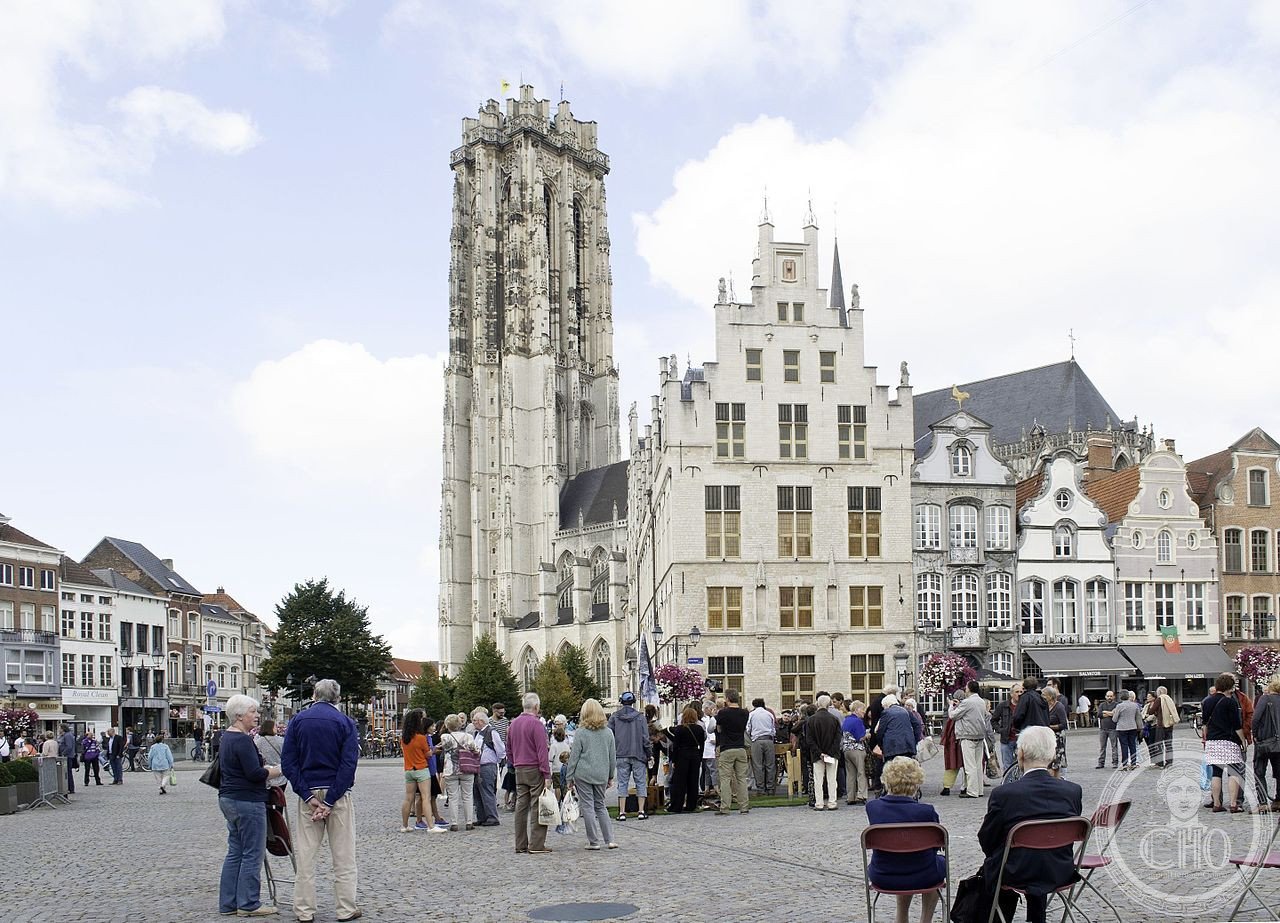
Built between 1200 and 1520 and dedicated to Saint Rumbold, patron of Mechelen — a missionary and martyr whom tradition says was killed by two men after he accused them of their sins — the cathedral was consecrated in 1312 and raised to an episcopal see in 1559. Its tower, today 97 metres high, was meant to reach 167 metres and become the tallest church spire in the world, but the work stopped in the early sixteenth century for lack of funds. According to legend, in 1583 the stones already cut to finish the spire were carried to Zeeland to build the defensive walls of the town of Willemstad. In 1985, visiting the cathedral, Pope John Paul II remarked simply: “Your tower is not complete”.
About St Rumbold’s Cathedral
St Rumbold’s Cathedral in Mechelen was constructed over more than three centuries, between 1200 and 1520, and is dedicated to Saint Rumbold, the patron saint of the city, a missionary and martyr whose remains are traditionally believed to rest within the cathedral itself. According to legend, Rumbold was murdered by two men after he confronted them over their sins; a four-metre Baroque sculpture inside the cathedral depicts him triumphantly holding a missionary cross and crosier, with symbolic figures representing his murderers positioned at his feet. The church was consecrated in 1312 and formally elevated to cathedral status in 1559. Its single most distinctive and famous feature is its dramatically unfinished tower: rising to 97 metres today, the tower was originally intended to reach a full 167 metres, which would have made it the tallest church spire anywhere in the world at the time. Construction of the upper portion was abandoned in the early 16th century, not due to any technical or structural problem, but purely because of financial constraints facing the project. According to a persistent local legend, the stones already cut and prepared to complete the spire were instead transported to the region of Zeeland in 1583 and used to help build the defensive walls surrounding the town of Willemstad. The tower’s permanently unfinished state became famous enough that Pope John Paul II, visiting the cathedral in 1985, is said to have remarked simply: “Your tower is not complete.” The tower today houses two full carillons of 49 bells each, ringing out across Mechelen every hour; the city became a world centre for the art of carillon playing when city carillonneur Jef Denyn established the world’s first dedicated carillon school here in 1922, which remained the only institution of its kind anywhere until a second school opened in the Netherlands in 1953.
Key facts
- 1200-1520: cathedral constructed over more than three centuries
- 1312: church consecrated
- 1559: elevated to cathedral status
- 97 m: the tower’s actual completed height, against a planned 167 m
- Early 16th century: tower construction halted due to lack of funds
- 1583 (legend): prepared stones reportedly repurposed for the walls of Willemstad, Zeeland
- 1922: world’s first carillon school founded in Mechelen by Jef Denyn
- 1985: Pope John Paul II remarks on the tower’s unfinished state during his visit
History
The cathedral’s centuries-long construction timeline, spanning from 1200 to 1520, reflects the scale of ambition invested by medieval Mechelen — briefly one of the most important political and administrative centres of the Burgundian Netherlands — in a tower project intended to surpass every other church spire in Europe, an ambition ultimately defeated by economics rather than engineering. The tower’s permanently arrested state has, somewhat paradoxically, become as much a defining civic symbol of Mechelen as a completed spire might have been, a monument to unrealised ambition that draws pointed observation from visitors ranging from ordinary tourists to a visiting pope.
Mechelen’s emergence as the world centre of carillon music, formalised through Jef Denyn’s founding of the first dedicated carillon school in 1922, gave the cathedral’s substantial but unfinished tower a second, entirely musical significance independent of its original architectural ambitions, cementing the building’s central role in the city’s cultural identity regardless of its incomplete silhouette.
What you see
The cathedral’s Brabantine Gothic tower dominates Mechelen’s skyline at 97 metres, its flat, unfinished summit visibly truncated where the planned upper stages toward 167 metres were never built. Inside, Baroque decoration includes the four-metre sculpture of Saint Rumbold triumphant over his murderers, while the tower itself houses two 49-bell carillons that continue to ring hourly across the city.
Practical information
- Opening hours: generally open daily with seasonal variation; tower climbs available separately, admission fee applies; check current hours before visiting
- Address: Grote Markt, 2800 Mechelen, Belgium
Getting there
St Rumbold’s Cathedral stands on the Grote Markt in the historic centre of Mechelen, roughly midway between Brussels and Antwerp, reachable by train to Mechelen station and a short walk. GPS: 51.0289° N, 4.4790° E.
Nearby
- Grote Markt — Mechelen’s historic main square, immediately adjacent
- Antwerp — major Belgian city, a short train ride north
- Brussels — Belgium’s capital, a short train ride south
Sources
- Wikipedia — “St. Rumbold’s Cathedral” (en.wikipedia.org)
- Atlas Obscura — “St. Rumbold’s Cathedral in Mechelen” (atlasobscura.com)
- Visit Mechelen — “St. Rumbold’s Cathedral” (visit.mechelen.be)
Find it on the map
See this place and what’s around it →📷 Become a Cultural Heritage Online photographer
Share your photos of places: they stay published under your name as the author. The more they're seen, the more you get noticed — and soon a contest will reward the most appreciated photos.
Log in or sign up free to add a photo