
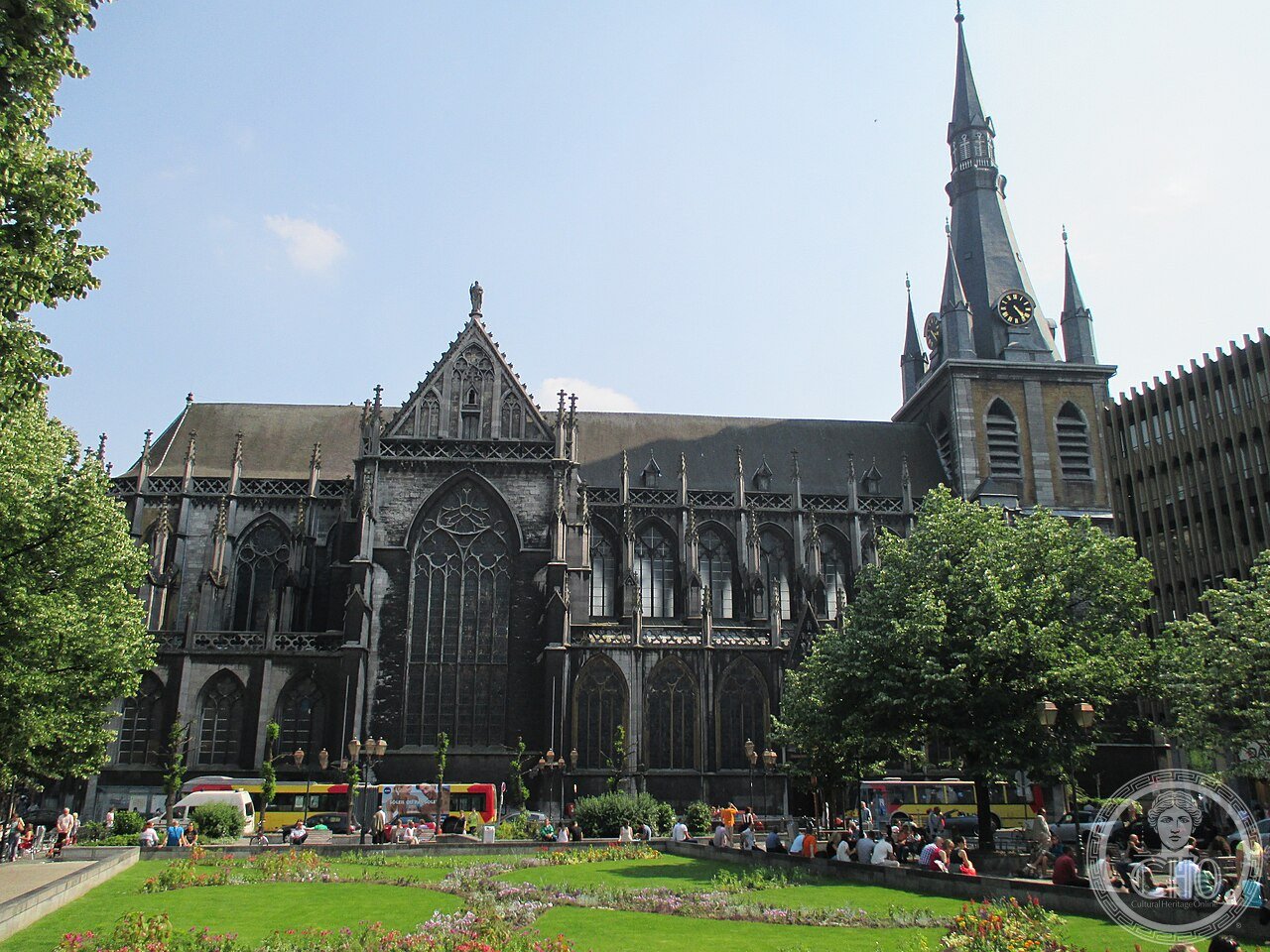
Until 1794 Liège possessed in Saint Lambert’s Cathedral one of the largest Gothic buildings in northern Europe: 96 metres long (173 including the cloisters), 37 wide with its side chapels, almost 30 metres to the vault, comparable in style to Notre-Dame in Paris. The revolutionaries of the Liège Revolution saw it as the symbol of the power of the prince-bishops who had governed the city for centuries: the demolition, decided in 1793, began in 1794 by stripping the roof of its lead to make arms and ammunition, went on with the felling of the towers only in 1803, and ended with the levelling of the ground in 1827 — 33 years of systematic erasure. In its place the former collegiate church of Saint Paul was raised to cathedral in 1802, receiving in 1805 the organs of the old Collegiate of Saint Peter and much of the surviving treasure of Saint Lambert’s.
About Liège Cathedral
Liège Cathedral, dedicated to Saint Paul, was originally founded in the 10th century and substantially rebuilt across the 13th to 15th centuries, later restored again in the mid-19th century. For most of its history, however, the church served merely as a collegiate church, standing in the shadow of Liège’s true cathedral: Saint Lambert’s Cathedral, one of the largest cathedrals anywhere in Northern Europe, measuring some 96 metres in length (173 metres including its cloisters), 37 metres wide across its side chapels, and roughly 30 metres high to the top of its vault — comparable in style, if not quite in scale, to Notre-Dame de Paris. Saint Lambert’s held the saint’s own relics, reinstalled there in 1197 following an earlier fire, and served for centuries as the seat of the powerful Prince-Bishopric of Liège. During the anti-clerical fervour of the French Revolution, following the Liège Revolution of 1789, the cathedral came to be seen by revolutionaries as a direct symbol of the temporal power wielded by the prince-bishops, and its destruction, already agreed the previous year, formally began in 1794 under a dedicated Commission destructive de la cathédrale. Demolition started with the stripping of lead from the roof, repurposed for the manufacture of arms and munitions, but the process dragged on for decades: the cathedral’s towers were not finally pulled down until 1803, and the site was not fully levelled until 1827 — a full 33 years after the demolition first began. In the aftermath, the former collegiate church of Saint Paul was elevated to cathedral status in 1802, formally replacing Saint Lambert’s; in 1805, the organs from the old Collégiale Saint-Pierre de Liège, along with most of the surviving treasures rescued from Saint Lambert’s Cathedral, were transferred into the newly promoted building, where a treasury museum in its 15th-century cloisters still preserves artwork from both the present cathedral and its vanished predecessor.
Key facts
- 10th century: present cathedral (originally a collegiate church) first founded
- 13th-15th centuries: substantial rebuilding of the church
- 1197: relics of Saint Lambert reinstalled in the earlier cathedral after a fire
- 1794-1827: Saint Lambert’s Cathedral progressively demolished by revolutionaries
- 1802: former collegiate church of Saint Paul elevated to cathedral status
- 1805: organs and surviving treasures of Saint Lambert’s transferred to the new cathedral
- Mid-19th century: present cathedral further restored
History
The deliberate, decades-long erasure of Saint Lambert’s Cathedral stands as one of the more thorough acts of revolutionary-era religious-architectural destruction anywhere in Europe, its scale and duration — nearly a third of a century from first demolition to final ground-levelling — reflecting both the cathedral’s enormous physical size and revolutionaries’ determination to eliminate every visible trace of the prince-bishops’ centuries-long temporal authority over Liège. The elevation of the comparatively modest former collegiate church of Saint Paul to replace it represents a pragmatic, almost accidental transfer of ecclesiastical status, turning what had been a secondary Liège church into the city’s new cathedral by default rather than by original design.
The transfer of Saint Lambert’s surviving organs and treasury into the new cathedral in 1805 preserved at least a fragment of continuity between Liège’s vanished medieval religious identity and its 19th-century successor, giving the present cathedral’s treasury museum an unusual role as custodian of relics and artwork from a building that itself no longer exists.
What you see
The present Gothic cathedral, dating largely to its 13th-to-15th-century rebuilding with mid-19th-century restoration work, presents a considerably smaller footprint than its vanished predecessor, its tower and facade nonetheless forming a major landmark of central Liège. The 15th-century cloisters house a treasury museum displaying artwork and liturgical objects drawn from both the present cathedral and the lost Saint Lambert’s Cathedral, whose former site nearby is now an open square.
Practical information
- Opening hours: generally open daily with seasonal variation; treasury museum has separate admission; check current hours before visiting
- Address: Rue Bonne Fortune 6, 4000 Liège, Belgium
Getting there
Liège Cathedral stands in the historic centre of Liège, in Belgium’s Wallonia region, reachable by train to Liège-Guillemins station followed by a short walk or tram ride. GPS: 50.6401° N, 5.5715° E.
Nearby
- Place Saint-Lambert — the former site of the demolished Saint Lambert’s Cathedral, nearby
- Palace of the Prince-Bishops — former seat of Liège’s prince-bishops, on Place Saint-Lambert
- Liège-Guillemins railway station — the city’s main station, a short tram ride away
Sources
- Wikipedia — “Liège Cathedral” (en.wikipedia.org)
- Wikipedia — “Saint Lambert’s Cathedral, Liège” (en.wikipedia.org)
- VisitWallonia — “Saint Paul’s Cathedral (Liège)” (visitwallonia.com)
Find it on the map
See this place and what’s around it →📷 Become a Cultural Heritage Online photographer
Share your photos of places: they stay published under your name as the author. The more they're seen, the more you get noticed — and soon a contest will reward the most appreciated photos.
Log in or sign up free to add a photo