

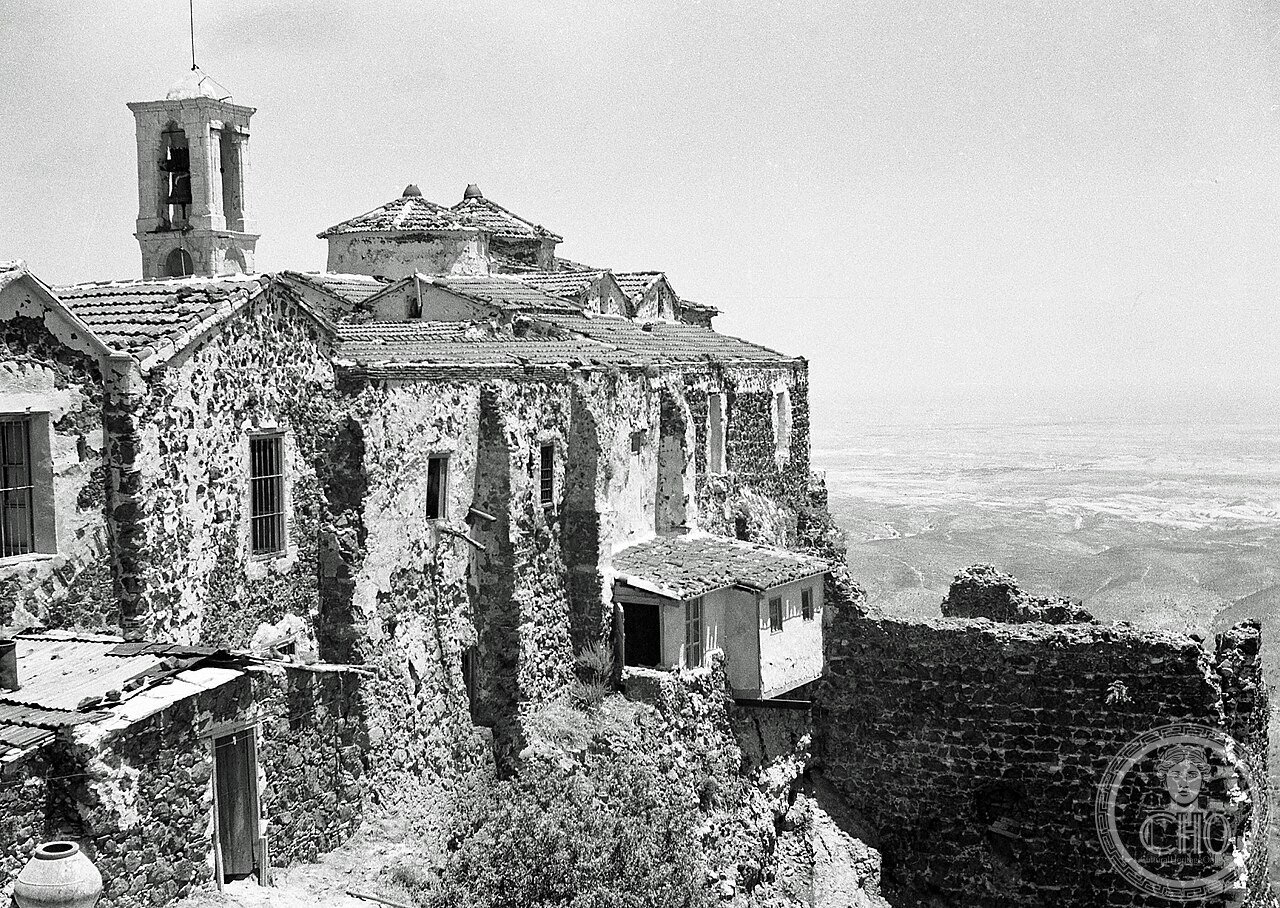
According to tradition, Saint Helena, mother of the emperor Constantine, stopped in Cyprus around AD 327–329 on her way back from Jerusalem, where she had had the fragments of the True Cross dug up, bound for Constantinople. A shipwreck forced an unplanned stay on the island; according to the religious account, a piece of the cross moved miraculously during the night to the top of a high hill, from which an intense light shone. After several failed attempts to bring it back down, Helena decided to leave it there and built a small chapel to hold it, giving rise to the oldest documented monastery on the island. The name Stavrovouni comes from the Greek stavros (cross) and vouno (mountain): “the mountain of the Cross”. To this day, as on Mount Athos, women are forbidden to enter the monastery.
About Stavrovouni Monastery
Stavrovouni Monastery was founded by Saint Helena, mother of Constantine the Great, and traditionally dated to around 327-329 CE, making it the earliest documented monastery anywhere on Cyprus, with the oldest surviving written reference confirming the site’s importance as a religious centre stretching back to the 4th century. According to tradition, Helena stopped in Cyprus while returning from Jerusalem, where she had overseen the excavation of fragments believed to be the True Cross on which Jesus was crucified, intending to carry these relics onward to Constantinople. An involuntary stop caused by a shipwreck brought her to the island, and religious tradition holds that during her stay, one of the cross fragments was miraculously transported overnight to the summit of a high hill, with a powerful light said to emanate continuously from the peak. After several unsuccessful attempts to remove the cross fragment from the mountain, Helena chose instead to leave it there permanently, building a small chapel to house and protect it — the origin of the monastery that still stands on the same mountaintop today. The monastery’s name, Stavrovouni, combines the Greek words stavros (“cross”) and vouno (“mountain”), meaning “the Mountain of the Cross.” Alongside the True Cross fragment itself — today housed in a large, silver, cross-shaped reliquary — tradition holds that Helena also left several further relics at the monastery, including a fragment identified as the Cross of the Good Thief crucified alongside Jesus, one of the Holy Nails, and a portion of rope said to have bound Jesus to the Cross. In keeping with monastic traditions closely paralleling those of Mount Athos in Greece, women are strictly prohibited from entering Stavrovouni Monastery, though female visitors may light a candle at a chapel dedicated to Saint Barbara located at the monastery’s entrance.
Key facts
- c. 327-329 CE: monastery founded by Saint Helena, mother of Constantine the Great
- Tradition: a fragment of the True Cross miraculously relocates to the mountaintop
- Relics: fragment of the True Cross, the Cross of the Good Thief, a Holy Nail, and rope relics
- Name origin: Greek “stavros” (cross) + “vouno” (mountain)
- Status: earliest documented monastery on Cyprus
- Access rule: women prohibited from entering, as at Mount Athos
History
As the earliest documented monastic foundation on Cyprus, directly attributed to Saint Helena’s own return journey from her celebrated excavation of the True Cross in Jerusalem, Stavrovouni occupies a foundational place in the island’s Christian history stretching back to the very earliest years of Constantine’s Christianised Roman Empire. The monastery’s continuous religious use across roughly seventeen centuries, through Byzantine, Frankish, Venetian, and Ottoman rule, has made it a persistent symbol of unbroken Cypriot Orthodox monastic tradition despite the island’s frequently shifting political control.
Stavrovouni’s strict enforcement of Mount Athos-style monastic rules, including the prohibition on women entering the grounds and restrictions on photography, situates it within a small group of Orthodox monasteries worldwide maintaining some of the most rigorous traditional access rules still practised today, a discipline the monastery’s resident monks treat as inseparable from the sanctity of the relics they guard.
What you see
The monastery crowns the summit of Stavrovouni mountain, its whitewashed walls and modest domed chapel visible for a considerable distance across the surrounding Larnaca District landscape. Inside, the large silver cross-shaped reliquary housing the fragment of the True Cross forms the monastery’s central devotional focus, alongside the further relics traditionally attributed to Saint Helena’s original visit.
Practical information
- Opening hours: limited hours, generally mornings and early evenings, with a midday closure; women not permitted entry; photography prohibited; check current hours before visiting
- Address: Stavrovouni, Larnaca District, Cyprus, near the village of Pyrga
Getting there
Stavrovouni Monastery sits atop a mountain near Pyrga in the Larnaca District, roughly midway between Larnaca and Nicosia, reachable by a winding mountain road best travelled by car. GPS: 34.8864° N, 33.4357° E.
Nearby
- Pyrga — village at the foot of the mountain, with the medieval Royal Chapel of Pyrga
- Larnaca — coastal city with the Church of Saint Lazarus, a short drive away
- Nicosia — Cyprus’s capital, reachable via the same central route
Sources
- Wikipedia — “Stavrovouni Monastery” (en.wikipedia.org)
- Visit Cyprus — “Stavrovouni Monastery” (visitcyprus.com)
- Cyprus Cross Path — “Stavrovouni Monastery” (cypruscrosspath.com)
Find it on the map
See this place and what’s around it →📷 Become a Cultural Heritage Online photographer
Share your photos of places: they stay published under your name as the author. The more they're seen, the more you get noticed — and soon a contest will reward the most appreciated photos.
Log in or sign up free to add a photo