

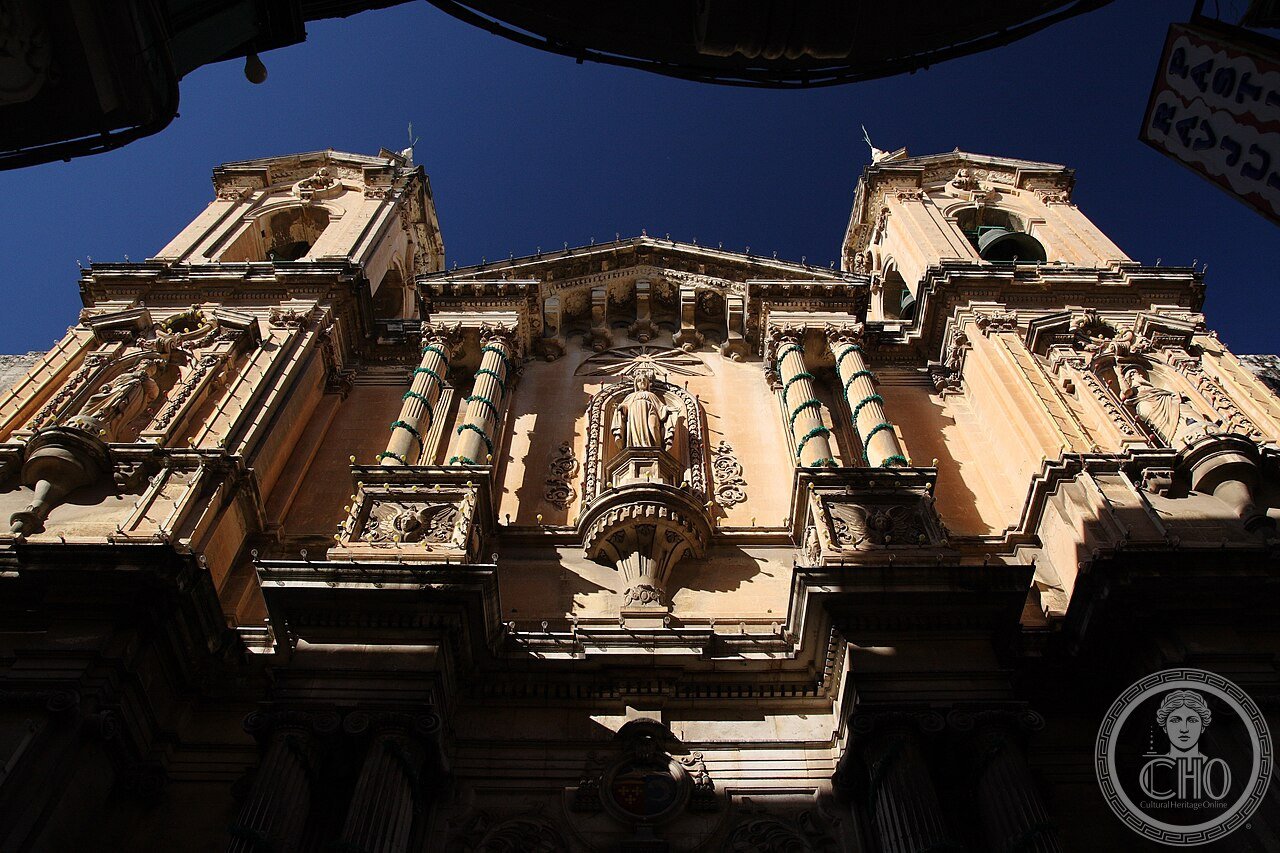
The church dedicated to St Paul’s shipwreck on Malta dates from the 1570s; the design was entrusted to the architect Girolamo Cassar and the building was completed in December 1582. Inside it holds two relics of extraordinary importance: the bone of the apostle Paul’s right wrist, whose authenticity was first certified on 26 September 1771 by Archbishop Monsignor Giovanni Pellerano and confirmed again in 1822 by a papal assistant in Rome, who resealed it for veneration; and a fragment of one of the four columns of the table on which the apostle was beheaded in Rome in AD 64, given to the church by Pope Pius VII in 1818 in recognition of the collegiate chapter’s services during the plague epidemic of 1813. The titular wooden statue of Saint Paul, carved in 1659 by Melchiorre Cafà — brother of Lorenzo Gafà, the architect of the dome — is still carried in procession through the streets of Valletta on 10 February, the feast of St Paul’s shipwreck.
About the Church of St Paul’s Shipwreck
The Church of St Paul’s Shipwreck in Valletta traces its origins to the 1570s, designed by the architect Girolamo Cassar and completed in December 1582. The church was later ceded to the Jesuit Fathers, and a further new church building was begun in 1639; the present facade was rebuilt in 1885 to designs by Nicholas Zammit. The church’s greatest significance lies in the two extraordinary relics it preserves, both directly connected to the Apostle Paul himself. The first is a relic of Paul’s own right wrist bone; its authenticity was first formally certified on 26 September 1771 by Archbishop Monsignor Fra Giovanni Pellerano, and reconfirmed in 1822 by a papal assistant in Rome, who resealed the relic for continued veneration. The second is a fragment of one of the four marble pillars, or table legs, upon which Paul is traditionally said to have been beheaded in Rome in 64 CE — a relic donated to the church by Pope Pius VII himself in 1818, in direct recognition of the services rendered by the church’s collegiate chapter during Malta’s devastating plague outbreak of 1813. Among the church’s other significant artistic treasures is the wooden titular statue of Saint Paul, carved in 1659 by the sculptor Melchiorre Cafà, brother of Lorenzo Gafà, the architect responsible for the church’s dome. This statue continues to be carried in procession through the streets of Valletta each year on 10 February, the Feast of St Paul’s Shipwreck, one of the most significant dates in the Maltese religious calendar, commemorating the tradition that Paul himself was shipwrecked on Malta around 60 CE while being transported as a prisoner to Rome.
Key facts
- 1570s-December 1582: church built, designed by Girolamo Cassar
- 1639: a new church building begun after the site passed to the Jesuits
- 1885: present facade rebuilt to designs by Nicholas Zammit
- Relic: Saint Paul’s own right wrist bone, certified authentic in 1771 and 1822
- Relic: fragment of the pillar on which Paul was beheaded in Rome in 64 CE, donated by Pope Pius VII in 1818
- 1659: titular wooden statue of Saint Paul carved by Melchiorre Cafà
- 10 February: Feast of St Paul’s Shipwreck, statue paraded through Valletta
History
The church’s possession of two relics directly connected to the physical body and death of the Apostle Paul — his wrist bone and a fragment of his execution pillar — places it among a select group of European churches holding tangible material relics of the apostles themselves, giving Valletta a religious significance disproportionate to the city’s modest size. Pope Pius VII’s 1818 gift of the execution-pillar relic, made explicitly in gratitude for the church’s charitable role during the catastrophic 1813 plague outbreak, illustrates the direct connection between a religious community’s charitable service during crisis and the elevated ecclesiastical recognition it could subsequently receive from Rome.
Melchiorre Cafà’s 1659 titular statue of Saint Paul, still central to the annual Feast of St Paul’s Shipwreck procession, connects the church’s relics directly to Malta’s broader foundational Christian narrative — the tradition of Paul’s own shipwreck on the island around 60 CE — making 10 February one of the most significant dates in the entire Maltese religious and civic calendar.
What you see
The church’s facade, rebuilt in 1885 to designs by Nicholas Zammit, stands within Valletta’s dense historic urban fabric, its dome the work of architect Lorenzo Gafà. Inside, the reliquaries housing Paul’s wrist bone and the execution-pillar fragment form the church’s principal devotional focus, alongside Melchiorre Cafà’s 1659 titular statue of the saint, carried through Valletta’s streets each 10 February.
Practical information
- Opening hours: generally open daily with seasonal variation; check current hours before visiting
- Address: Triq Santa Luċija, Il-Belt Valletta VLT 1185, Malta
Getting there
The Church of St Paul’s Shipwreck stands in the historic centre of Valletta, Malta’s capital, easily reachable on foot from the city gate and Republic Street. GPS: 35.8974° N, 14.5139° E.
Nearby
- St John’s Co-Cathedral — the city’s principal cathedral, a short walk away
- Grandmaster’s Palace — former seat of the Order’s government, nearby
- Republic Street — Valletta’s main thoroughfare, adjacent
Sources
- Wikipedia — “Collegiate Parish Church of St Paul’s Shipwreck” (en.wikipedia.org)
- Atlas Obscura — “Of Shipwrecks and Wrist Bones: The Story of St. Paul’s Remains” (atlasobscura.com)
- Peregrinatio Sancti Pauli Apostoli — “Saint Paul’s Shipwreck Collegiate Church” (sanctipauli.mt)
Find it on the map
See this place and what’s around it →📷 Become a Cultural Heritage Online photographer
Share your photos of places: they stay published under your name as the author. The more they're seen, the more you get noticed — and soon a contest will reward the most appreciated photos.
Log in or sign up free to add a photo