
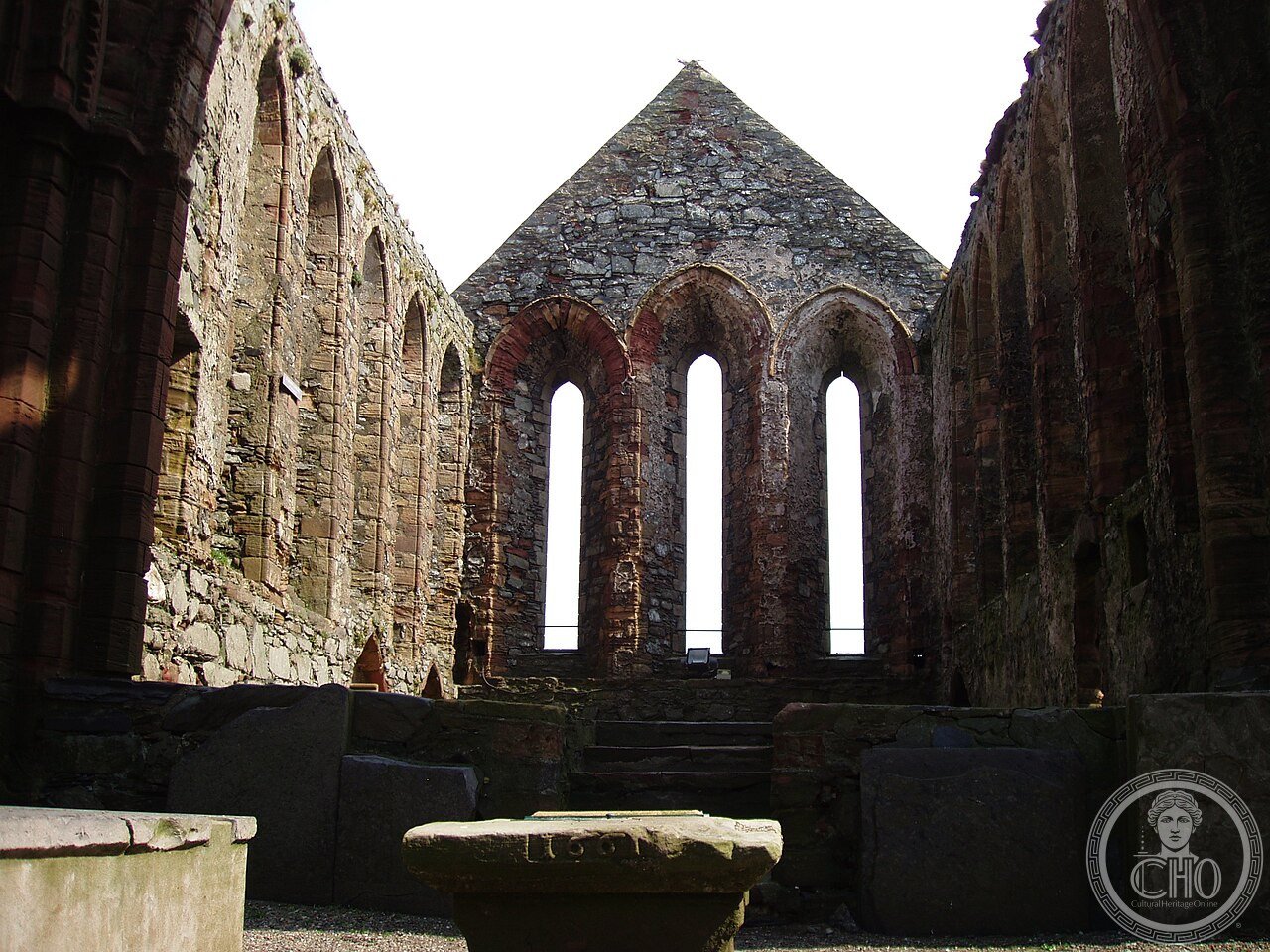
The cathedral dedicated to Saint German was built in the twelfth century within the walls of Peel Castle, on the islet of St Patrick’s Isle, when the island was still under the rule of the Norse kings; it became the seat of the diocese of Sodor and Man, but was finally abandoned during the eighteenth century. Today only the outer walls remain, roofless, with a barrel-vaulted crypt beneath the choir. Towards the end of the seventeenth century the legend of the Moddey Dhoo — “black dog” in Manx Gaelic — spread among the garrison soldiers: a spectral ghost dog that appeared every evening at dusk from an underground passage linking the guardroom to the church, lying down silently by the fire until dawn. In 1666 a soldier, made bold by drink, decided to cross that passage alone to challenge the animal: he came out terrified, his clothes in shreds, and died three days later without ever saying what he had seen. The legend of the Moddey Dhoo is considered one of the possible sources of inspiration for Arthur Conan Doyle’s “The Hound of the Baskervilles”.
About St German’s Cathedral
The Cathedral Church dedicated to St German was erected sometime in the 12th century within the walls of Peel Castle, on St Patrick’s Isle just off the town of Peel on the Isle of Man, during the period when the island lay under the rule of Norse kings, including Magnus Barefoot, who had built the surrounding castle in the 11th century. The cathedral served for centuries as the seat of the Diocese of Sodor and Man, one of the ancient dioceses of the British Isles, but it was ultimately abandoned during the course of the 18th century as the diocese’s needs shifted elsewhere. Today the cathedral survives only as a roofless ruin, its outer walls largely intact but its interior open to the sky, alongside a distinctive pointed barrel-vaulted crypt beneath the chancel, measuring roughly 34 by 16 feet and rising to 9 feet at its western end. The wider Peel Castle complex, developed over some seven centuries from the 11th to the 18th, also includes the ruins of St Patrick’s Church, various chapels, and a round tower dating to around 1124. The castle and cathedral ruins are inseparably associated with one of the most celebrated ghost legends in the entire Isle of Man: the Moddey Dhoo, Manx Gaelic for “black dog,” a spectral hound said to haunt the castle’s corridors and guardroom as an omen of impending doom. According to tales emerging in the late 1600s, the phantom dog would appear nightly around dusk from a subterranean passage connecting the castle’s guardroom to the church, lying silently by the fire until dawn; soldiers stationed there grew accustomed to its unsettling presence over time. The most famous episode dates to 1666, when a soldier, emboldened by drink, resolved to walk the haunted passage alone to prove his courage. He returned in a state of visible terror, his clothes torn and his face pale, and died three days later without ever speaking of what he had encountered. The Moddey Dhoo legend is counted among several black-dog folklore traditions from across the British Isles believed to have influenced Sir Arthur Conan Doyle’s celebrated novel The Hound of the Baskervilles, alongside other regional legends such as that of the Dartmoor squire Cabell.
Key facts
- 11th century: Peel Castle built by Norwegian King Magnus Barefoot
- 12th century: St German’s Cathedral built within the castle walls
- Seat of the Diocese of Sodor and Man for centuries
- 18th century: cathedral abandoned
- Crypt: pointed barrel-vaulted chamber beneath the chancel, roughly 34 x 16 feet
- Late 1600s: Moddey Dhoo ghost-dog legend emerges among the garrison
- 1666: a soldier reportedly dies three days after confronting the apparition
History
St German’s Cathedral’s origins under Norse royal patronage in the 11th-12th century situate Peel Castle within the wider medieval Kingdom of the Isles, a Norse-Gaelic maritime realm spanning the Isle of Man and the Hebrides, with the cathedral’s status as seat of the ancient Diocese of Sodor and Man reflecting the island’s distinct ecclesiastical identity straddling English, Scottish, and Scandinavian spheres of influence. Its eventual 18th-century abandonment, leaving the roofless ruin visible today, reflects the broader pattern of medieval island cathedrals losing their functional role as diocesan administration modernised and relocated to more practical locations.
The Moddey Dhoo legend, first recorded in the late 17th century and centred specifically on the passage connecting the castle guardroom to the cathedral ruins, represents one of the best-documented and most enduring black-dog ghost traditions in British folklore, its plausible influence on Arthur Conan Doyle’s Hound of the Baskervilles connecting this obscure Manx castle ruin to one of the most famous works of English detective fiction.
What you see
The cathedral’s roofless stone walls stand within the wider fortifications of Peel Castle on St Patrick’s Isle, its pointed barrel-vaulted crypt beneath the former chancel among the best-preserved individual features of the ruin. The surrounding castle complex, developed across seven centuries, includes the earlier ruins of St Patrick’s Church and a round tower dating to around 1124, together forming one of the most extensive medieval ecclesiastical and fortified sites in the Isle of Man.
Practical information
- Opening hours: generally open daily with seasonal variation, managed by Manx National Heritage; admission fee applies; check current hours before visiting
- Address: Peel Castle, West Quay, Peel, IM5 1TB, Isle of Man
Getting there
St German’s Cathedral ruins stand within Peel Castle on St Patrick’s Isle, connected by a causeway to the town of Peel on the Isle of Man’s west coast, reachable by bus or car. GPS: 54.2266° N, -4.6988° E.
Nearby
- Peel Castle fortifications — the wider medieval castle complex surrounding the cathedral
- Peel town — the historic fishing town, connected by causeway
- House of Manannan — heritage museum in Peel, nearby
Sources
- Wikipedia — “Peel Castle” (en.wikipedia.org)
- Manx National Heritage — “Peel Castle – Cashtal Phurt Ny H-Inshey” (manxnationalheritage.im)
- Transceltic — “Manx Castle Haunted By The Phantom Hound ‘Moddey Dhoo'” (transceltic.com)
Find it on the map
See this place and what’s around it →📷 Become a Cultural Heritage Online photographer
Share your photos of places: they stay published under your name as the author. The more they're seen, the more you get noticed — and soon a contest will reward the most appreciated photos.
Log in or sign up free to add a photo