
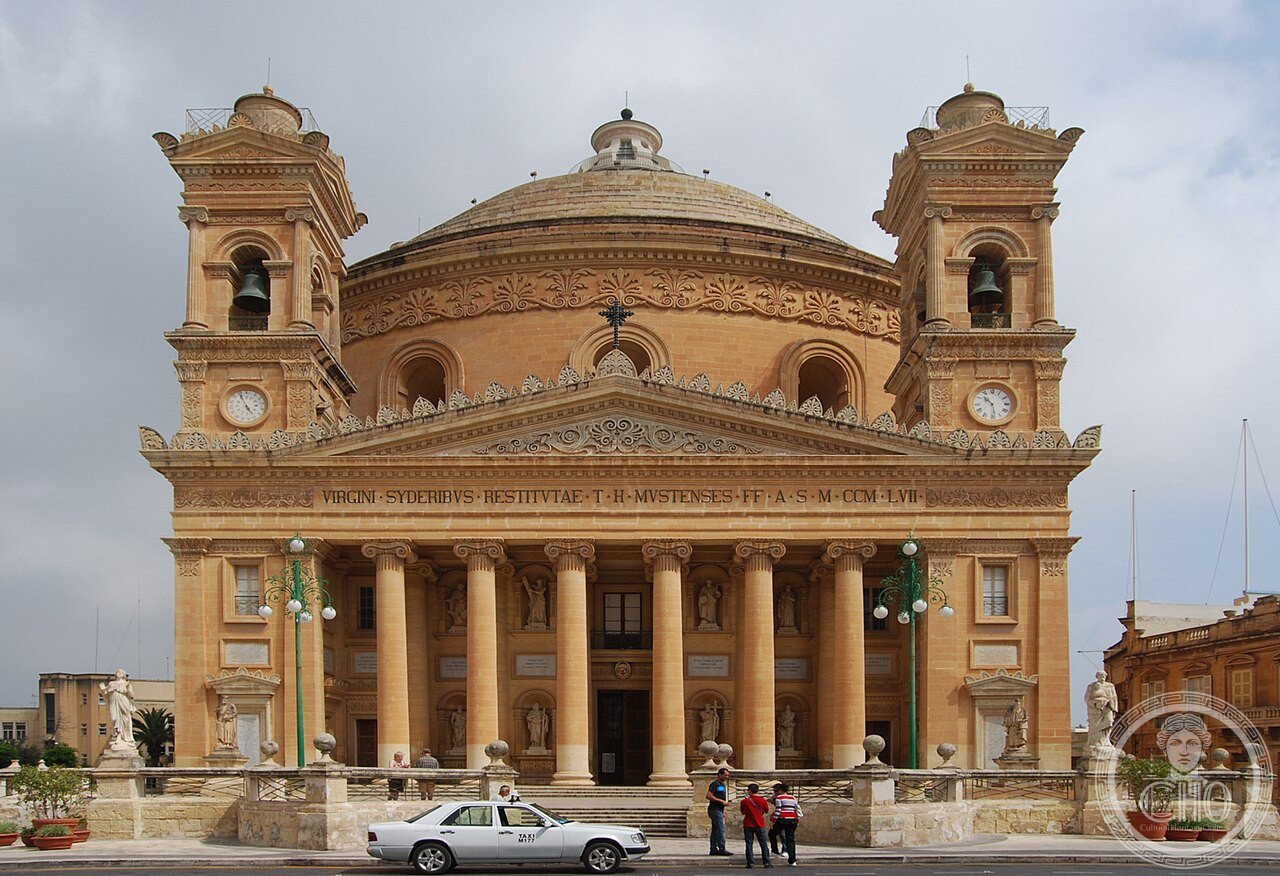
The Rotunda of Mosta, dedicated to the Assumption of Mary, was built between 1833 and 1860 to a Neoclassical design by Giorgio Grognet de Vassé, on the site of an earlier Renaissance church raised around 1614. Its dome is today the third largest in the world among those without internal supports. On 9 April 1942, during the siege of Malta in the Second World War, some 300 worshippers were gathered in the church for the four o’clock mass when a German 500-kilo bomb broke through the dome and fell inside the building, sliding across the floor between the pews. The bomb did not explode. Nobody was hurt. A bomb disposal unit of the British Royal Engineers defused it and sank it off Malta’s western coast; the islanders took the episode for a genuine miracle. Today the casing of an identical bomb is displayed in the church sacristy, a lasting reminder of that afternoon.
About the Rotunda of Mosta
The Rotunda of Mosta is a Roman Catholic parish church and basilica in the town of Mosta, Malta, dedicated to the Assumption of Mary. Built between 1833 and the 1860s to neoclassical designs by the architect Giorgio Grognet de Vasse, the church stands on the site of an earlier Renaissance-era church, itself built around 1614 to designs by Tommaso Dingli. The Rotunda’s most distinctive architectural feature is its dome, which ranks as the third-largest unsupported dome anywhere in the world, a remarkable engineering achievement for a 19th-century Maltese parish church. The building’s greatest historical fame, however, stems from a single dramatic wartime episode. On 9 April 1942, during the height of the Siege of Malta in the Second World War, roughly 300 parishioners had gathered inside the church for evening Mass at four o’clock in the afternoon when a 500-kilogram German SC demolition bomb, a thin-cased weapon, pierced directly through the dome and fell into the crowded church below. Remarkably, the bomb failed to explode, skidding harmlessly across the floor as stunned worshippers rushed for the exits; there were no casualties. A Royal Engineers bomb disposal unit was called to defuse the unexploded ordnance, which was subsequently dumped into the sea off Malta’s western coast. Given the sheer number of people present and the bomb’s evident failure to detonate despite a direct hit on a crowded building, the event was immediately and widely interpreted by the local population as a genuine miracle. Malta as a whole endured such intensive and sustained Axis bombing during the war that, by its end, the island had become, proportionally, the most heavily bombed place on earth — making the Mosta bomb’s failure to explode all the more striking within this wider context of relentless aerial attack. The casing of an identical bomb is preserved and displayed today in the church’s sacristy, a permanent physical reminder of the event.
Key facts
- 1833-1860s: present church built to neoclassical designs by Giorgio Grognet de Vasse
- c. 1614: earlier Renaissance church on the same site, designed by Tommaso Dingli
- Dome: third-largest unsupported dome in the world
- 9 April 1942: a 500 kg German bomb pierces the dome during Mass, with roughly 300 parishioners present
- Outcome: the bomb fails to explode; no casualties
- Disposal: defused by Royal Engineers and dumped at sea
- Today: an identical bomb casing is displayed in the church sacristy
History
The Rotunda’s third-largest unsupported dome represents a significant feat of 19th-century engineering ambition for a parish church on a relatively small Mediterranean island, reflecting the considerable civic and religious investment Mosta placed in its rebuilt church during this period. Malta’s status as the most heavily bombed place on earth by the end of the Second World War, a direct consequence of its strategic importance as an Allied outpost in the central Mediterranean, provides the essential wartime context for the events of 9 April 1942, when the island’s civilian population endured sustained and repeated Axis aerial attack.
The 1942 bomb’s failure to explode inside a church packed with hundreds of worshippers, at the exact moment of a direct hit through the dome, has become one of the most widely recounted “miracle” stories of the entire Mediterranean theatre of the Second World War, cementing the Rotunda of Mosta’s place in both Maltese religious memory and the island’s broader wartime historical identity.
What you see
The Rotunda’s neoclassical exterior, crowned by its immense unsupported dome, dominates the skyline of Mosta and remains visible from much of the surrounding countryside. Inside, the vast domed interior accommodates the congregation beneath the very ceiling the 1942 bomb pierced, while the sacristy displays the casing of an identical bomb as a lasting memorial to the event.
Practical information
- Opening hours: generally open daily with seasonal variation; admission fee applies for some areas; check current hours before visiting
- Address: Pjazza Rotunda, Il-Mosta MST 9042, Malta
Getting there
The Rotunda of Mosta stands in the centre of the town of Mosta, in northern Malta, reachable by bus or car from Valletta. GPS: 35.9101° N, 14.4258° E.
Nearby
- Mosta town centre — surrounding the church
- Valletta — Malta’s capital, a short drive south
- Mdina — Malta’s former capital, a short drive away
Sources
- Wikipedia — “Rotunda of Mosta” (en.wikipedia.org)
- GuideMeMalta — “Relics of WWII: Remembering ‘the bomb miracle’ of Mosta” (guidememalta.com)
- Atlas Obscura — “Rotunda of Mosta” (atlasobscura.com)
Find it on the map
See this place and what’s around it →📷 Become a Cultural Heritage Online photographer
Share your photos of places: they stay published under your name as the author. The more they're seen, the more you get noticed — and soon a contest will reward the most appreciated photos.
Log in or sign up free to add a photo