

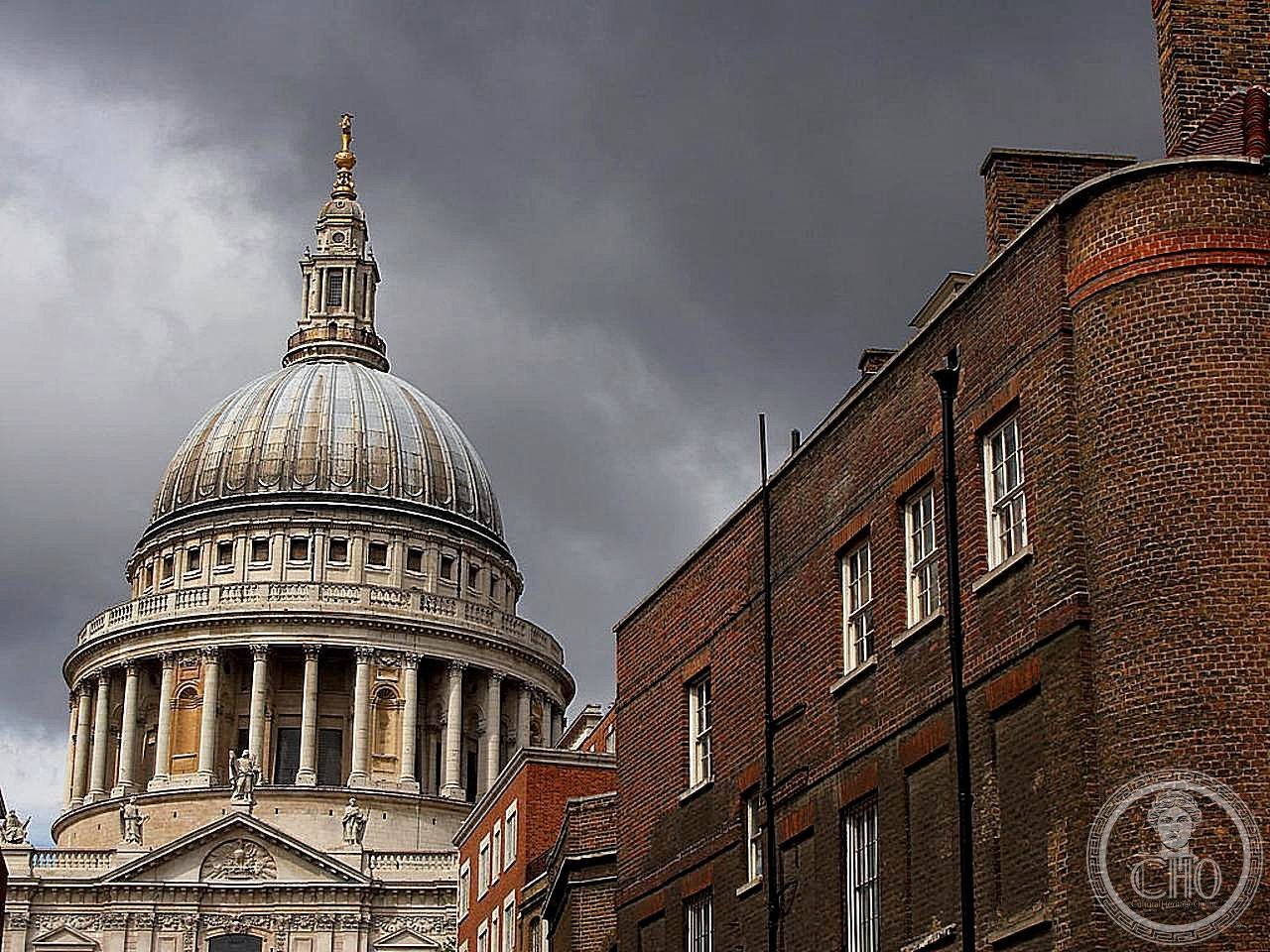
On the site of St Paul’s, in London, a cathedral has stood since 604 AD, when Mellitus was consecrated first bishop by Augustine of Canterbury. The medieval cathedral, the so-called «Old St Paul’s», was largely destroyed in the Great Fire of London of September 1666. Sir Christopher Wren was given the task of rebuilding in 1669, with a design approved in 1675. The works went on until 1710, when the son of Wren placed the last stone on the lantern of the dome, and Parliament formally declared the cathedral complete on 25 December 1711. Wren was buried in the crypt of the cathedral, where a slab bears the Latin inscription «Lector, si monumentum requiris, circumspice», that is, «Reader, if you seek his monument, look around you». The dome, 111 metres high to the cross at its summit, was among the largest in the world in its day, built with a triple-shell structure ingeniously devised by Wren. Inside it, the Whispering Gallery, reached by 259 steps, lets a whisper be heard on the other side of the gallery. During the Blitz, St Paul’s survived the German bombing thanks in part to a team of volunteer fire-watchers: the famous photograph «St Paul’s Survives», taken by Herbert Mason on the night of 29 to 30 December 1940 and published in the Daily Mail, shows it emerging intact from a blanket of smoke. Here were held the state funeral of Winston Churchill in 1965 and the wedding of Prince Charles and Lady Diana in 1981, and in the crypt rest Admiral Nelson and the Duke of Wellington.
About St Paul’s Cathedral
St Paul’s Cathedral, in London, occupies a site that has held a cathedral since 604 CE, when Mellitus was consecrated as the first bishop by Augustine of Canterbury; the medieval structure known as Old St Paul’s was largely destroyed in the Great Fire of London in September 1666. Sir Christopher Wren was assigned the task of rebuilding in 1669, his accepted design dating to 1675, with construction continuing until 1710, when Wren’s son placed the final stone atop the lantern, and Parliament formally declared the cathedral complete on 25 December 1711. Wren himself is buried in the crypt, beneath a plaque bearing the Latin inscription “Lector, si monumentum requiris, circumspice” — “Reader, if you seek his monument, look around you.” The cathedral’s dome, rising 365 feet (111 metres) to the cross at its summit, ranked among the largest in the world at the time, its ingenious triple-shell construction concealing a structural brick cone reinforced with iron chains between an inner and outer dome; inside, the Whispering Gallery, reached by 259 steps, allows a whisper spoken against its curved wall to be heard clearly on the opposite side. During the Blitz, St Paul’s survived repeated German bombing raids, aided by a dedicated volunteer fire-watch; the iconic photograph “St Paul’s Survives,” taken by Herbert Mason on the night of 29-30 December 1940 and published in the Daily Mail, captured the cathedral’s dome emerging intact from a sea of smoke, becoming one of the most reproduced images of the war. The cathedral has hosted major national events including Winston Churchill’s 1965 state funeral and the 1981 wedding of Charles, Prince of Wales, and Lady Diana Spencer, and its crypt holds the tombs of Admiral Lord Nelson and the Duke of Wellington alongside Wren’s own grave.
Key facts
- 604 CE: the site’s first recorded cathedral, under Bishop Mellitus.
- 1666: Old St Paul’s largely destroyed in the Great Fire of London.
- 1675-1710/11: Christopher Wren’s rebuilding of the current cathedral.
- 111-metre dome, one of the largest in the world at the time of construction.
- 29-30 December 1940: the cathedral survives the Blitz, captured in the iconic “St Paul’s Survives” photograph.
- 1965 and 1981: Winston Churchill’s state funeral and the wedding of Charles and Diana.
- Crypt burials: Admiral Lord Nelson, the Duke of Wellington, and Christopher Wren himself.
History
St Paul’s Cathedral’s reconstruction under Christopher Wren, following the near-total destruction of its medieval predecessor in the Great Fire of London, stands as one of the defining achievements of English Baroque architecture, its engineering innovations in dome construction influencing church design across Britain for generations. Its survival through the Blitz, immortalised in Herbert Mason’s photograph, transformed the cathedral into an enduring symbol of London’s resilience during the Second World War, a status it has carried into its continued role as the setting for the nation’s most significant state occasions.
What you see
Wren’s Baroque facade, with its paired columns and twin west towers, rises toward the cathedral’s defining feature, the great dome, whose triple-shell engineering allowed it to achieve a scale and lightness unusual for its era. Inside, the Whispering Gallery encircles the dome’s interior base, while the crypt below houses the tombs of Nelson, Wellington and Wren, alongside memorials to countless other notable British figures.
Practical information
- Opening hours: generally open daily except Sundays for tourist visits, with seasonal variation; admission fee applies; check current hours before visiting.
- Address: St Paul’s Churchyard, London, England.
Getting there
St Paul’s Cathedral stands in the City of London, easily reached via St Paul’s Underground station. GPS: 51.5138° N, 0.0983° W.
Nearby
- Millennium Bridge — pedestrian bridge linking St Paul’s to the Tate Modern across the Thames.
- Museum of London — nearby museum of the city’s history.
- City of London — London’s historic financial district, surrounding the cathedral.
Sources
- Wikipedia — “St Paul’s Cathedral” (en.wikipedia.org).
- Wikipedia — “St Paul’s Survives” (en.wikipedia.org).
- Encyclopaedia Britannica — “Saint Paul’s Cathedral, London” (britannica.com).
Find it on the map
See this place and what’s around it →
📷 Become a Cultural Heritage Online photographer
Share your photos of places: they stay published under your name as the author. The more they're seen, the more you get noticed — and soon a contest will reward the most appreciated photos.
Log in or sign up free to add a photo